



NVIDIA has spent the past year pitching “physical AI” as the next big computing platform: models that interpret the world through video, images, audio, and eventually act inside it.
Its latest move is less flashy than a humanoid robot onstage, but arguably more important: NVIDIA is trying to automate the tedious, expensive work required to turn a general-purpose vision model into one that can actually handle a specific real-world job.
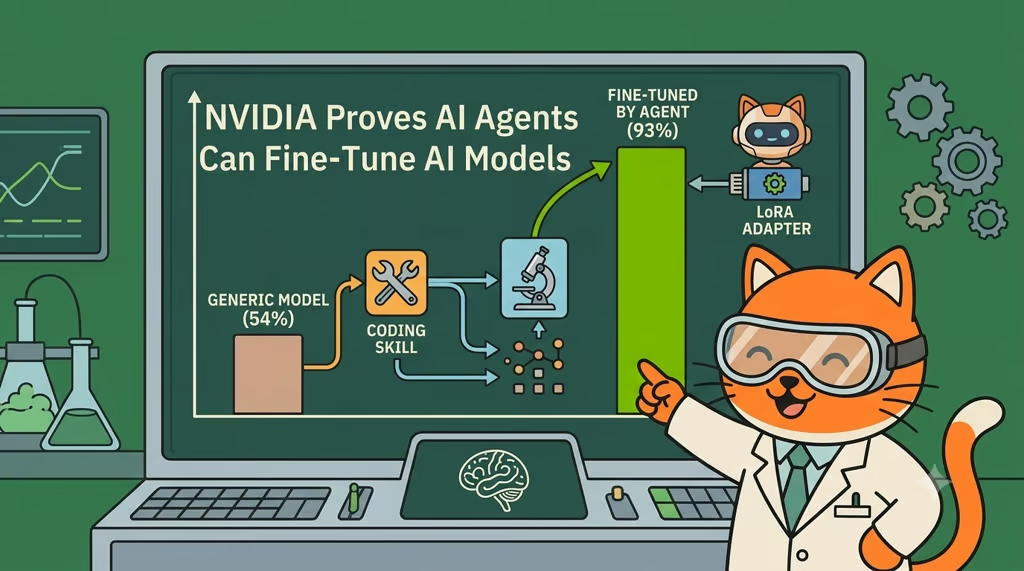
In a new technical walkthrough, NVIDIA showed how it used a coding agent, its Cosmos 3 Nano vision-language model, TAO agent skills, LoRA fine-tuning, and AutoML to adapt a model for traffic-safety video questions. NVIDIA says the process pushed accuracy from 54.41% zero-shot to 87.14% after one LoRA training run, then to 93.35% after automated hyperparameter tuning.
The headline claim is “post-train a model in one day.” The more interesting claim is this: fine-tuning is becoming an agent task.
NVIDIA is packaging the messy parts of model customization
The AI industry loves foundation models because they start competent at a wide variety of tasks. The catch is that “generally competent” is not the same as “reliably understands this factory floor, this warehouse camera, this intersection, or this robotic workcell.”
That last mile has traditionally meant a lot of unglamorous work: cleaning and formatting data, setting up training containers and GPU infrastructure, writing configuration files, running baseline evaluations, debugging failed jobs, and trying different learning rates, batch sizes, LoRA ranks, and other hyperparameters.
NVIDIA’s answer is to turn that procedural knowledge into reusable “agent skills.” In its example, a coding agent queries the TAO skill library, selects the appropriate Cosmos workflow, detects a missing video frame-rate parameter in the dataset, patches the configuration, runs the baseline, launches fine-tuning, evaluates the result, and then kicks off an AutoML sweep.
That is a meaningful change in where the expertise lives. Instead of asking every engineering team to become deeply fluent in a specific training framework, NVIDIA wants teams to state the goal in natural language and let an agent navigate the machinery.
Think of it as moving from “here are the tools, good luck” to “here is the runbook, now let the agent execute it.”
The one-day result has an asterisk the size of eight A100s
NVIDIA’s demo uses the Woven Traffic Safety dataset, a Toyota-backed collection of more than 8,000 video question-answering samples. The base Cosmos 3 Nano model scored 54.41% on the four-choice validation task. After a LoRA run, NVIDIA reports 87.14% accuracy in roughly 30 minutes of training on eight NVIDIA A100 GPUs.
That is an impressive improvement—though it is important to distinguish the first result from the full “one-day” story.
NVIDIA says the AutoML phase used 43 parallel trials and took 19.5 hours across multiple A100 nodes hosted on Oracle Cloud Infrastructure. In other words, this is not “anyone can turn a model into a domain expert from their laptop before lunch.” It is “an organization with serious GPU access can compress a multiday MLOps workflow into a more automated day.”
Still, that distinction does not make the work less consequential. It clarifies where the productivity gain is actually happening.
The breakthrough is not that training stopped needing compute. It is that the human labor around training—setup, troubleshooting, experimentation, and repeatability—is increasingly being handed to agents.
Why LoRA is central to NVIDIA’s pitch
NVIDIA used LoRA, short for Low-Rank Adaptation, rather than full fine-tuning. LoRA keeps the base model weights frozen and adds relatively small trainable adapters. That makes it much cheaper and faster to specialize a model without retraining the whole thing.
NVIDIA estimates that, for Cosmos 3 Nano in this setup, LoRA required about seven times fewer GPU hours than full-parameter supervised fine-tuning.
That matters because the real market for physical AI will not be won by the company with one impossibly capable model. It will be won by whoever makes specialized models practical for thousands of different environments.
A model that understands generic road scenes is useful. A model tuned to a particular city’s camera placement, weather patterns, road markings, and safety edge cases is more useful. The same logic applies to distribution centers, hospitals, manufacturing plants, retail stores, and robots operating in spaces with very little tolerance for confident mistakes.
NVIDIA’s broader physical-AI strategy has always depended on this customization layer. As we wrote in our breakdown of NVIDIA’s GTC 2026 announcements, the company is building for the full pipeline: training, simulation, data generation, edge inference, and deployment. TAO agent skills add a more agentic bridge between the foundation model and the specific job.
This is NVIDIA selling workflow, not just models
Cosmos 3’s architecture is built around multiple kinds of inputs—text, images, video, audio, and action data—with separate reasoning and generation pathways. That makes it a natural candidate for tasks where a model needs to look at the world, not just read about it.
But architecture alone does not make a deployment successful. The software layer does.
NVIDIA has already pushed this same stack logic with hardware, CUDA, NIM microservices, Omniverse, Isaac, NeMo, and its AI Enterprise tooling. TAO agent skills extend the strategy to model customization: if teams use NVIDIA’s tooling to train, optimize, and serve the model, the company becomes harder to displace even when the base model is open.
The deployment piece follows that logic too. NVIDIA says its Cosmos 3 Reasoner NIM can serve the post-trained LoRA adapter as an OpenAI-compatible endpoint, removing more infrastructure work from the customer’s plate.
It is a familiar NVIDIA move: reduce the number of seams customers have to manage, then own more of the stack behind the scenes.
The real signal: agents are becoming the interface to ML operations
There is a tendency to imagine AI agents primarily as knowledge workers with browsers and Slack access. NVIDIA is making the case for another category: agents as operators of technical systems.
The agents in this story do not merely summarize a training run. They choose the appropriate workflow, inspect data, repair a configuration issue, launch containers, run experiments, compare metrics, and select better settings.
That is closer to an entry-level machine-learning engineer with a highly constrained remit than to a chatbot.
The important word is constrained. These agent skills are not simply vague instructions like “make the model better.” They encode the approved paths, framework details, data requirements, and evaluation workflows required to execute a specific job. That structure is likely what makes agentic ML operations more dependable than a free-form prompt-and-pray approach.
It also fits the direction NVIDIA has taken with multimodal AI agents. Its Nemotron 3 Nano Omni model is designed to give agents a sensory layer for video, audio, images, and documents. TAO agent skills are about giving those systems a procedural layer: a way to act on an ML workflow instead of merely observing it.
NVIDIA has not eliminated the need for machine-learning expertise, careful evaluation, or expensive compute. A 93.35% multiple-choice score on one traffic dataset is not proof that a system is ready to make high-stakes driving decisions. But it has made an important bet about the next bottleneck.
As models become more capable, the scarce resource will increasingly be the ability to adapt them safely and quickly to the messy places where they have to work.
NVIDIA wants the agent to handle that part, too.
