


For years, AI developers have had a cheat code: open models, shared datasets, reproducible benchmarks, and libraries that let a smart person with a laptop build something surprisingly powerful.
Robotics has had... a lab.
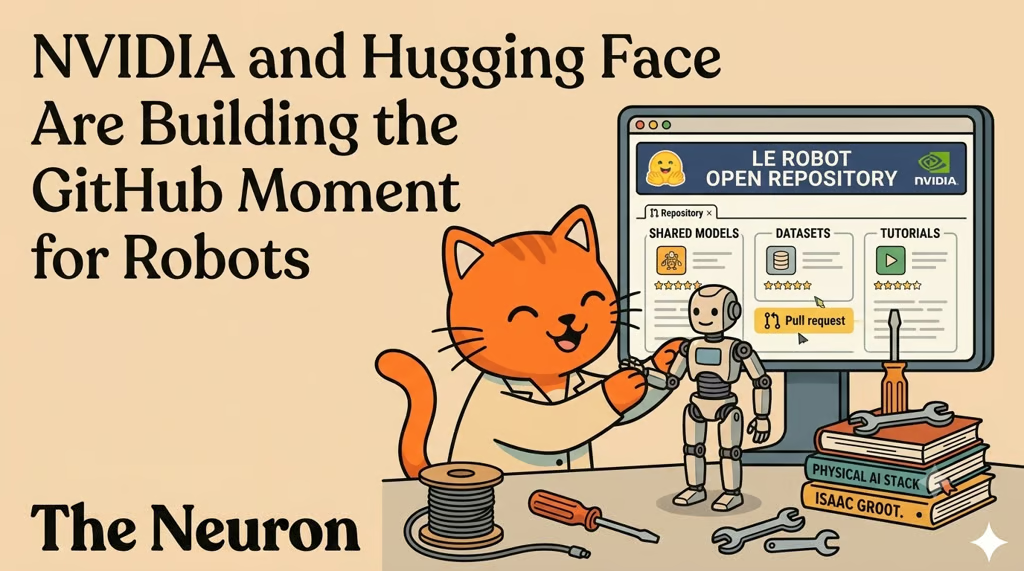
That is the real tension behind NVIDIA and Hugging Face's new collaboration around LeRobot. The two companies are bringing NVIDIA Isaac GR00T 1.7, Isaac Teleop, robotics datasets, and simulation workflows into Hugging Face's open-source robotics library, with NVIDIA Cosmos 3 support planned next.
Robotics is trying to copy the open-source flywheel that made software AI move so fast.
And if it works, the next wave of robot builders may not need to start with a seven-figure lab, a proprietary simulator, and a heroic amount of duct tape.
LeRobot is Hugging Face's open-source library for robot learning. It helps developers train, run, and share robot datasets, models, policies, and workflows. NVIDIA is now plugging more of its physical AI stack into that ecosystem, including Isaac GR00T, a vision-language-action model for humanoid robots. In normal-person terms, that means a model that can look at the world, understand instructions, and turn them into robot actions.
The new integrations include Isaac Teleop, an open-source framework for collecting human demonstrations; Isaac GR00T 1.7, for fine-tuning and deploying robot foundation models; and, soon, Cosmos 3, NVIDIA's world model for physical AI. World models help AI systems simulate how the physical world might change, which matters a lot when your AI is not just writing emails but moving metal through someone's kitchen, warehouse, or factory floor.
That matters because robotics has a data problem, a tooling problem, and a reality problem.
The data problem: robots need huge numbers of examples to learn reliable behavior. But real-world robot data is expensive, slow, and annoying to collect. A chatbot can train on the internet. A humanoid robot cannot casually scrape ten trillion examples of "don't knock over the vase while folding laundry."
The tooling problem: robotics workflows are still fragmented. One team collects data in one format, trains in another system, simulates somewhere else, then discovers deployment is its own fresh disaster. LeRobot's pitch is that robot learning should have a more standard, reproducible pipeline.
The reality problem: unlike text or images, robot mistakes happen in physical space. A model hallucinating a fake citation is bad. A robot hallucinating where the staircase ends is an insurance claim with joints.
That is why NVIDIA's stack is so focused on simulation and synthetic data. The company's Cosmos platform is built around the idea that physical AI needs to train digitally first: a digital version of the robot, a digital version of the task, and a model of the world where developers can test failure cases before reality gets a vote.
This is also why Hugging Face is such an important partner. NVIDIA already has the compute, robotics frameworks, and simulation tools. Hugging Face has the community muscle. Its ecosystem turned open AI models into something builders could find, fork, fine-tune, and argue about in public.
Robotics needs that kind of shared surface area.
The announcement also connects NVIDIA's 3 million robotics developers with Hugging Face's 16 million AI builders. That is not just a big-number flex. It points to a shift in who gets to build robots. The field has historically been limited by hardware access, expensive data collection, and closed toolchains. Open workflows do not magically make robotics cheap or easy, but they can make progress more cumulative.
That is the quiet superpower of open source: it turns isolated breakthroughs into ingredients.
For humanoids specifically, the sense. Companies from Tesla to Figure to 1X to Agility are all trying to prove that general-purpose robots can move from demos to useful work. But the industry still needs better shared infrastructure before "generalist robot" becomes more than a conference-stage phrase.
NVIDIA does not need to build the winning humanoid to win here. It can become the picks-and-shovels layer: the models, simulation tools, data pipelines, edge hardware, and developer workflows underneath everyone else's robots.
That is a very NVIDIA strategy. Let the market fight over which robot body wins. Sell the nervous system.
The caveat is that open robotics is still not open-source software with wheels. Physical systems are slower, riskier, and much harder to debug. A model that works in simulation may still fail when lighting changes, a gripper slips, or a human does something inconveniently human.
But this announcement is a meaningful step toward making robotics development feel less like bespoke lab work and more like an ecosystem.
The big question is whether open robot learning can create the same compounding loop that open AI models did: more builders create more datasets, more datasets improve more models, better models attract more builders, and suddenly the field starts moving faster than any single company could manage alone.
That loop has already changed software AI.
Now NVIDIA and Hugging Face are betting it can teach robots to do the same thing, preferably without dropping the dishes.
