



NVIDIA just released Nemotron 3 Nano Omni, and the easiest way to misunderstand it is to treat it like “another multimodal model.”
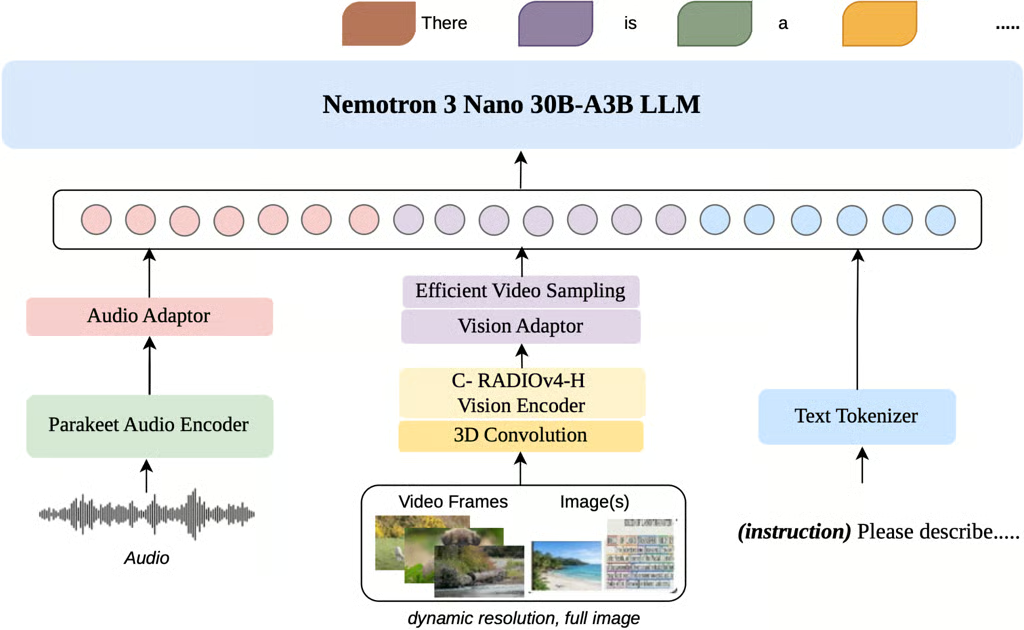
Yes, it can understand text, images, audio, and video. Yes, NVIDIA is pitching it as a 30B-A3B open model built for sub-agent multimodal understanding and reasoning. And yes, the company claims up to 9x higher throughput than other open omni models for similar interactivity.
But the more interesting story is where this thing fits.
Nano Omni is not trying to be the one giant AI brain that does everything. It is much more interesting as a fast sensory layer inside agent systems: the model you hand messy real-world inputs to before another model plans, decides, writes, routes, or acts.
In other words, this is less “chatbot that can see” and more “sub-agent that can inspect the world.”
That distinction matters because a lot of today’s “multimodal agents” are still weirdly text-first under the hood. A video gets summarized into text. A meeting gets transcribed into text. A screenshot gets OCR’d into text. Then a language model reasons over the flattened version, like someone trying to understand a movie by reading the closed captions and glancing at three still frames.
Nano Omni points toward a different setup: specialized agents that can work closer to the original input. One agent watches the screen recording. Another listens to the customer call. Another reads the PDF. Another checks the dashboard. A planner agent coordinates the work. A final agent turns it into something useful.
That is the real unlock. AI agents do not just need bigger brains. They need better eyes and ears.
The “Nano” part is the point
NVIDIA’s broader Nemotron 3 family has been built around a fairly clear thesis: agentic AI will not run on one model. It will run on systems of models, routed by task, cost, latency, context, and risk. NVIDIA’s public Nemotron 3 materials describe Nano as a 30B-ish model with only about 3B active parameters per token, designed for efficient targeted work, while Super and Ultra handle heavier reasoning workloads.
That sizing matters because agents multiply model calls.
A normal chatbot might answer once. A serious agent workflow may call five, ten, or twenty workers: a planner, a retriever, a browser, a critic, a summarizer, a compliance checker, a UI inspector, a code reviewer, and so on. If every one of those workers requires a frontier-scale model call, the bill starts looking like a small nation’s infrastructure plan.
Nano Omni’s role is more practical: give those worker agents multimodal understanding without making every step expensive or slow.
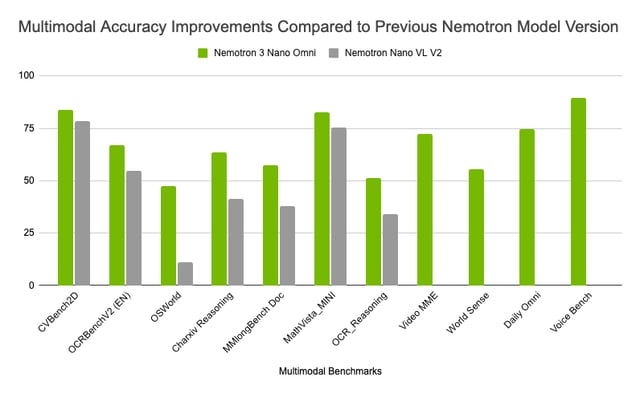
NVIDIA’s earlier Nemotron 3 materials emphasized 1-million-token context, higher throughput, and reasoning budget control for long, multi-step agentic systems. The new Nano Omni briefing adds the multimodal layer: top OCR and ASR, converged video and audio context, GUI understanding, and one model for video, audio, image, and text.
That means this is a bet on where enterprise AI is going: from “ask a model a question” to “assemble a team of models that can perceive, reason, and act.”

.png?w=1024)


We had early access. The speed is the first thing you notice.
We have had early access to Nano Omni for a couple of weeks, and the first impression is simple: it is blisteringly fast.
The reasoning speed feels closer to the experience of a diffusion-style LLM than the slower, heavier “thinking” models many people have gotten used to. That does not mean it is a frontier reasoning model. It means it feels unusually well-suited to the jobs you actually want sub-agents to do: inspect, classify, summarize, caption, extract, verify, and hand off.
That speed changes how you think about use cases.
Take image understanding. In testing, turning “thinking” on generally produced more pointed answers. They were sometimes shorter, but more accurate. Turning it off produced longer answers with a smidge less precision, but still surprisingly strong. Both modes recognized Salesforce Tower and surrounding landmarks from an image, which is the kind of task that sounds simple until you remember how many enterprise workflows depend on models correctly understanding messy visual context.
For business workflows where accuracy is paramount, thinking mode is the safer default. For more casual or high-throughput applications where latency and compute cost matter more, turning it off still felt useful.
That flexibility is important. Agents do not need to “think hard” about every subtask. Sometimes they just need to look, listen, and return a clean structured output.
The most boring use case may be the most useful one
The flashiest demos for omni models usually involve video understanding, voice assistants, or robots. Fine. Cool. Very sci-fi.
But one of the most immediately useful applications may be far more mundane: cleaning up messy digital assets.
For example, our parent company, TechnologyAdvice, manages roughly 100 websites across a portfolio of built and acquired properties. Those sites were built by different teams, under different standards, with different levels of website hygiene. Some have images with missing alt text. Some have legacy media libraries. Some have content that was clearly optimized by someone whose filing system was “final_final_v7_REALFINAL.png.”
Nano Omni’s ability to handle image inputs in practical workflows, including base64-style handoffs, makes it feel like a strong first step toward generating useful alt text, captions, descriptions, and metadata at scale. The model can inspect the asset, reason about what matters, generate the description, and pass that output directly into a CMS or QA workflow.
That is not glamorous. It is also exactly the kind of thing AI is supposed to make less painful.
And this is where Nano Omni’s sub-agent framing becomes useful. You would not necessarily ask it to run your entire editorial operation. You would ask it to be the visual hygiene worker: inspect every unlabeled image, generate candidate alt text, flag low-confidence cases, and route edge cases to a human.
That is what specialized agents should do. Not “replace the team.” Take the work nobody wants to do and make it reviewable.
Audio is where it gets more interesting
The audio side may be even more compelling.
The obvious use case is transcription, but that undersells it. In testing, Nano Omni did not just transcribe audio. It described what it heard: speaker characteristics, faint electrical hiss, context, setting, and the shape of the conversation.
That difference matters.
A transcript tells you what words were said. An audio-aware model can help you understand the meeting, call, or interview as an event. Was there background noise? Did the speaker sound uncertain? Was the recording quality bad? Did the conversation shift topics? Did an answer sound like a confident explanation or a hesitant dodge?
For podcasters, researchers, sales teams, recruiters, customer support teams, and anyone sitting on hundreds of hours of conversations, that unlocks a better kind of archive.
As a podcaster, an easy way to semantically search a database of conversations, topics, guests, clips, claims, and moments has been a long-running goal. The ability to drop in an audio or video file and get a clean, contextual walkthrough in seconds points toward something more useful than transcription: a searchable memory of conversations.
Not “find the episode where someone said the word agent.” More like: “find the conversation where a guest explained why orchestration matters more than model choice.”
That is a very different product.
Why sub-agents are the right lens
NVIDIA’s March messaging around Nemotron 3 already positioned omni-understanding models as a way for agents to combine language, vision, voice, and safety. It described Nemotron 3 Omni as integrating audio, vision, and language so agents can extract insights from videos and documents.
Nano Omni makes that idea smaller, faster, and more deployable.
The most likely architecture is not “Nano Omni replaces every model.” It is “Nano Omni becomes the perception worker inside a larger stack.”
That stack might look like this:
A customer support agent watches a screen recording, reads the customer’s screenshot, listens to the call, checks the CRM record, and writes a support summary.
A software QA agent watches a bug reproduction video, reads console logs, inspects the UI, and files a ticket with steps to reproduce.
A financial analyst agent reads charts, scanned PDFs, earnings call audio, and filings before handing structured findings to a reasoning model.
A content compliance agent checks narration, visuals, text overlays, and generated copy before publication.
NVIDIA’s briefing materials explicitly frame customer service, financial analyst, and computer-use agents as near-term developer use cases for Nano Omni, combining screen recordings, screenshots, speech, audio, documents, charts, dashboards, forms, and policy text.
That is where the model makes the most sense: not as the final answer machine, but as the agent that can perceive enough of the real world to make the rest of the system smarter.
This is also a NeMo story
The model is only part of the story. NVIDIA is also trying to own more of the agent-building stack around it.
NVIDIA describes NeMo as a toolkit for managing the AI agent lifecycle, including data curation, post-training, evaluation, guardrails, observability, reinforcement learning, speech, and safety. That matters because production agents are not just models with prompts. They are systems with permissions, tools, memory, logs, routing, monitoring, and failure modes.
That is the same broader shift we wrote about after NVIDIA’s GTC open model panel: the center of gravity is moving from “which model is best?” to “who builds the best system around many models?”
Nano Omni fits neatly into that shift. It is not the whole system. It is a useful component in the harness.
And because it is part of NVIDIA’s open model push, the enterprise pitch is not just performance. It is control. Developers can run, tune, route, inspect, and govern these systems more directly than they can with a closed API-only setup. NVIDIA has emphasized open weights, datasets, recipes, and tooling across the Nemotron 3 family where redistribution rights allow.
For companies dealing with customer calls, internal docs, meeting recordings, dashboards, screenshots, support videos, and regulated data, that is not a minor detail. That is often the difference between “cool demo” and “legal might let us try this.”
The bigger signal
Nano Omni is not going to end the model race. It is not going to make frontier models irrelevant. And it probably will not be the model you ask to solve your hardest strategic problem from scratch.
But it may be the kind of model that makes agent systems more practical.
That is a quieter but more important category. Fast multimodal sub-agents can turn messy inputs into structured context. They can inspect the world before a planner acts. They can reduce the need to pipe everything through a bloated chain of separate OCR, ASR, captioning, summarization, and reasoning tools. They can help enterprises build AI systems that are less like chatbots and more like teams of specialized workers.
The funny thing about “omni” models is that they sound broad. Nano Omni’s best use may be narrow.
Give it a job. Let it watch the video. Let it listen to the call. Let it read the chart. Let it inspect the interface. Let another model decide what to do next.
That is the shape of where AI is heading: not one all-knowing assistant, but a stack of smaller, faster, more specialized agents with the right senses for the job.
And for once, the boring enterprise use cases may be the best proof that the model matters.
You can get started with the model on Hugging Face (BF16, FP8, NVFP4). You can also check out NVIDIA's tech report and tech blog for more details.
