



AI used to be a model race. Then it became a chip race. Now it is turning into something bigger and much more expensive: a national infrastructure race.
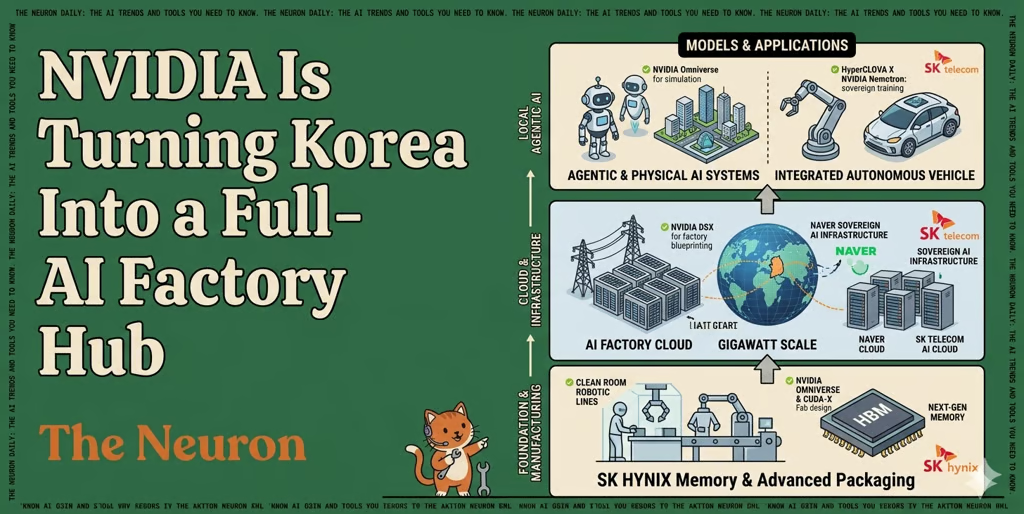
During Jensen Huang’s visit to Korea, NVIDIA announced a trio of partnerships with SK hynix, SK Telecom, and NAVER that point in the same direction. Korea is not just trying to use AI. It is trying to build the whole stack: memory, data centers, sovereign models, telecom infrastructure, digital twins, robotics, and the industrial systems needed to make AI useful outside the demo room.
That is the real story here. NVIDIA is not simply selling more GPUs into Korea. It is helping knit together a country-scale AI supply chain.
The biggest immediate shift is infrastructure. NAVER will expand its AI factories with NVIDIA, starting with 55 megawatts of sovereign AI infrastructure and plans to scale toward gigawatt capacity using NVIDIA’s DSX platform. In parallel, SK Telecom plans to build a gigawatt-scale AI Cloud, with its first AI factory expected to come online in 2027.
That matters because the AI bottleneck is no longer just “who has the best model?” It is “who can actually run the thing at scale?” As The Neuron has covered in the broader AI capex crunch, demand for compute is outrunning supply. NVIDIA’s Korea announcements show how that pressure is now reshaping national strategy.
NAVER's Infrastructure Push
NAVER’s angle is sovereign AI. The company is building infrastructure meant to serve enterprises, industries, and government customers in Korea, while also supporting demand in Europe and the Middle East. It is also advancing HyperCLOVA X by fine-tuning NVIDIA’s Nemotron 3 Ultra open model with NAVER’s own data and training expertise. Translation: Korea wants models that understand Korean users, Korean culture, Korean regulations, and Korean industries without depending entirely on foreign cloud stacks.
SK Telecom’s role is different but just as important. Telecom networks already connect people, devices, machines, and businesses. NVIDIA and SKT are betting those networks can become the backbone for AI clouds that serve agentic AI, physical AI, robotics, and industrial workloads. SKT also plans to become an NVIDIA Cloud Partner, putting it inside NVIDIA’s global ecosystem for AI cloud services.
SK Hynix to Develop the Memory
Then comes the supply chain layer: memory.
NVIDIA and SK hynix announced a multiyear technology partnership to co-develop next-generation memory aligned with NVIDIA’s AI infrastructure roadmap. That includes memory for Vera Rubin AI supercomputers, Vera CPUs, RTX Spark-powered PCs, and Jetson Thor robotic computing platforms.
This is arguably the least flashy announcement and maybe the most structurally important. AI factories do not run on GPUs alone. They need high-bandwidth memory, advanced packaging, power, networking, and software that can squeeze more tokens out of every megawatt. If compute is the new industrial base, memory is one of its load-bearing walls.
The partnership also goes beyond supply. SK hynix plans to use NVIDIA CUDA-X, PhysicsNeMo, and Omniverse to speed up semiconductor design, simulation, and manufacturing. That means AI is not just the product. It is becoming part of the factory process that produces the product.
This is where the Korea story gets especially interesting. SK Telecom has already been applying NVIDIA Omniverse digital twin technology to SK hynix fabs. SK hynix is also developing fab digital twins for more autonomous manufacturing. NAVER is working on a Seoul World Model using urban street-view data and NVIDIA Cosmos. Across the announcements, the same pattern keeps showing up: AI infrastructure is being tied directly to physical-world systems.
That is the next phase NVIDIA has been teeing up all year. At GTC 2026, NVIDIA framed its roadmap around agentic AI, physical AI, and the infrastructure needed to power them. These Korea deals make that strategy feel less abstract. The company is not just pitching “AI everywhere.” It is creating regional clusters where clouds, models, memory suppliers, telecom operators, and manufacturers all pull in the same direction.
Big Upside for Both NVIDIA and Korea
For Korea, the upside is obvious. The country already has global strength in semiconductors, telecom, consumer electronics, robotics, and advanced manufacturing. Those are exactly the industries where AI is moving from chat interfaces into production systems. If Korea can combine local infrastructure with local models and local industrial data, it gets more than cheaper inference. It gets strategic leverage.
For NVIDIA, the upside is even more obvious. DSX becomes the blueprint for building AI factories. Nemotron becomes a foundation for sovereign model development. Omniverse becomes the simulation layer for factories and cities. CUDA-X and PhysicsNeMo become part of chip design and fab operations. And NVIDIA’s future hardware roadmap gets deeper co-development with one of the world’s most important memory suppliers.
The catch, of course, is that these are massive buildouts with long timelines. Gigawatt-scale AI clouds do not appear because a press release says “sovereign AI” three times and sprinkles in some trademark symbols. They require land, energy, cooling, capital, supply coordination, government alignment, and customers willing to pay for production AI at scale.
But that is exactly why these announcements are worth watching. They show where the market is headed when the experimentation phase ends. The winners will not only have clever models. They will have power contracts, memory partners, data centers, model pipelines, cloud distribution, and industrial customers.
Korea is positioning itself as one of the first countries to build that full-stack AI economy. NVIDIA, naturally, would like to be the operating system for it.
