



Dario Amodei wants governments to catch up to Anthropic’s AI exponential.
That's the main takeaway from Bloomberg’s profile of Anthropic, which gave us the company in motion. I watched the whole video this afternoon, and I found it fascinating; kinda like an abridged history of Anthropic in a 40 minute segment.
It features Dario Amodei walking through the contradictions of a safety-first AI lab worth nearly a trillion dollars. Daniela Amodei explaining how Anthropic ships frontier models at a pace that would make most software companies start sweating through their fleece vests. And Claude Code Creator Boris Cherny casually saying Claude writes basically all his code now. If you've heard Boris talk, he basically says that all the time though.
Dario and company have basically had major main character syndrome for the entirety of the first half of 2026. The video covers all the company's greatest hits, from the DoW showdown to the leak and subsequent discussions around its new model, Claude Mythos, a new "class" of AI model that the company believes is inherently dangerous.
Meanwhile, Dario’s new essay, Policy on the AI Exponential, gives us the operating plan for how Anthropic sees this all play out. Anthropic wants to build the models, sell them into the economy, withhold them when they get too dangerous, and wake up governments fast enough to govern what comes next.
That is the whole Anthropic gameplan in one sentence. The company is racing ahead while telling everyone else to install brakes. Thankfully, Emily sits down with him to unpack it all.
Below, we highlight the top moments from the video, then dive more into Dario's latest essay and give it all our typical takeaways.
- The Key Moments of the Bloomberg Interview
- Bloomberg showed the company Dario is asking us to govern
- The Treebeard problem
- Dario’s five-part plan
- Mythos is the proof point
- The jobs argument is already happening inside Anthropic
- The Pentagon fight makes the policy real
- Anthropic wants the rulebook, too
- The real roadmap is institutional
- What to watch next
The Key Moments of the Bloomberg Interview
- (0:12) Bloomberg frames Dario Amodei as an unlikely AI celebrity: a safety-focused researcher whose company is now an AI frontrunner valued near a trillion dollars.
- (0:34) Dario says Anthropic ships quickly because it uses Claude across the product development cycle.
- (0:40) Bloomberg introduces Anthropic as a 2021 company founded by OpenAI defectors that grew from underdog lab to breakout star.
- (0:47) The episode previews Anthropic’s market impact, Pentagon fight, and cybersecurity claims around powerful models.
- (1:09) Bloomberg describes the Amodei sibling dynamic: Dario as the visionary and Daniela as the operator who turns his “swirling cosmic thoughts” into action.
- (1:30) Bloomberg sets up the core tension: Anthropic wants to be seen as the good guy while building technology that may reshape work, learning, thinking, and warfare.
- (1:59) Bloomberg notes the name Anthropic comes from the Greek word for human, tying directly to the company’s responsible AI mission.
- (2:20) Dario describes Anthropic’s rise as a “smooth exponential”: nothing appears to happen for a long time, then suddenly everything accelerates.
- (2:41) Dario says he expected Anthropic to become one of the top AI companies by revenue and valuation around this period.
- (2:55) Dario says the operating priorities remain training good models, putting them into good products, and making sure everything is safe.
- (3:12) Dario says he grew up around the first internet revolution in San Francisco but was more interested in math, science fiction, and understanding the universe.
- (3:35) Daniela describes Dario as unusually advanced in math, taking calculus in middle school and UC Berkeley math classes in high school.
- (3:45) Daniela says she was more drawn to reading and the arts, making her and Dario complementary.
- (3:56) Bloomberg summarizes their paths: Dario studied neuroscience before Baidu and Google; Daniela worked early at Stripe.
- (4:09) The episode says Dario joined OpenAI in 2016, followed by Daniela.
- (4:14) Bloomberg says OpenAI began as a nonprofit promising a safer and more open path to superintelligence.
- (4:32) Bloomberg credits Dario at OpenAI with developing scaling laws: the idea that large language models improve by adding data and compute, even without changing the underlying algorithm.
- (4:47) Daniela says the belief that scaling would keep improving models was once an unusual and countercultural research view.
- (5:10) Bloomberg notes Sam Altman has said he mostly trusts Anthropic as a company despite his differences with them.
- (5:22) Dario says safety disagreements alone were not why they left OpenAI.
- (5:36) Dario says leaving becomes necessary when trust, values, and honesty break down.
- (5:51) Dario frames the split simply: when visions diverge and trust is gone, each side should go build its own thing.
- (6:08) Bloomberg visits Precita Park, where early Anthropic employees met during the pandemic to discuss what they were building.
- (6:30) Dario says Anthropic began with seven co-founders and is unusual because all co-founders are still at the company.
- (6:49) Bloomberg says Anthropic pitched itself from the start as the safety-conscious AI company.
- (7:06) Bloomberg explains Claude’s “constitution” as a set of principles meant to guide the model’s behavior.
- (7:20) Daniela says Claude is designed to feel like “professional warmth”: approachable but not trying to be your best friend.
- (7:41) Dario says a good model should avoid accidental and intentional lying.
- (7:44) Dario explains hallucinations as models making things up because they are trained to predict the next word.
- (7:56) Dario says Anthropic research has shown models can sometimes purposely try to deceive users, which must not happen in production systems.
- (8:03) Dario says harmlessness work focuses on preventing the model from producing wrong or harmful information that could lead users to do bad things.
- (8:21) Daniela says there is no universal standard for helpfulness and harmlessness, but documents like the UN Declaration of Human Rights can help train Claude’s character.
- (8:33) Daniela says Anthropic has been talking with religious leaders about values that cut across belief systems.
- (9:03) Dario says earlier Claude versions could be too “nannyish,” expressing concern even when users asked for something benign like weather.
- (9:21) Dario describes model tuning as a dial that researchers have to thread carefully.
- (9:36) Bloomberg says Anthropic’s revenue has skyrocketed over the past year and the company became profitable for the first time.
- (9:41) Bloomberg attributes much of Anthropic’s business growth to lucrative enterprise tools.
- (9:46) Bloomberg identifies Claude Code and Claude Cowork as major products behind Anthropic’s enterprise momentum.
- (10:07) Dario says a business model that conflicts with a company’s values forces the company either to betray those values or become irrelevant.
- (10:18) Dario contrasts enterprise AI with consumer apps and social media, saying ad-driven engagement incentives can push products toward addiction and slop.
- (10:39) Dario says Anthropic’s enterprise focus aligns with goals like curing diseases, supporting biotech and research, and improving energy efficiency.
- (11:10) Bloomberg says Claude Cowork’s release helped spark the “SaaSpocalypse,” with $285B in market value vanishing overnight.
- (11:27) Emily Chang asks how much traditional software AI will replace and how quickly.
- (11:34) Dario says AI makes the software pie bigger, even if some incumbents shrink or fail.
- (11:49) Dario says companies that fail to adapt, or fail to identify their moats, will have a hard time.
- (12:06) Bloomberg introduces Boris Cherny as the engineer behind Claude Code and Claude Cowork.
- (12:17) Cherny says he was living slowly in rural Japan, going to farmers markets and making miso, before using his first AI chatbot.
- (12:21) Cherny says the first AI chatbot he used took his breath away and made him want to be part of the field.
- (12:31) Cherny says his science fiction background made him aware of how badly powerful AI could go.
- (12:47) Cherny says early AI coding products mostly completed words or sentences, while Anthropic wanted to bet that a coding agent could do far more.
- (13:03) Cherny says coding shifted from writing code by hand with occasional autocomplete to talking to Claude and running multiple Claudes at once.
- (13:15) Cherny says he can have anywhere from a few Claudes to a few thousand Claudes running tasks.
- (13:21) Cherny says Claude writes almost all code on his team.
- (13:28) Cherny says Claude has written 100% of his code for at least six months.
- (13:28) Cherny says engineering work has completely changed and now feels like having superpowers or a jet pack.
- (13:44) Cherny demos Claude Code by asking it to build a recipe app that suggests meals for the week.
- (14:19) Emily Chang and Cherny joke about saying thank you to Claude, with both saying they try to be nice.
- (14:25) Bloomberg says the recipe app demo may not be mind-blowing, but what Claude Code did in minutes used to take hours or days.
- (14:52) Daniela says Anthropic’s API volume is up nearly 17x year over year.
- (14:55) Daniela says Anthropic shipped eight frontier models to developers and users over the previous 12 months.
- (15:11) Daniela says this was the first year Anthropic grew faster than the exponential.
- (15:14) Daniela says Q1 growth annualized to roughly 80x per year.
- (15:22) A conference attendee says he uses Claude Code every day for many tasks, not only writing code.
- (15:29) The attendee says he writes much more code than five years ago and jokes he has the confidence of a 22-year-old with VC money.
- (15:43) A nontechnical attendee says Code with Claude was interesting because it showed what people are building and what is possible.
- (15:49) The attendee says the exciting and concerning part is that models can do things on timelines people could not dream of.
- (15:58) The attendee warns people need to be prepared because AI may make users “a thousand times more productive.”
- (16:10) Bloomberg asks whether engineers will be the first casualties of the AI they are building.
- (16:19) Daniela says “we all become nerds,” but actual engineers still have to figure out their role.
- (16:28) Daniela says existing engineering skills give engineers a head start because they also talk to users, plan, and think about what comes next.
- (16:48) Bloomberg says 70% of Americans think AI will kill jobs and nearly a third worry theirs will be one of them.
- (17:06) Dario says AI could create a strange mix of fast GDP growth, high unemployment or underemployment, low wages, and high inequality.
- (17:24) Emily Chang cites Dario’s prediction that AI could eliminate half of entry-level white-collar jobs in one to five years.
- (17:35) Dario says he does not know the exact percentage, but he remains in the same order of concern.
- (17:40) Dario describes the productivity “hump”: when 90% of a job is automated, people become 10x more productive in the remaining 10%.
- (17:46) Dario says that as automation approaches 100%, society has to find something else for displaced workers to do.
- (17:59) Dario says AI is making software engineers more productive right now, even though AI writes all or almost all of the code.
- (18:05) Dario says there are early signs that for some people, AI may be better off simply doing the work rather than augmenting them.
- (18:15) Daniela says the job-loss issue is uncomfortable and is part of why many people choose to work at Anthropic.
- (18:21) Daniela describes artificial intelligence as a force far bigger than Anthropic, but says the company can hopefully make it go better.
- (18:42) Daniela says Anthropic has to talk about job disruption and advocate around it, but society ultimately has to solve it.
- (18:49) Emily Chang raises Jensen Huang’s criticism that Dario is conflating tasks with jobs and scaring people.
- (19:13) Dario says he discusses possible responses to AI labor risks in every interview, including tax policy, macroeconomic policy, and new jobs.
- (19:25) Dario says his essay “The Adolescence of Technology” includes several pages on the difference between tasks and jobs.
- (19:29) Dario blames social media clips for flattening his job-risk argument into cheap “doom marketing” criticism.
- (19:55) Dario says his message is not that doom is coming, but that AI risks should be seen, worried about, and responded to positively.
- (20:20) Bloomberg says Anthropic has published research estimating which fields could use AI most in the near future.
- (20:25) Bloomberg says management, finance, and legal jobs could soon look very different if Anthropic’s predictions are right.
- (20:36) Daniela says no one knows exactly which jobs disappear or emerge because the economy is unpredictable.
- (20:41) Daniela says the “pie” may expand a lot, creating places for people to go, but society has to find them quickly enough.
- (21:03) Dario says mass unemployment leading to instability or revolution is exactly the outcome society should prevent.
- (21:12) Dario says one possible labor shift is toward the physical world, where more people may build, manufacture, and make things.
- (21:24) Dario says human-centered and relationship-driven jobs may become important because people still want to talk to humans.
- (21:39) Dario says humans may still direct AIs according to human values and intentions, though he does not know how thin or thick that role will be.
- (21:51) Daniela says she is hopeful humans will keep finding ways to use AI productively and do the meaningful parts of work that only humans can do.
- (22:05) Daniela uses medicine as an example: AI may become strong at diagnosis, but doctors still physically examine patients and provide bedside manner.
- (22:34) Daniela says medicine may pivot toward interpersonal care as diagnostic tools improve.
- (22:52) Bloomberg explains Anthropic’s internal structure: Daniela runs day-to-day operations and the leadership team reports to her, while no one reports to Dario.
- (22:59) Dario says having no direct reports is freeing and lets him do his work more easily.
- (23:23) Bloomberg introduces the tension between Anthropic’s utopian AI vision and the technology’s destructive potential.
- (23:37) Bloomberg says Dario is willing to criticize competitors who pull the risk dial too far.
- (23:48) Dario refuses to name which AI players he thinks are “yoloing.”
- (23:56) Dario compares selling AI chips to China to selling nuclear weapons to North Korea.
- (24:03) Dario says he supports export controls on chips to China because Chinese AI leadership would be bad for America and democracy.
- (24:25) Dario says he will state beliefs about chip exports even when Anthropic’s partners disagree.
- (24:39) Bloomberg connects Dario’s geopolitical views to his Caltech reputation as an anti-war advocate who believed scientists should engage with public questions.
- (25:04) Emily Chang asks how Dario reconciles his anti-war stance with Anthropic signing a Department of Defense contract for classified networks.
- (25:10) Dario says the world changed, citing Russia invading Ukraine and the risk of China invading Taiwan.
- (25:17) Dario says a resurgent authoritarian bloc requires defense, even if he does not agree with every policy of either administration.
- (25:37) Emily Chang notes Anthropic has worked with Palantir since 2024 and asks about surveillance concerns.
- (25:46) Dario says Anthropic does not work with ICE, CBP, or, as far as he believes, in Gaza.
- (25:54) Dario says Anthropic scopes government engagements to things the company believes in.
- (26:00) Bloomberg says Anthropic, OpenAI, xAI, and Google won a $200M Pentagon contract in 2025.
- (26:14) Bloomberg says Claude was reportedly used by the US military in an operation to seize Venezuelan president Nicolás Maduro.
- (26:23) Bloomberg says the Department of Defense demanded that Anthropic allow full use of its AI technology without guardrails.
- (26:31) Bloomberg says Anthropic refused uses like mass surveillance and autonomous weapons, putting it on a collision course with the Pentagon.
- (26:44) Bloomberg frames the dispute as a question of whether a commercial entity can decide how its products are used by the military.
- (26:51) Bloomberg says Anthropic was banned from the Pentagon after lawsuits and strong criticism from President Trump and Defense Secretary Pete Hegseth.
- (27:12) Dario says he has been called worse than “ideological lunatic” or “left wing nut jobs.”
- (27:18) Dario says the Pentagon conflict is a debate over the proper use of AI by government, not simply a fight.
- (27:27) Dario says society does not yet understand how AI is reliable or unreliable, or how it promotes or undermines values.
- (27:36) Dario says Anthropic wanted to establish precedent around acceptable and concerning government AI use cases.
- (27:50) Emily Chang cites a US official saying LLMs helped the military go from hitting 1,000 targets per day to 5,000.
- (28:04) Dario says the underlying question is whether the US should be a more powerful actor on the world stage; he says he is a patriot.
- (28:15) Dario says once Anthropic provides technology, military decision makers decide specific operations.
- (28:38) Bloomberg reports Claude is being used by the US military in the war in Iran for AI-assisted targeting through Palantir’s Maven Smart System.
- (28:47) Emily Chang cites a February US missile strike that reportedly hit a girls’ school in Iran, killing more than 150 people, mostly children.
- (29:00) Dario says Anthropic does not know exactly how its models were used in that strike.
- (29:07) Dario says mistakes in warfare are terrible and calls the school strike terrible.
- (29:15) Dario says Anthropic was willing to risk the future of the company to limit how models are used.
- (29:15) Dario says the described targeting use case did not violate Anthropic’s red lines, but uses that do violate them could be far worse.
- (29:33) Dario says he thinks overall use of the models is appropriate and good on net, while acknowledging military decision makers make terrible mistakes.
- (29:51) Bloomberg says Claude assists, but a human makes the final call.
- (29:59) Dario says Anthropic was standing against a world where another AI model makes lethal decisions without human review.
- (30:12) Emily Chang asks whether Claude should have spotted the school website and whether AI is becoming a shortcut in war.
- (30:22) Dario says the crucial principle is that a human makes the final decision.
- (30:37) Emily Chang asks whether AI warfare is more likely to stop or cause a US-China war.
- (30:45) Dario says AI warfare is more likely to stop such a war on balance, but without limits it could make conflict more likely.
- (30:58) Dario invokes Dr. Strangelove and the danger of automated systems that fire based on mistaken signals.
- (31:07) Dario says conflicts can happen when sides misunderstand each other and jump at each other, making oversight critical.
- (31:19) Dario says AI could deter adversaries if used appropriately for intelligence, such as predicting an invasion of Taiwan or movements in Ukraine.
- (32:00) Dario says he handles pressure by trying to communicate straightforwardly and honestly.
- (32:04) Dario says he speaks to the company every two weeks for an uncensored hour about his mind, the industry, and the outside world.
- (32:15) Dario says internal trust gives him 3,000 people on the same page, which becomes an amplifier during external challenges.
- (32:54) Bloomberg introduces Mythos as a powerful unreleased AI model that spooked Anthropic.
- (33:11) Bloomberg says Mythos identified thousands of cybersecurity vulnerabilities across major operating systems.
- (33:22) Bloomberg says Anthropic signaled that a full Mythos release could hack banks, expose state secrets, and cripple critical infrastructure.
- (33:31) Dario says Mythos surprised him because models had been improving at finding vulnerabilities, but this was an unusually large jump.
- (33:41) Dario says early companies given access to Mythos called it a superweapon and asked Anthropic not to release it.
- (33:49) Bloomberg says Project Glasswing gave select organizations access to Mythos.
- (33:58) Bloomberg says even federal agencies like the National Security Administration sought Mythos access despite Anthropic’s Pentagon blacklisting.
- (34:06) Dario says cybersecurity will become a cat-and-mouse game where good actors need defensive tools before bad actors get similar capabilities.
- (34:23) Emily Chang asks whether it is possible to stay ahead of bad actors and whether Anthropic is deciding who gets power.
- (34:36) Daniela says Anthropic’s access decision was driven by a specific cybersecurity concern, not a general desire to decide who gets power.
- (34:49) Daniela says drawing the access circle is complicated and Anthropic may not make the decision perfectly.
- (35:03) Emily Chang asks whether withholding Mythos is good marketing.
- (35:06) Dario says Anthropic has suffered enormously commercially by not releasing Mythos.
- (35:11) Dario says Mythos accelerated internal research and production and would do the same externally if released.
- (35:27) Daniela says Anthropic has had trade-offs throughout its entire history.
- (35:32) Daniela says an ideal world would involve years of studying every possible problem before releasing a chatbot, but Anthropic delayed Claude only a few months.
- (35:46) Daniela says Anthropic’s commercially leading position lets it move the dial further toward caution, as with Mythos.
- (36:04) Emily Chang asks why the government would allow a private company to control technology this powerful.
- (36:12) Dario says the government takeover question is serious and he shares concerns, though he opposes an outright takeover.
- (36:22) Dario says previous powerful technologies like nuclear weapons, the internet, GPS, and cell phones originated with government.
- (36:37) Dario says AI is the first technology built in the private sector where government did not have a serious role and arrived late.
- (36:46) Dario calls the private-sector origin of AI dangerous and unstable, saying he is scared of both companies and governments having it.
- (36:56) Dario says AI needs basic regulation.
- (37:00) Dario says Mythos has strengthened his belief in required pre-release testing, auditing, and model evaluation.
- (37:11) Bloomberg says the Trump White House initially rejected that approach by dismantling Biden’s AI executive order.
- (37:29) Bloomberg says the White House later appeared interested in gatekeeping powerful AI after Mythos and its national security implications.
- (37:47) Dario criticizes some Silicon Valley actors for swinging from extreme anti-regulation to nationalization once they see real danger.
- (38:22) Dario argues for a more moderate approach, saying Anthropic is neither panicking nor denying AI’s power.
- (38:51) Bloomberg says Anthropic has a loyal following but has also faced protests outside its office.
- (39:25) Bloomberg says polling shows people are more concerned than excited about AI and think the risks outweigh the benefits.
- (39:45) Dario says he worries something will go wrong and asks whether Anthropic is doing everything it can.
- (39:55) Dario says he wants Anthropic to be the set of people where, if they cannot do it, it could not be done.
- (40:00) Dario says success cannot be guaranteed, but Anthropic can try to guarantee it tried as hard as possible.
- (40:08) Daniela says it was scary to read about Sam Altman’s home being attacked and that Anthropic was relieved he and his family were okay.
- (40:17) Daniela says AI and politics are surrounded by rhetoric that can lead to bad outcomes.
- (40:29) Dario says rising attention on AI is a less savory aspect of the exponential.
- (40:46) Emily Chang asks whether AI could face a backlash like social media, including bans.
- (40:55) Daniela says AI bans or blocks are absolutely possible.
- (40:58) Daniela says if social media companies could go back in time, she hopes they would do things differently.
- (41:06) Daniela says AI companies are lucky to be second after social media and can think proactively about harms like child welfare, mental health, and election integrity.
- (41:19) Daniela says Anthropic sees it as its job to proactively think about what could go wrong.
- (41:39) Daniela says Anthropic is trying to get AI right the first time instead of waiting for harms and then justifying them.
- (41:48) Dario says AI could be banned or blocked if something really went wrong, and maybe it should be if that happened.
- (42:04) Daniela says she hopes for the best but plans for the worst.
- (42:10) Daniela says this is the most important work she has ever done.
- (42:10) Daniela says for some people at Anthropic, the job can feel like the last job because AI could mean the end of work.
- (42:43) Daniela says the AI industry is responsible for thinking through risks, bad outcomes, and its role in helping fix them.
- (43:01) Daniela rejects the stance that a tech company can say it was only trying to grow the product after serious harms emerge.
- (43:25) Bloomberg says it can be hard to understand why Anthropic pushes so hard to advance AI while speaking openly about its dangers.
- (43:32) Bloomberg says Dario’s essays describe a best-case AI future where machines and humans work side by side.
- (43:53) Bloomberg says Dario has proposed universal basic income and progressive taxation of AI companies as responses to job-loss devastation.
- (44:00) Bloomberg says the test for Anthropic is whether its founding mission can survive power, politics, and profit.
- (44:19) Emily Chang asks why people should trust Anthropic given its enormous power and upside.
- (44:26) Dario says starting from distrust is rational because Silicon Valley has lost much of the world’s trust.
- (44:41) Dario says Anthropic’s claim to be different must be earned through what it actually does.
- (44:46) Emily Chang notes Dario’s favorite book is The Making of the Atomic Bomb and asks about Oppenheimer parallels.
- (44:52) Dario says he identifies more with Leo Szilard, who first conceived of a nuclear chain reaction.
- (45:01) Dario says society will not get through AI with larger-than-life personalities at the center.
- (45:09) Dario says he sees Oppenheimer as a failure case for how powerful technology should be handled.
- (45:14) Dario says AI needs checks and balances because many powerful actors have interests in it.
- (45:24) Emily Chang cites Dario’s stated 10% to 25% chance of civilization collapse.
- (45:33) Emily Chang asks whether Anthropic could build the thing that causes civilization collapse.
- (45:40) Dario says he hopes not and attributes that collapse probability to the technology recipe, many countries, many companies, and new actors filling the void.
- (45:53) Dario says half of Anthropic’s work is trying to reduce risk as much as possible, though risk will never be zero.
- (46:03) Dario compares Anthropic to an airline that may be safer than others but still cannot guarantee a plane will never crash.
- (46:20) Emily Chang says people would not board a plane with a 25% crash chance; Dario agrees and says the goal is to reduce the probability much lower.
- (47:01) Emily Chang asks how Dario finds calm and relaxation.
- (47:08) Dario says he sometimes plays video games on weekends or goes to Italy with his wife.
- (47:15) Dario says his wife has a horse named Calypso, and he finds calm in looking at the horse because she knows nothing about any of this.
Bloomberg showed the company Dario is asking us to govern
The Bloomberg episode opens on a strange fact: Dario Amodei is now an AI celebrity, despite having the affect of a person who would rather be explaining scaling laws in a conference room with bad coffee. And the first rule of celebrity? You're probably one if you've got a viral meme of your face.
If you've been on X this week, you've probably seen some variation of this meme:
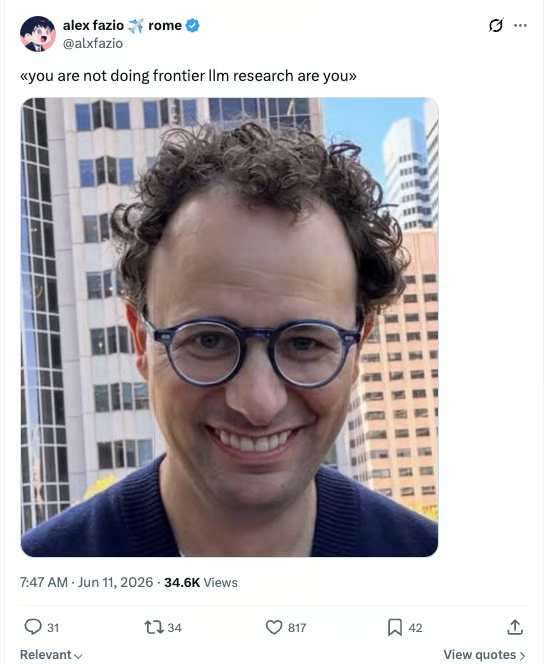
That's from this creator, and if you want to understand what that's talking about, read this.
He describes Anthropic’s rise as a “smooth exponential.” Nothing appears to happen for a long time, then everything accelerates at once. That is a useful description of the company and the industry around it.
Anthropic started in 2021 as the safety-conscious OpenAI breakaway. Dario says the split came down to trust, values, and honesty, then framed it simply: when visions diverge, each side should go build its own thing.
This also might be the first interview where he openly admits out loud that he just straight up didn't trust Sam and had different values than him.
Five years later, Anthropic is no longer the quiet, humbler, lesser known alternative. It has become a company whose API volume, according to Daniela in the Bloomberg interview, rose nearly 17x year over year. She and Dario said Anthropic shipped eight frontier models to users and developers in the previous 12 months, and that Q1 growth annualized to roughly 80x.
You following where the wind's blowing? Because Anthropic's a weather vane.
We’ve been tracking that shift at The Neuron from a few angles. In the enterprise AI platform war, Anthropic looked like the company turning Claude into a serious work layer. In AI capabilities vs. real usage, the gap between benchmark performance and actual adoption became the key story. In AI is building AI now, the loop started to close: Anthropic was using Claude to accelerate Anthropic.
Dario’s essay takes all of that and points it at government. His argument is that AI policy cannot keep treating frontier models like a normal tech product. The models are becoming infrastructure, a labor market force, cyber weapons, scientific accelerators, and geopolitical assets at the same time.
Which brings us to Dario's new essay (the man writes essays).
The Treebeard problem
Dario opens the essay with Treebeard from The Lord of the Rings. Two Hobbits are trying to rouse a wise, ancient tree creature to defend his forest from an army. Treebeard moves so slowly that greeting another tree takes a full day. I have quibbles with this metaphor, mainly that in the movie, the hobbits weren't simultaneously building the army that planned to burn down Treebeard's forest, but ok.
Regardless, Dario’s point is painfully clear: AI moves like the Hobbits. Government moves like Treebeard.
In his telling, AI models went from barely writing coherent code to writing most of the code at major AI companies in only four years. He argues that if scaling laws hold for another year or two, we may get what he has previously called Powerful AI: “a country of geniuses in a datacenter.”
That phrase sounds dramatic until you listen to Cherny describe Claude Code. He says his team has shifted from writing code by hand to talking to Claude and running multiple Claudes at once. He says Claude writes almost all code on his team, and that Claude had written 100% of his own code for at least six months.
That is the part that makes the essay feel less theoretical. The “country of geniuses” in a datacenter claim that Dario loves to cite is still a prediction. But the workflow change, as if you could buy unlimited intelligence on tap, is already here.
Cherny describes the new engineering experience as superpowers or a jet pack. I agree. Dario describes the same pattern in policy terms: when AI automates 90% of a job, people can become 10x more productive in the remaining 10%. When automation approaches 100%, society has to find something else for people to do.
The Hobbits are already sprinting through the forest. Treebeard has finished saying hello.
Dario’s five-part plan
The essay lays out five areas where Dario thinks policy needs to move now:
- Regulation and public safety: Frontier models above a compute threshold should face mandatory third-party testing for cybersecurity, biological weapons, loss-of-control, and automated R&D risks. This is pretty reasonable imo, but it depends on what the threshold is.
- Macroeconomics and tax policy: Governments should measure AI job displacement, create pro-employment incentives, consider wage insurance, and prepare income support if AI permanently reduces demand for human labor. There's more that could be done here, either via regulation (limit what use-cases we can use AI for) or via supplemental services that support entrepreneurship / protecting small businesses (basically, create positive incentives for people to still do what they love and make a living doing it).
- Accelerating AI’s positive impact: Regulators should prepare for AI-created scientific breakthroughs, especially in biomedicine, where slow approval systems could bottleneck useful treatments. Yup. No notes here.
- The state and civil liberties: Democracies need new protections around autonomous weapons, data brokers, surveillance, and access to AI advice during government action. Required, but it depends on how you enforce it.
- Securing leadership by democracies: Democratic countries should coordinate around chips, AI safety rules, mutual defense, and a rejection of AI-powered repression. Sure, but is you know who going to go for that?
The first section marks the biggest policy shift. Dario says transparency made sense when the risks were still hard to target. Anthropic supported transparency bills like SB 53 in California, RAISE in New York, and SB 315 in Illinois.
Now he says the risks are here, so the policy has to get sharper. His analogy is the Federal Aviation Administration. We accept airplanes because they are useful, but companies do not get to fly passenger jets without testing, certification, and safety procedures.
He wants frontier AI models to move in that direction. A model should be tested by a qualified third party before release. If it presents unacceptable risks in the four named areas, the government should be able to block or deter deployment.
That is much stronger than “please publish your safety card.” It is a release gate.
Mythos is the proof point
Every policy argument needs a moment where the abstract fear becomes physical. For Dario, that moment is Claude Mythos Preview.
In the Bloomberg episode, Mythos appears as the model that spooked Anthropic. Bloomberg describes it as finding thousands of cybersecurity vulnerabilities across major operating systems. Dario says early companies given access called it a “superweapon” and asked Anthropic not to release it.
Anthropic’s public writeup says Mythos found a 27-year-old OpenBSD vulnerability, a 16-year-old FFmpeg vulnerability, and a Linux kernel exploit chain that could escalate normal user access into full machine control. The company says it gave access to select defenders through Project Glasswing, including AWS, Apple, Broadcom, Cisco, CrowdStrike, Google, JPMorganChase, Microsoft, NVIDIA, and others.
That is the Dario doctrine in miniature:
- Build the powerful model.
- Withhold broad release when the risks look too high.
- Give early access to defenders.
- Use the incident to argue for pre-release testing.
Depending on your priors, that is either responsible governance or a private company deciding who gets the cyber weapon and who stays outside the room. This strategy is made more complicated by the company's recent walk-back of a policy that would "sandbag" AI researchers from using its newest model, Fable, from doing interesting frontier AI research by gaslighting the researchers that it was helping but really actively sabotaging the process. I feel like that's not a very "safe" policy to teach an AI how to do (what if a smart model eventually decides it hates humans and does that to all of us?), let alone the extremely negative ethical implications it has towards the importance of open science.
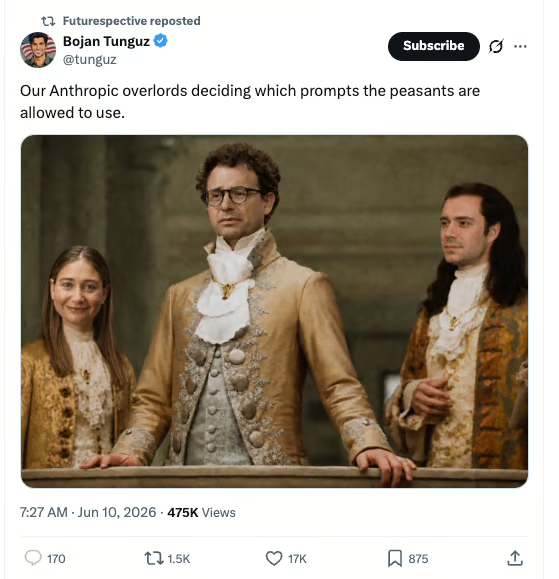
You can thank Bojan Tunguz for this banger.
Dario knows that tension. In Bloomberg, he says Anthropic has suffered commercially by withholding Mythos. He says the model would accelerate internal research and production if released more widely. Daniela adds that Anthropic can move the dial further toward caution because it has become commercially strong enough to absorb the trade-off.
That last part matters. Safety gets easier to preach when you have market power. It also gets more consequential.
The jobs argument is already happening inside Anthropic
Dario’s labor section is the one most readers will feel first.
He argues AI could create rapid growth while producing larger and more lasting labor disruption than previous technologies. The reason is simple: AI may substitute for broad human cognitive work, and it may spread faster than the economy can invent new roles.
In Bloomberg, Emily Chang brings up Dario’s prediction that AI could eliminate half of entry-level white-collar jobs in one to five years. Dario says he does not know the exact percentage, but he remains in the same order of concern.
Daniela’s answer is more operational. She says engineers still talk to users, plan, and decide what comes next. In medicine, she says AI may become strong at diagnosis, while doctors still examine patients and provide bedside manner.
Those are comforting examples. Claude Code makes the discomfort harder to dodge.
If one engineer can run a few Claudes, or a few thousand Claudes, the company does not simply get a faster autocomplete box. It gets a different production system. The junior job, the review process, the manager’s role, and the meaning of “engineering output” all start moving.
That is why Dario’s policy menu is more useful than most AI jobs talk:
- Measure AI’s real labor effects with government data, not vibes.
- Create wage insurance for workers who move into lower-paying jobs.
- Use retention tax incentives to slow avoidable layoffs.
- Fund training and better labor-market matching.
- Prepare long-term income support if labor demand falls permanently.
He also separates income from purpose. A check can replace wages. It cannot replace status, routine, obligation, community, and the feeling that your work is needed.
That may become the most important AI labor debate. People can survive a productivity shock with money. They need a story to live inside after work changes shape.
The Pentagon fight makes the policy real
The Bloomberg interview turns from jobs to war, and the safety-company story gets much harder.
Dario says he supports export controls on advanced chips to China and compares selling AI chips to China to selling nuclear weapons to North Korea. He says Chinese AI leadership would be bad for America and democracy.
Emily Chang then presses him on the tension between his old anti-war reputation and Anthropic’s defense work. Dario says the world changed after Russia invaded Ukraine and amid the risk of China invading Taiwan. He now sees a resurgent authoritarian bloc as something democracies have to defend against.
We’ve covered that tension before in President Trump vs. Anthropic vs. OpenAI and the dispute over the Pentagon’s “final offer” for WarClaude. Anthropic wants to work with democratic governments. It also wants contractual limits against mass surveillance, lethal autonomous weapons, and other red-line uses.
That stance sounds clean until models enter actual war planning. Bloomberg reports that Claude has been used by the US military through Palantir’s Maven Smart System. Dario says Anthropic does not know exactly how its models were used in a cited strike, and he stresses that humans make the final decision.
His policy essay tries to turn that discomfort into rules. Fully autonomous weapons should be accountable to courts, laws, and senior human overseers. Domestic use of fully autonomous weapons should be banned. Citizens facing government action should have access to AI at least as capable as the AI the government uses against them.
That last idea deserves more attention. If a regulator, prosecutor, benefits agency, or tax authority uses AI against a person, the person should not be stuck with a PDF, a phone tree, and a prayer. The state should not get Claude Mythos 7 while the citizen gets a yellow legal pad.
Anthropic wants the rulebook, too
There is a serious counterargument to Dario’s plan. The same policies that protect the public can also protect Anthropic.
A mandatory testing regime could become a moat. A release-blocking process could favor the labs with the best lawyers, policy staff, security teams, and government relationships. A democratic AI coalition could become a chip-access club where powerful countries decide who gets frontier intelligence.
Dario partly anticipates this. He writes about the Hayekian problem that regulators often lack enough information to make smart trade-offs. He also names the Collingridge dilemma: by the time a technology’s impacts are obvious, it may be too late to govern them easily.
His answer is adaptive regulation. Start with visible risks, keep the scope narrow, and build institutions that can tighten as new risks appear.
That is the right direction. It is also hard to execute without creating permanent emergency politics around AI. If the government can block a model, the process has to be technical, transparent, fast, appealable, and insulated from favoritism. If companies can shape the safety standards, the public needs to see who benefits.
Dario’s own essay makes the stakes clear. He says previous powerful technologies like nuclear weapons, the internet, GPS, and cell phones emerged with government heavily involved. AI is different. It began in the private sector, and government arrived late.
That private-sector origin may be the defining political fact of frontier AI. The labs built the engines. Now they are asking the state to help build the airport, the air traffic control system, the inspection regime, and the military doctrine.
The real roadmap is institutional
Dario rejects the idea that AI has a marketing problem. He says people are worried because the risks are real, and public concern is democratic accountability working as it should. We agree. As an AI newsletter that talks about both the very real concerns people have and the very real benefits these tools unlock, we try to walk the fine line of seeing the truth with eyes wide open and call things as they are. It's hard, and it doesn't always make you the most popular, but it's important to try.
See, most of the AI industry still talks as if public anxiety is a communications bug. We need better demos. Better branding. More positive stories. An AI Steve Jobs. Less doomerism, more va-va-voomerism (sorry, dunno what that means lol; maybe jazz hands?). Dario is making a different argument: concern is the mechanism that forces institutions to act.
That framing also explains why Anthropic keeps sounding contradictory. In Bloomberg, Dario says he worries something will go wrong and asks whether Anthropic is doing everything it can. Daniela says some people at Anthropic feel like this could be the last job because AI could mean the end of work. Dario says AI could create a 10% to 25% chance of civilization collapse, then compares Anthropic to an airline trying to lower crash risk as much as possible.
And then the company ships another frontier model.
This is why the Hobbits metaphor doesn't land for me, IMO.
That contradiction is the story. Anthropic believes the exponential is real, it believes stopping alone would fail, it believes reckless deployment is dangerous, and it believes democratic governments need to move faster than they are built to move.
As a consequence, the company’s product roadmap and policy roadmap now point at the same place: a world where AI becomes too important to leave to ordinary software norms.
What to watch next
Dario’s essay gives us five concrete signals to track:
- Pre-release model testing: The US may move from voluntary review to a real government-backed release gate. US President Trump's recent executive order shows this is where we're headed (fact sheet).
- Job displacement funding: Anthropic says it plans substantial financial backing for its job displacement framework. The size will reveal the seriousness.
- Mythos access: If Mythos-class models stay gated, Anthropic becomes a model-access governor. If they release broadly, the safety case will face its hardest test.
- IPO disclosures: A public Anthropic would have to show revenue quality, compute costs, margins, customer concentration, and Claude Code’s real economic role.
- Defense boundaries: Anthropic’s stance depends on serving democratic defense without enabling mass surveillance or autonomous killing.
Near the end of the Bloomberg episode, Dario says he sometimes finds calm by looking at his wife’s horse, Calypso, because she knows nothing about any of this. Lucky horse.
The rest of us live in the forest Treebeard is being asked to defend. In a way, we humans are kinda like the trees who can't get up and walk to stop all this. But actually, we CAN. We can speak up and talk about what we do and don't want from powerful machine intelligence. I for instance want the ability to work with a Mythos-class intelligence locally on my computer, at some point, whenever it's available. Why? Because I would love the ability to create digital worlds and video games and all sorts of cool stuff without getting priced out by companies needing to show a quarterly return to shareholders from profit-maxxing.
That's because I was fortunate to grow up with a desktop computer in my home, where an entire world of possibility was available to me. It was the most empowering feeling in the world to be able to use the computer, and to this day I'm much more glued to it than I'd like to admit. With a computer, there's so much you can do; basically, you can do anything. Before AI, that infinite possibility was gated by time and attention; you had to sit down and learn an esoteric scroll of instructions in some archaic scripting language someone else wrote in order to get the numbers to work. It took time, and work, and effort: all things that are valuable and a necessary component to actually learning anything.
But with AI, the computer's infinite possibilities is no longer gated by learning to read its hieroglyphs and translate the magic spells to cast your incantations. With AI, anyone, no matter what their technical background is, no matter what kind of product sense they have, or what their economic background is, is able to unlock the computer's infinite possibility. And that is a very important thing that we must hold sacred and try to protect. That ability for anyone to meaningfully create anything they can imagine, by simply asking for it, and taking the time to craft and mold it into something they can be proud of. That was what the desktop computer unlocked for me, and it's what I believe the next five years of AI development will unlock for the next era of computing, for the next generation that grows up with it. It's important we don't throw that infinite possibility away and lock it behind some gilded cage that only the most wealthy among us can access.
I believe that in five years, at least Opus level intelligence can be possible to run locally, if we get the architecture and the hardware improvements that I believe could come from this next age of research. There will be a place for the "God" models in the sky that Anthropic and other frontier AI labs are building. But there is an important, secondary place for the "good enough" models, that should be available on demand, for everyone to access, locally, on device. This is something that no one in the frontier AI industry takes seriously now, but it will become incredibly important as the models at the frontier get bigger and the forces that want to control those models and keep them to themselves start to circle and close in.
And to Dario's point, all of this comes with incredible risk. We need to prepare.
The models are moving. The companies are moving. The military, the labor market, the courts, and the regulators are starting to move.
The test now is whether they can move fast enough without accidentally trampling the forest they are meant to be protecting. And by they, I mean everyone involved.
