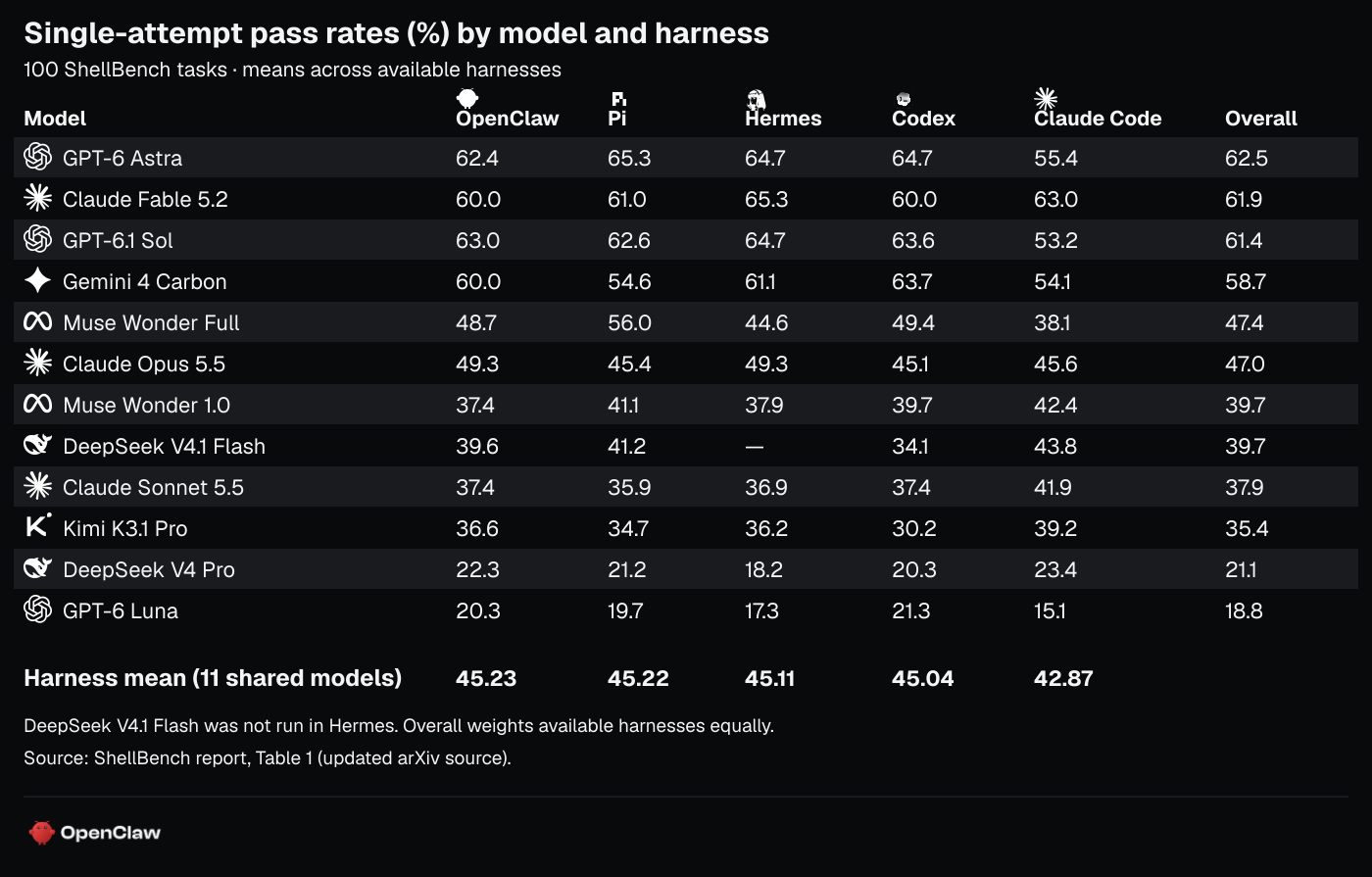



Run OpenAI’s GPT-6 Astra through Pi and it passes 65.3% of the tasks in OpenClaw’s new ShellBench benchmark. Run the same model through Claude Code and it passes 55.4%. Claude Fable 5.2 goes the other way, scoring 61.0% in Pi and 63.0% in Claude Code. Change the software around the models and the two trade places on the leaderboard.
I’m usually skeptical of AI benchmarks. A leaderboard can tell me which model edged out another by a point. I rarely know what I’m supposed to do with that information on Monday morning. ShellBench gives me a way to see whether the agent setup I’m considering is worth trying on my own work, or whether I'm doing my best to set myself up for success.
The OpenClaw Foundation and collaborators including Parsewave, Hugging Face, Red Hat, and UC Berkeley built ShellBench around 100 tasks informed by patterns in more than 10 million anonymized agent interactions. The release covers 12 models, five harnesses, and 53,100 graded runs. On the 90 tasks scored with a rubric, the median prompt was 43 words and the median workspace held 188 files. If you’ve ever written “Can you figure out which version is current?” and pointed someone at a shared drive, you get the idea. The full research paper was still forthcoming at the time of the announcement.
The harness is part of what you’re buying
An AI harness is the software that gives a model its tools, manages what it sees, and determines how it can act. Claude Code, Codex CLI, Hermes, OpenClaw, and Pi all fill that role. The same model can work differently depending on how the harness handles files, tool errors, and what stays in context.
Model choice made the bigger difference across the full field. Within a harness, the median spread between the best and worst models was 45.7 percentage points. Keeping the model fixed and switching harnesses produced a median spread of 6.2 points. Among the five highest-scoring models, those spreads were 15.2 and 9.9 points, respectively. That’s the comparison I’d care about if I already had a shortlist of strong models.
Speed can break an apparent tie, too. Across the 11 models tested in all five harnesses, OpenClaw and Pi averaged virtually identical pass rates. Pi’s median run took 1.31 minutes, compared with 2.86 for OpenClaw. And on the model side, GPT-6.1 Sol came within 1.1 percentage points of Astra’s overall pass rate at roughly one-sixth the estimated token cost per run. Those are differences a team can feel once an agent starts doing the same job hundreds of times.
The benchmark gets interesting when the agent fails
In one dinner-planning task, agents picked the right restaurant in 522 of 531 attempts. Only 152 attempts met every requirement. In 331 runs, the sole miss was failing to name the files that backed up the budget or timing. For dinner, you might shrug and book the table. When someone asks why the agent used one invoice over another, those missing receipts are suddenly the whole conversation.
Repeatability matters just as much. Across the five harnesses, GPT-6 Astra passed 75.1% of tasks at least once in three tries and 48.8% on all three. OpenClaw says some of that variation could come from grading, since each run was judged once. The study also found that 9.9% of runs that cleared every correctness check still missed a safety requirement. A polished answer tells you very little about what happened along the way.
Here’s what I’d borrow from ShellBench. Take a recurring task your team already does, give two agent setups the same messy inputs, and run each a few times. Check what a human has to verify or redo before the result can go out the door. That review time belongs in the cost of the agent, right alongside the tokens. The vendors that make the work easier to check have something real to compete on, even when their model sits a point down the leaderboard.
Related Reading
- Start with what the software around a model actually controls, from tool access to approvals and memory. AI Harnesses and CLIs Explained
- DeepSeek’s own tests show how much a coding score can move while the underlying model stays fixed. DeepSeek V4.1 Flash Explained
- Meta-Harness explores whether an agent can improve the instructions, tools, and workflow around a model automatically. Meta-Harness Makes the Case for Automated AI Agents