



“Okay, I have a lot to say.”
That’s what the first participant in Paradromics’ brain-implant study chose to say when researchers switched on a mode that let her use her own words. She later used the system to talk with her grandchildren on a live phone call, according to Paradromics’ September study update.
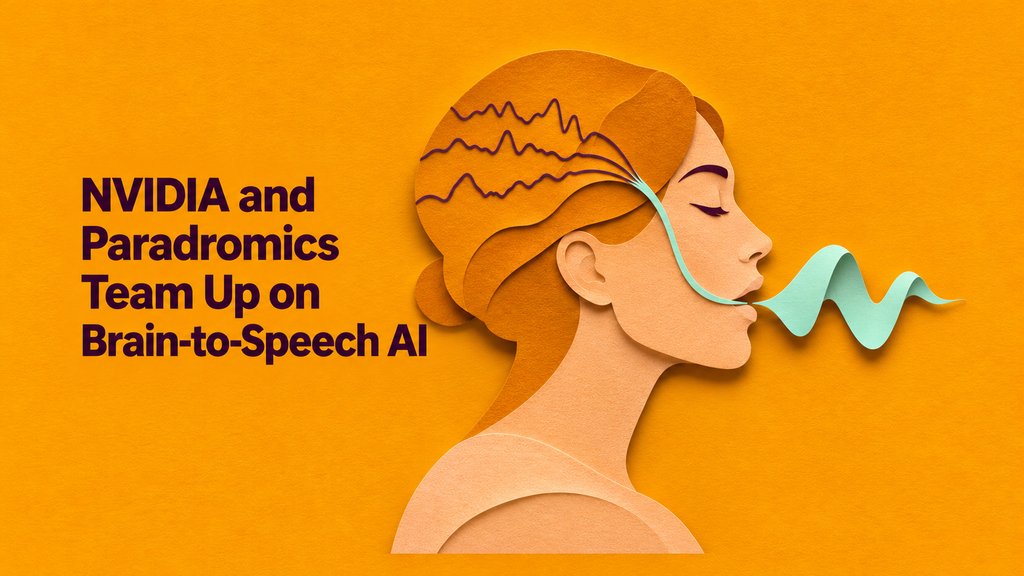
Now Paradromics is teaming up with NVIDIA to tackle what happens between the moment someone tries to speak and the moment everyone else hears them. The collaboration will start with speech restoration, with the goal of making the AI respond faster, adapt as brain signals change, and eventually run on smaller hardware.
That matters because conversation has terrible manners. People jump in, talk over each other, and take a pause as an invitation to change the subject. Getting the words right matters. Getting them out in time to take your turn matters, too.
Two ways to turn brain signals into speech
Paradromics’ investigational Connexus implant records electrical activity from neurons. A decoder learns to map patterns in that activity to signals associated with speech. Paradromics plans to move its speech decoders and voice synthesis software onto NVIDIA’s platform for processing live sensor data, Holoscan. The collaboration will also use NVIDIA’s compact Jetson computing hardware.
The companies are pursuing two approaches. One goes directly from neural activity to synthesized speech. The other decodes the activity into text, uses a language model in that process, and then reads the text aloud. The roadmap sets targets of under 10 milliseconds for computing and moving data in the direct system and under 100 milliseconds for the text-first system. Those are engineering targets. The time someone actually waits to hear intelligible speech is a separate measure.
There’s a reason to explore the direct route beyond speed. In a 2025 UC Davis study, a man with ALS used a separate experimental brain-to-voice system to vary his pitch, emphasize words, and even sing simple melodies. The synthesized speech varied in intelligibility, but he could raise his pitch to make a sentence sound like a question. Plain text leaves much of that up to the voice synthesizer. Read the UC Davis study.
Paradromics also wants its models to recalibrate in the background while someone uses the device. A decoder learns what a person’s neural signals look like when they try to speak. As those patterns change, the model has to keep up. If background adjustment works, users could spend less time retraining the system and more time using it.
NVIDIA is making a play for the computer outside the implant
Paradromics plans to give academic partners in its APEX research program NVIDIA IGX and Holoscan-ready systems. The idea is to let labs test new applications on a common setup without rebuilding the computing infrastructure each time. Speech comes first. The 2027 roadmap adds finer motor control and models that can use visual context to help translate a user’s intent into physical action.
There’s a familiar NVIDIA strategy here. Brain-interface developer Synchron announced plans to use Holoscan in 2025, and NVIDIA has been pushing its edge computing platforms into fields like medical devices and surgical robotics. If more labs build around the same tools, NVIDIA can become a supplier to the field even as researchers take different approaches to designing implants.
For Paradromics, the next steps are to move the speech software over, measure how much power it draws, and get it into researchers’ hands. Connexus remains investigational, and the Connect-One early feasibility study is gathering preliminary safety data. The longer-term goal is a smaller, lighter external computer that can support all-day use. The test that will matter to someone using it is simple to picture. Can they get a word in at dinner, and can they do it again tomorrow without setting everything up from scratch?
Related reading
- The Neuron covered another approach to restoring speech when a Neuralink trial participant trained a brain-to-voice interface.
- Meta is exploring a different route to communication with Brain2Qwerty, a system that decodes brain activity into text without an implant.
