



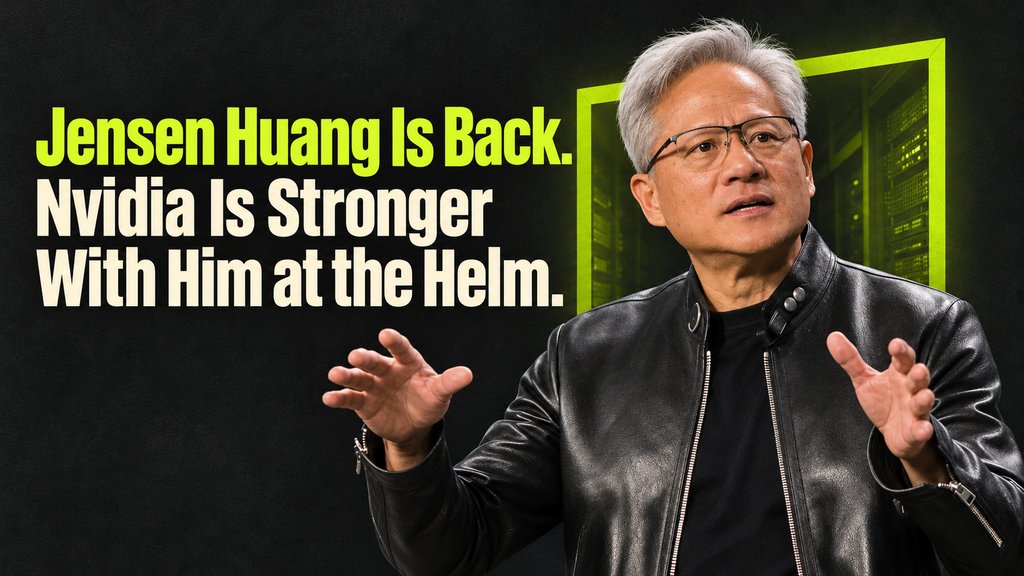
Nvidia’s board spent last Tuesday telling investors it had no intention of bringing Jensen Huang back. On Monday, it voted unanimously to do exactly that. Huang is once again president, CEO, and a board member, effective immediately. Interim CEO Colette Kress will continue as CFO, and Harvey Jones will remain board chair, the Associated Press reported.
I’m bullish on Nvidia with Huang back. When he stepped down, I argued that Nvidia would probably be fine without him. The company had the team and technology to keep executing. Its next challenge is deciding where to push that advantage as customers get more selective about what they spend on AI. I’d rather have Huang making those calls.
The comeback follows Nvidia’s worst week since 2008
Nvidia announced Huang’s resignation on Nov. 12. He had acknowledged an affair, and the board had opened an independent investigation after reports that he may have been targeted by a foreign intelligence operation. Jones told investors last Tuesday that Huang had stepped down after disclosing conduct that fell short of company standards. That was also when Jones said the board didn’t intend to reinstate him.
Nvidia shares fell 23% last week, their worst week since October 2008. They dropped about 14% on Friday alone, as a broader tech sell-off deepened and Reuters reported that the SEC was examining potential accounting issues at Nvidia. All of that happened in the same week Nvidia reported $115.8 billion in quarterly revenue, up 103% year over year. The company more than doubled sales and still ended the week down nearly a quarter.
In early trading Monday, Nvidia was up 28%.
Where Huang gives Nvidia an edge
The strongest argument for bringing Huang back is the business he built around the GPU. Nvidia sells the chips, the networking that lets thousands of them work together, and the software developers use to make the whole system run. That gives it several ways to lower what customers pay to run a model. A faster chip helps. So does better software that gets more work out of the same rack. Nvidia is betting on both with Vera Rubin.
That matters as more of the AI bill comes from running models day after day. If you’re paying to run an AI agent millions of times, the cost of each run can decide whether the product makes money. A cloud provider can keep buying Nvidia GPUs for some jobs and move others to its own chips. Google is already offering customers more ways to use its custom TPUs. Huang’s job is to make the case for Nvidia one workload at a time, and his track record of getting chips, software, and customers moving together is why I like the company’s chances.
The board has work to do, too. It said it received input from senior U.S. officials before the vote and that the independent investigation will continue. Nvidia is also hiring a chief compliance officer who will report to a board committee. The board owes employees and shareholders a clear account of what the investigation finds and how it will enforce its standards. Meanwhile, the commercial headaches are real. Nvidia recently halted licensed H200 shipments to China despite U.S. approval.
The next phase of AI infrastructure is going to be won contract by contract, as buyers figure out which workloads are worth running at scale and what they can afford to pay for them. Nvidia enters that fight with an enormous lead and the founder who built it. That’s a stronger position than the one it was in on Friday.
Related Reading
- Our original analysis of the leadership crisis explains what Kress inherited and why Nvidia’s software and customer relationships gave it room to weather the shock. Jensen Huang Resigns. Nvidia Will Probably Be Fine—Eventually.
- The H200 episode shows how much uncertainty Nvidia faces even after Washington approves a chip sale. Why Did Nvidia Stop Selling AI Chips to China After Getting U.S. Approval?
- Huawei’s hardware and DeepSeek’s software show how competitors are trying to make it easier for developers to switch away from Nvidia. DeepSeek Opened the Code. Can Huawei Deliver the Compute?
