


Most of us interact with healthcare backward.
Something hurts. A prescription runs out. A referral disappears into the void. You realize you’re six months overdue for a physical. Then you start calling people.
That usually means phone trees, hold music, missed callbacks, scheduling rules nobody understands, and occasionally discovering that the specialist you finally reached is not actually the specialist you needed.
Assort Health thinks AI agents can flip some of that relationship around.
The healthcare AI company started by putting generative voice agents on inbound patient calls, particularly around scheduling. It has since expanded into referrals, intake, payments, medication refills, lab requests, outbound outreach and other administrative workflows that sit between a patient and actually receiving care.
Jeffery Liu of Assort told The Neuron the company has now handled roughly 290 million patient-facing interactions across that journey.
But the more interesting idea isn't simply getting an AI to answer the phone.
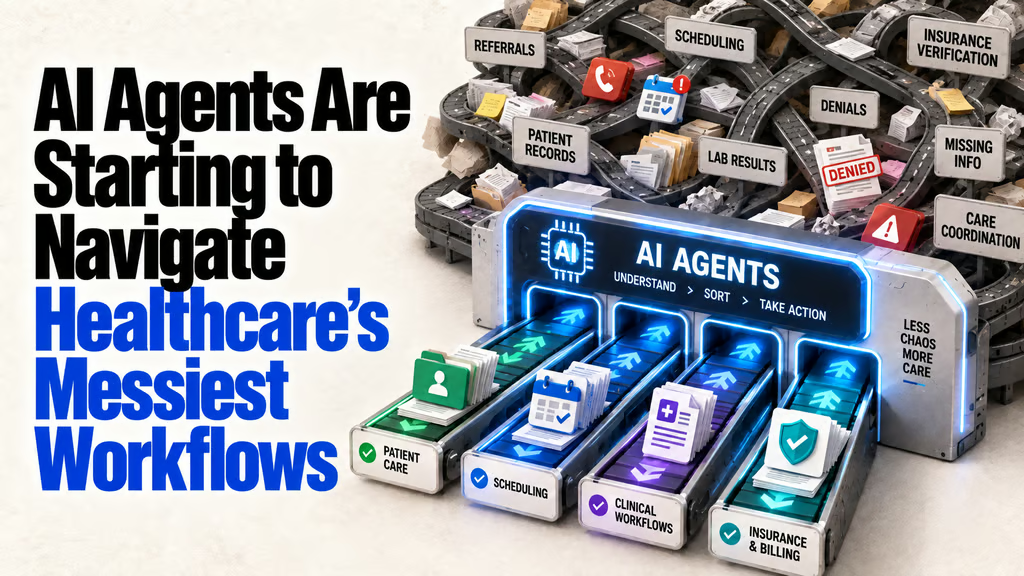
Assort is working toward agents that remember where patients are in their healthcare journey, understand the often-ridiculous operational rules hiding underneath the healthcare system, and increasingly reach out before the patient thinks to call.
If that works, healthcare AI starts looking less like a smarter phone tree and more like a persistent coordination layer between patients and one of the most complicated bureaucracies they regularly encounter.
From answering calls to finding patients
One of Assort's more interesting concepts is something Liu calls Patient Journey Memory: context that follows someone across interactions instead of forcing them to effectively start from scratch each time.
If you previously interacted with the system in Spanish, for example, the agent can remember that and use Spanish when it reaches out again. It can also consider when and how to contact someone rather than blindly placing another 11 a.m. phone call that gets ignored.
Take that idea a little further and an agent might know that you have an outstanding referral, recognize that you're difficult to reach during the day, see an appropriate evening appointment become available and contact you before you remember to call.
That's where Liu sees the possibility of making healthcare more proactive instead of waiting for patients to push themselves through the system.
“Imagine if you just had someone call you at just the right time and they’re like, ‘Hey, Corey, we know you’re really busy on these days. We have a slot open for you at 5:30,’” Liu said. “One of the benefits of our platform is that it allows us to be more proactive with these patients. We have something called our Activate product line, which is really activating patients to do things that they otherwise may not have.”
That could mean getting someone to schedule a physical, follow through on a referral or come in for a flu shot before a small healthcare chore becomes a larger problem.
Liu argues one of the barriers to preventative care isn't necessarily fear of doctors. Sometimes navigating the machinery around seeing one is simply annoying enough that people put it off until something becomes serious.
Importantly, Assort isn't trying to make the agent the doctor.
Liu said its agents don't provide clinical advice, and sensitive situations or requests that fall outside what the system is designed to handle are transferred to human patient-access teams. The goal is to automate front-office workflows while leaving people available for the parts of healthcare that still require them.
That distinction matters. The vision here isn't necessarily AI replacing your physician.
It's AI making sure you manage to reach one.
The AI calling you isn't necessarily the smartest AI available
Making that work also exposes one of the more interesting lessons emerging from real-world AI agents: the best model isn't always the best model for the job.
A conversation with a patient contains tasks with wildly different requirements.
Capturing someone's name doesn't require elite reasoning. Navigating complicated appointment availability, applying provider-specific rules or making a series of tool calls might.
And in voice AI, there is another constraint that benchmark leaderboards don't capture particularly well: people notice when you make them wait.
Assort therefore doesn't run an entire patient interaction through one giant frontier model.
“We use a lot of different models during the course of a call,” Liu said. “A simpler interaction, we’re gonna use a faster, cheaper model. But for something that’s very complex, like choosing from a bunch of different slots that we provided, or for areas that need more advanced tool calling, we’re gonna use a more complex model — a more expensive model that’s better at thinking.”
Assort can also replay previous conversations and edge cases against newly released models to see whether they actually improve performance. That evaluation isn't just about accuracy. The company looks at latency and how a model affects the patient's experience as well.
It's a useful reality check for the broader AI industry.
Leaderboard scores matter. But once an AI system starts doing actual work, cost, latency, reliability, tool use and the consequences of failure all become part of what “better” means.
The newest frontier model might be exactly what you want for the hardest portion of a workflow and complete overkill for the next five steps.
We're starting to see that philosophy appear elsewhere in agent infrastructure, too. Model routing is increasingly becoming part of the architecture rather than assuming every request should automatically go to the most capable model available.
At Assort's scale, that's not just an architectural preference. Inference costs stack up quickly across hundreds of millions of interactions.
Then there are the sticky notes
Choosing the right model may actually be the easy part.
Healthcare organizations contain enormous amounts of operational knowledge that barely qualifies as “data” in the tidy way AI systems would prefer.
There are rules determining which doctor sees which patient, what insurance is accepted, which appointment type somebody needs, where a referral should go, and what to do with thousands of exceptions accumulated over years of operating a medical practice.
Some of those rules live inside software.
Others live in binders, spreadsheets and, as Liu described it, even sticky notes on schedulers' computers.
Consider something as seemingly simple as a referral.
A physician may know the name of a specialist and send a patient there without knowing that another doctor in the same practice is actually the one who handles that specific injury. Within orthopedics alone, two doctors may work on the same body part but specialize in completely different problems.
Assort's system has to understand enough of those practice-specific rules to catch the mismatch and route the patient correctly — without crossing the line into making a clinical diagnosis itself.
That's where Assort's accumulated data becomes particularly interesting.
Liu said the system now operates against millions of edge cases and tens of thousands of care protocols across numerous specialties. Every interaction can also create more data about the odd rules, exceptions and decisions required to make these workflows function.
“We have all this proprietary data that’s extremely powerful,” Liu said. “Our agents are generating data that didn’t ever exist before. We understand our customers, their very complex rules, the best, so then we can actually really design the models in a way that best serves our specific agents’ use cases.”
Liu said Assort is investing in post-training around that data, with the goal of creating specialized models that can perform better on its particular tasks while also being faster and cheaper than relying exclusively on frontier models.
That may be the bigger lesson hiding underneath Assort's healthcare story.
A company's AI advantage may increasingly come not from having privileged access to the smartest general-purpose model, but from turning years of weird exceptions, undocumented processes, customer interactions and employee know-how into something models can actually use.
The sticky notes might be the moat.
From conversation to action
There is one more ingredient required before proactive agents become truly useful: they have to be able to do things.
A chatbot that tells you there is probably an appointment available is helpful.
An agent that determines the appropriate appointment, applies the provider's scheduling rules and books it is doing actual work.
That's the broader transition happening across AI right now. Agents are moving beyond generating answers and toward navigating software, using tools and completing workflows — something we've covered extensively in our guide to actually using AI in 2026.
Healthcare just happens to offer an unusually unforgiving version of that transition.
Errors matter more. Privacy matters more. The rules are uglier. Human escalation matters. And “works 95% of the time” sounds considerably less impressive when you're talking about whether somebody gets access to the right medical care.
Assort says it tests against those messy edge cases before agents reach patients. Liu pointed to examples as specific as distinguishing between two doctors with extremely similar-sounding names who treat similar areas of the body.
Healthcare may consequently become one of the more interesting proving grounds for what production AI agents actually look like when the demo ends.
Healthcare that notices before you do
Liu's five-year vision is surprisingly mundane: healthcare should become as easy to navigate as booking a restaurant reservation.
That may be harder than it sounds.
But consider what success would actually look like.
An outstanding referral doesn't quietly die because you missed a call at 11 a.m.
The system remembers how you prefer to communicate.
An appropriate open appointment finds you instead of requiring you to continually refresh a portal.
Administrative software notices that you're overdue for something and makes fixing it almost embarrassingly easy.
None of that requires an AI capable of diagnosing you better than a doctor.
In fact, the most useful healthcare agent may not be the one capable of answering the hardest medical question.
It may be the one that calls and says:
Hey, we found an appointment for you. Does 5:30 work?
And suddenly, you actually go.
