

Project Astra
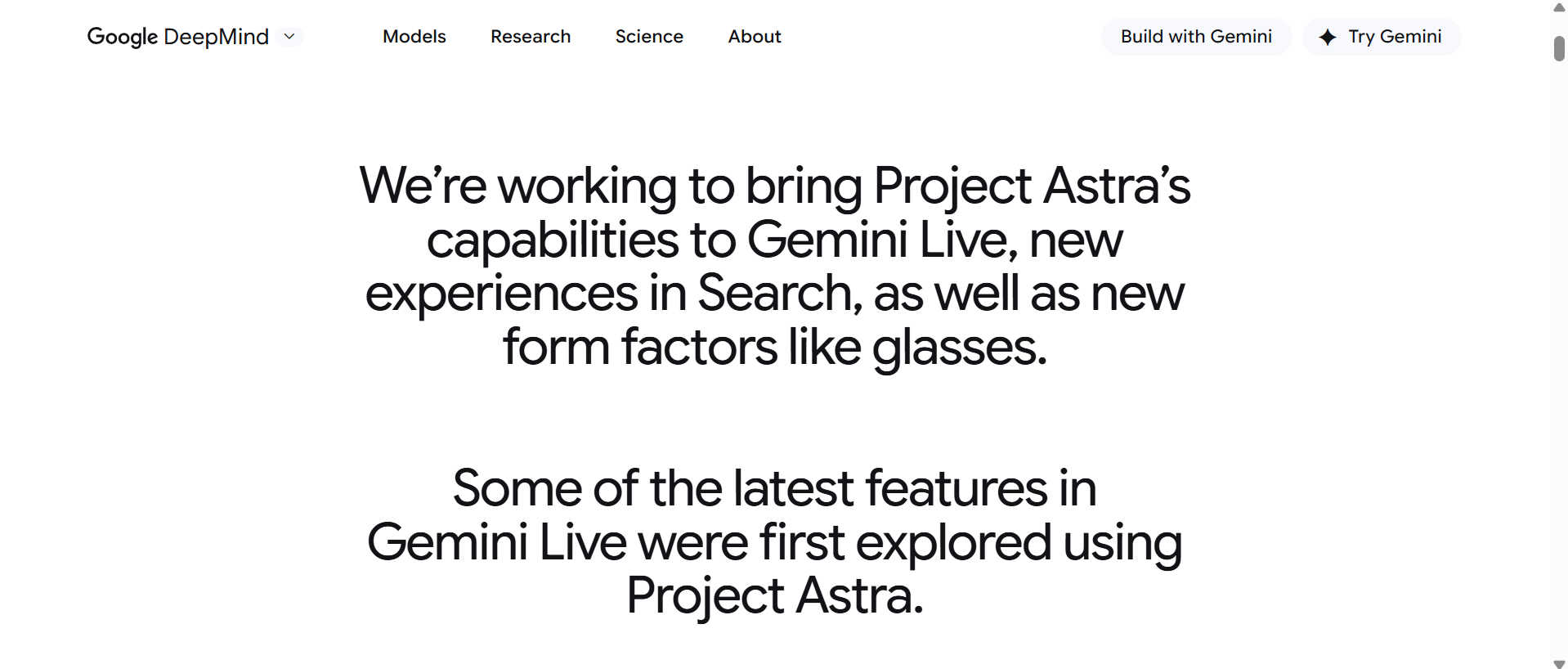
Project Astra represents Google DeepMind’s fullest vision of a computer-use agent, blending perception, reasoning, and action across Google services. While still in prototype and waitlist mode, Astra has already seeded features in Gemini Live, showing Google’s commitment to embedding agentic AI across devices. Reliability, privacy UX, and broad rollout remain hurdles, but if polished, Astra could deliver frictionless, “do this for me” computing at scale.
Fast Facts
- What it is: A research prototype for a universal AI assistant blending language, vision, and action.
- Computer-use angle: Can take actions on your behalf using tools like Search, Gmail, Calendar, Maps, and UI control.
- Availability: Limited trusted tester waitlist; broader rollout via Gemini Live.
- Platforms: Android phones and prototype glasses; supports cross-device memory.
- Accessibility push: Dedicated prototype for blind and low-vision users, developed with Aira.
- Languages: 24-language native audio dialog.
Similar Tools
- OpenAI Operator – Computer-use agent performing web tasks with safety layers.
- Microsoft Copilot for Windows – OS-integrated AI assistant evolving toward agentic behavior.
- Gemini Live – Commercial rollout of Astra-incubated capabilities.
Related Tools
Bolt.new
Bolt.new is a flagship “vibe coding” tool. Its environment control and strong integrations make it unusually practical: you can plan in Discussion Mode, then implement, publish, and iterate without local setup headaches. Great for MVPs, prototypes, hackathons, and many production-ready web apps. Complex non-JS backends still require other stacks.
Firebase Studio
Firebase Studio distinguishes itself with multimodal prototyping (text, drawings, images) and a direct pipeline to Firebase hosting and monitoring. It balances ease of prototyping with enterprise-grade infrastructure. For advanced backend needs, users can switch from Prototyper to Code view and extend projects with Firebase/Google Cloud services.
Make
Make is a visual-first automation platform designed for flexibility and scale. It combines classic no-code workflow automation with AI-powered capabilities like Agents and integrated AI apps, allowing both individuals and enterprises to automate with ease. Its enterprise-grade compliance and strong API tooling make it a serious competitor to Zapier, especially for teams seeking advanced logic and governance.
v0 (Vercel)
Among “vibe coders,” v0 stands out for its Design Mode and design-system fidelity. With shadcn/Tailwind defaults, its outputs are production-friendly, while the Figma integration helps larger teams keep workflows aligned. For deeper backend needs, v0 works best paired with other stacks.
