

AI can write your emails, generate your code, and argue with you about dinner. Predicting what happens inside a living cell requires a different kind of homework.
Biohub is organizing a $1.8 billion effort to generate that homework at an unprecedented scale.
On October 7, the nonprofit science organization backed by Mark Zuckerberg and Dr. Priscilla Chan announced an expansion of its Virtual Biology Initiative, with Google DeepMind, Meta, Isomorphic Labs and U.S. government agencies joining the effort.
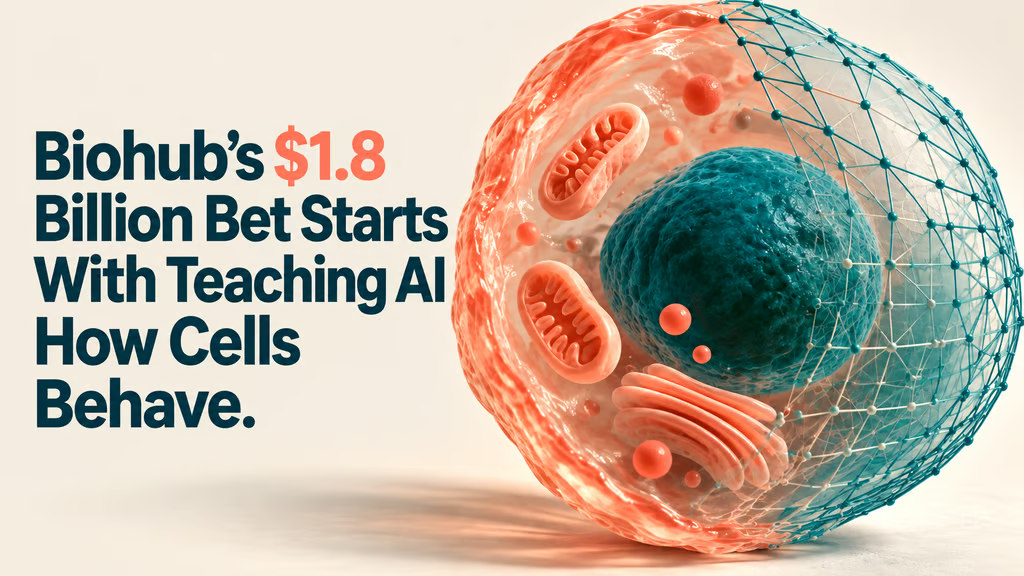
The ambition is to build the data foundation for a “virtual cell”: an AI model that can predict how living cells respond to interventions. Eventually, researchers could test biological ideas on a computer before deciding which experiments deserve time in a laboratory.
Getting there starts with a considerable amount of laboratory work.
Who’s backing Biohub’s biology bet?
Biohub launched the five-year initiative in April with a $500 million commitment. Of that, $400 million supports its own data generation and technologies for measuring biology, while $100 million supports a broader international effort.
DeepMind, Meta and Isomorphic Labs are now contributing $300 million collectively. The Department of Energy is committing more than $500 million over five years. NIH will coordinate existing datasets and research resources developed through more than $500 million in previous federal investment.
That last detail matters. The $1.8 billion figure combines funding, existing data, computation and measurement technology. It includes earlier commitments and previously funded resources.
The initiative also brings together scientific organizations including the Allen Institute, Broad Institute, Wellcome Sanger Institute, Human Cell Atlas and Human Protein Atlas. NVIDIA will support computing infrastructure, software and technical expertise. Biohub plans to help these resources work together through shared standards, common identifiers and a single access point.
What a virtual cell could let scientists do
There is a reason so much of this effort revolves around measurement.
AlphaFold demonstrated what AI could do for molecular structure prediction. Predicting how a cell behaves introduces a much broader challenge: learning how biological systems respond when something changes.
A virtual cell could help researchers explore questions such as: What happens when we alter this gene? How does this cell respond to a compound? Which intervention might move a diseased cell toward a healthier state?
For that to work, models need evidence of cellular responses across many conditions. Biohub’s planned investments include advanced imaging and molecular, cellular and tissue engineering, intended to capture biology across its molecular, spatial and dynamic dimensions.
You cannot photograph a cell once and expect to know its entire life story.
The DOE partnership adds supercomputing, advanced experimental facilities and automated laboratories. Those resources could help researchers generate measurements, build models and test whether their predictions survive contact with actual biology.
The commercial appeal is straightforward. Better predictions could help researchers choose more promising experiments and avoid spending resources on weaker ideas. As we explored in The Neuron’s conversation with Isomorphic Labs, moving from AI models to useful medicines involves many connected scientific problems.
Open data, with a head start for commercial partners
There is also a commercial advantage built into the data-sharing arrangement.
Axios reports that commercial partners get one year of exclusive access to the data they develop before public release. Biohub head of science Alex Rives told Reuters that embargo periods help attract private funding, while government-funded work running in parallel will have no such restrictions.
That gives participating companies time to learn from a resource that will eventually be available more broadly. How much advantage that creates will depend on the datasets, access terms and models built with them.
The predictions still have to hold up in the lab
Rives expects a first dataset in about a year and accurate predictive models within five years, according to Reuters. Those are ambitious expectations, with a substantial scientific test still ahead.
A peer-reviewed study in Nature Methods evaluated 27 methods for predicting cellular responses across 29 datasets. It highlighted continuing difficulties with generalization: making useful predictions in unfamiliar cellular contexts and intervention scenarios.
That is the hurdle to watch. A model becomes scientifically valuable when it predicts something researchers did not already know, and experiments confirm the result.
My read: Biohub’s expansion shows how much of the next phase of AI may depend on deliberately generating new evidence. The opportunity extends beyond training larger models to building the instruments, experiments and shared infrastructure that make better predictions possible.
For readers following AI in medicine, the most revealing milestone will be a prediction that helps a scientist choose a better experiment. Enough of those could change how discovery happens.
Related reading
- Inside Isomorphic Labs and how AI drug design works — Our interview explores the scientific work involved in turning AI predictions into potential medicines.
- Google’s AI Co-Scientist — Background on another approach to accelerating research: helping scientists generate and evaluate hypotheses.
