
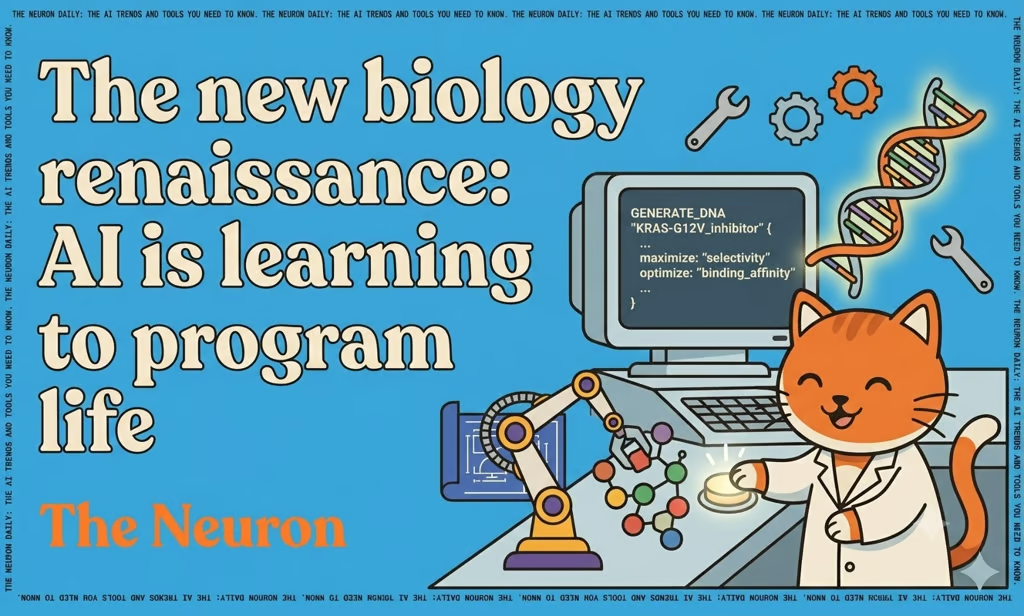



The word renaissance gets abused in tech. Every new app store feature is apparently a rebirth of civilization now. Somewhere, a Medici ghost is asking why the new calendar widget needed venture funding.
Biology has a better claim. Over the last few days, the field produced a strange cluster of announcements that all point in the same direction: AI is starting to give biology a usable interface.
That interface shows up at several layers at once:
- Arc Institute introduced Proto, a high-level programming language for generative biology.
- NVIDIA launched the BioNeMo Agent Toolkit, which gives AI agents callable life science tools.
- OpenAI published a case study showing GPT-5 Pro helping immunologist Derya Unutmaz revisit a three-year-old T cell mystery.
- Nabla Bio said JAM-2 designed drug-like antibodies against difficult intracellular cancer targets, with wet-lab validation in a new technical report.
- Intercept launched as a $500M philanthropic effort to reduce respiratory infections like colds and flu.
- A developer reverse engineered an Oura Ring 5 to stream live accelerometer data and control a computer with hand motion.
The shared movement is AI shrinking the distance between biological signal, hypothesis, design, experiment, and deployment. Biology is getting something that looks a little like an API layer.
- First Up, the TL;DR
- AI biology is moving from prediction to loops
- Proto gives generative biology a language
- NVIDIA is giving agents a life science tool belt
- OpenAI shows the collaborator version of the loop
- JAM-2 brings the loop back to the wet lab
- Intercept moves the renaissance into public health
- The Oura hack is the toy-box version of the same shift
- The constraint that keeps this honest
- What changes next
First Up, the TL;DR
Biology has always had code. DNA, RNA, and proteins are all sequences. The hard part has been writing sequences that do something useful inside messy living systems.
A cluster of new AI biology updates suggests that part is starting to look more programmable. The shift is from AI models that predict biology to AI workflows that can read a signal, propose an explanation, design a candidate, test it, and update the next round.
Here's what happened:
- Arc Institute introduced Proto, a programming language for generative biology.
- NVIDIA launched BioNeMo Agent Toolkit, which gives AI agents callable life science tools.
- OpenAI showed GPT-5 Pro helping immunologist Derya Unutmaz revisit a three-year-old T-cell mystery.
- Nabla Bio said JAM-2 designed drug-like antibodies against hard cancer targets, with wet-lab validation.
- Intercept launched a $500M effort to reduce respiratory infections through preventatives and cleaner air.
Why this matters: The first AI biology wave was mostly about prediction: tell us how a protein folds, how a molecule binds, or how a DNA sequence might behave. Useful, but still fragmented. Scientists were left stitching together specialized tools, data formats, lab assays, and judgment calls.
The new wave is about loops. Proto gives researchers a way to specify biological design goals. BioNeMo gives agents a tool belt. GPT-5 Pro shows how models can help scientists connect mechanisms across fields. JAM-2 shows generated designs still have to survive real lab tests.
Even the sillier edge of the story points the same way: a developer reverse engineered an Oura Ring 5 to stream live motion data and control a computer. The serious version is a lab assay. The toy-box version is hand gestures. Both start with biological signal becoming readable software input.
That is where the renaissance framing earns its keep. The work is moving from “can AI understand biology?” to “can AI help us build better biological systems on purpose?”
Our take: The lab remains the judge. Cells still fail in expensive, annoying, very real ways. But if AI can turn 10,000 guesses into 50 credible experiments, the economics of biology change fast.
The next fight is trust: how much confidence can one AI-generated candidate carry before it deserves real-world testing?
One important caveat, this is only the developments over a several day period. This trend is ongoing and has been a subject of discussion around The Neuron for weeks. They're getting more impactful and more frequent, so we decided to write this to share some context.
Now, let's dive into all this in a lot more detail.
AI biology is moving from prediction to loops
The first wave of modern AI biology was dominated by prediction. Could a model predict a protein structure? Could it estimate binding? Could it score a DNA sequence? Could it tell researchers what a molecule might do?
Prediction was a huge step. It also left researchers with a pile of specialized tools that did not naturally fit together. A model for protein structure might live in one software environment. A model for gene regulation might expect different inputs. A docking tool might produce files another tool cannot read cleanly. A wet-lab scientist might understand the biological goal perfectly and still spend days fighting installs, dependencies, and data formats.
The new biology renaissance is about turning those tools into loops:
- Read: capture biological signals from sequences, cells, papers, sensors, assays, or buildings.
- Reason: use models to connect mechanisms, constraints, and possible interventions.
- Design: generate candidate sequences, molecules, antibodies, or systems.
- Test: send the strongest candidates into experiments, clinics, or real-world pilots.
- Update: feed the results back into the next round.
The lab remains the grounding force. Cells grow or fail. Proteins fold or misfold. Molecules bind the right target, the wrong target, or nothing useful at all. AI makes the search more directed. Biology still grades the exam.
Proto gives generative biology a language
Arc described Proto as a way to program protein, DNA, and RNA systems like computer code, or eventually through natural language prompting of an AI agent. The precise claim is even more useful: Proto gives researchers a shared way to compose biological design campaigns across DNA, RNA, proteins, ligands, and their interactions.
The Proto preprint, which has not been peer reviewed, describes a high-level programming language for generative biology. The Proto site calls it a universal infrastructure layer for making biology programmable, and the team also published a getting started video for researchers who want the hands-on version.
Proto reduces biological design into four primitives:
- Sequences: the molecular strings being designed.
- Generators: models that propose possible candidates.
- Constraints: models or rules that score whether candidates satisfy the goal.
- Optimizers: systems that steer the next round toward better candidates.
Plain English version: Proto lets a scientist specify what a biological system should do, then turns that goal into a structured search across multiple AI models.
Arc says the team rebuilt five published design campaigns inside Proto: symmetric protein complexes, de novo protein monomers, CRISPR-Cas loci, multi-kilobase chromatin accessibility, and antibody CDRs. The models and optimizers differed across tasks. The design grammar stayed the same.
The new examples show why that grammar matters. With AlphaGenome and SpliceTransformer as constraint models, Proto designed introns with cell-line-specific splicing, then validated the results in human cells. In another experiment, Proto composed generative and structural models to design promoter-repressor pairs, meaning a DNA sequence and protein that work together like an on/off switch while avoiding unwanted interactions elsewhere in the cell.
That is the hard part of biology. Useful designs usually have several goals at once. A protein should bind one thing and avoid another. A DNA sequence should turn on in one cell type and stay quiet somewhere else. A therapy should hit a cancer mutation and spare healthy tissue.
Proto’s promise is a cleaner way to express those goals before the lab work begins.
NVIDIA is giving agents a life science tool belt
Proto gives scientists one kind of programming layer. NVIDIA’s BioNeMo Agent Toolkit gives AI agents a different layer: tools they can call without inventing the workflow from scratch.
The BioNeMo Agent Toolkit GitHub repo describes the project as a way to turn any agent into a life science expert with BioNeMo skills. The repo packages tools for protein folding, molecular docking, generative chemistry, genomics analysis, protein design, and biomarker discovery as ready-to-call agent skills.
Each skill tells an agent how to select a tool, prepare inputs, run the model, inspect outputs, and explain results across single tasks and multi-step workflows. NVIDIA’s blog says the toolkit supports models and tools such as OpenFold3, Boltz-2, DiffDock, GenMol, ProteinMPNN, MSA Search, RFdiffusion, and Evo 2.
This sounds procedural, which is exactly the point. Agents often fail at scientific work in boring ways. They choose the wrong model. They format inputs incorrectly. They misread an output file. They burn compute on an approach a graduate student would have skipped.
NVIDIA reported that adding the relevant BioNeMo NIM skills improved an agent benchmark from 57.1% task completion to 100% on average, and produced a 2x improvement in passing assertions per 1,000 tokens. That is a usability result as much as an AI result. The model gets better because the workflow stops asking it to guess the tool manual from vibes.
Arc’s response to BioNeMo used the phrase “programmable biology.” That phrase is the category. Models generate candidates. Agent skills coordinate the tools. Labs decide which outputs survive contact with reality.
OpenAI shows the collaborator version of the loop
OpenAI’s case study with Derya Unutmaz shows another version of the same shift. Here, the model does not design the molecule directly. It helps the scientist see a mechanism hiding across fields.
Unutmaz, an immunologist at The Jackson Laboratory and the University of Connecticut, had a three-year-old puzzle from a 2022 experiment. His lab was studying how glucose affects T cells, the immune cells that help fight viruses, cancer, and other threats.
The team expected two conditions to behave similarly: low glucose and deoxyglucose, a glucose-like molecule that interferes with how cells use sugar. Both conditions should have limited usable energy. Instead, deoxyglucose pushed many more T cells toward Th17 cells, an inflammatory-response cell type, and the effect persisted after the molecule was removed.
GPT-5 Pro suggested a mechanism: deoxyglucose may interfere with construction of IL-2, a protein that can prevent T cells from becoming Th17 cells. In plain English, the glucose mimic may have removed one of the cell’s internal brakes.
That answer mattered because it sat slightly outside the lab’s existing frame. The model gave Unutmaz a candidate explanation he was qualified to judge.
Unutmaz then asked GPT-5 Pro to simulate a separate experiment involving CD8+ T cells targeting lymphoma. According to OpenAI, the model correctly predicted the boosted killing ability he had already observed, before the result had been published.
This is the version most labs may feel first. A model reads across hundreds of papers, suggests mechanisms, predicts which experiment is worth running next, and helps researchers avoid spending months on lower-value paths. The scientist still supplies the judgment, the data, and the reality check.
JAM-2 brings the loop back to the wet lab
Nabla Bio’s JAM-2 report matters because it moves from interface and reasoning into wet-lab grading.
The company focused on peptide-MHC targets, often shortened to pMHC. Here is the plain-English version: many disease-driving proteins sit inside cells, beyond the reach of typical antibodies. Cells constantly chop up internal proteins and display small fragments on their surface using MHC molecules. T cells inspect those displays to decide whether a cell looks normal or dangerous.
A drug that recognizes the right pMHC display could, in principle, target disease signals coming from inside the cell. Precision is brutal here. The target may differ from a healthy self-peptide by one amino acid. A therapeutic that misses that distinction can attack healthy cells.
According to Nabla’s JAM-2 report, the model designed drug-like VHH antibodies, a small antibody format, against five pMHC targets across two HLA alleles and three antigen classes. It started from target sequence alone, generated roughly 84,000 proposed designs per target, and recovered binders across all five targets.
The report’s strongest numbers are concrete:
- Top designs for four of five targets showed sub-nanomolar T-cell activation potency.
- Anti-NY-ESO-1 designs showed at least 216-fold selectivity over the closest human self-peptides tested.
- A KRAS G12V design killed G12V-presenting cells with an EC50 of 0.07 nM while sparing wild-type in the reported assay.
- Cryo-EM, a high-resolution molecular imaging method, matched the designed KRAS binder to 0.93 angstroms across the complex.
- 78% of tested designs passed five early developability assays, which check properties like expression, stability, monomericity, and unwanted stickiness.
The KRAS example is the cleanest one. KRAS mutations help drive many cancers. Nabla’s reported binder distinguished a cancer-associated mutation from the wild-type version by reading one side chain, the tiny chemical group that differs between the mutant and healthy peptide.
That is the dream version of precision medicine: design from sequence, aim at a specific mutation, and validate against the nearest obvious safety traps before the candidate reaches the clinic.
Intercept moves the renaissance into public health
The Intercept story shows the same loop at institutional scale. Nan Ransohoff’s launch post framed Intercept as a $500M philanthropic initiative to make respiratory infections like colds and flu a thing of the past.
The official Intercept launch essay lays out two main tracks: broad-spectrum preventatives and air-cleaning technologies. Broad-spectrum preventatives could include shots, nasal sprays, or pills that protect across respiratory virus families. Air-cleaning technologies include filtration and far-UVC light, which aims to reduce airborne transmission in shared spaces.
Intercept’s target is bigger than “better flu shots.” The launch essay says healthy people spend roughly 15-25 days each year sick with respiratory infections. It also estimates routine respiratory illness drives 1-1.5% annual productivity losses, or roughly $600B to $900B globally in non-pandemic years.
Sholto Douglas summarized why he and colleagues donated in three buckets. He pointed to equity investments in broad-spectrum preventatives ready to reach Phase 2 within roughly four years, grants for basic research too early for commercial markets, and real-world proof for air-cleaning technologies like far-UVC.
Intercept’s buyer strategy is the practical part. Its launch essay says the Customer Advisory Board includes Stripe, Anthropic, BXP, Kilroy, Jane Street, JP Morgan, Mastercard, Meta, and Warby Parker. The funders include Stripe, Anthropic, Flu Lab, OpenAI Foundation, Patrick and John Collison, individuals from Jane Street, Bill Gates through a philanthropic entity, Coefficient Giving, and individual Anthropic employees. The Financial Times also covered the funding effort.
That belongs in a biology renaissance story because it changes the unit of action. The work expands from designing a better molecule to designing an intervention loop. Identify the biological problem, fund better tools, test them in humans or buildings, work with regulators, create buyer demand, and deploy what works.
A YouTube explainer on virus-prevention technology surfaced in the discussion for the same reason. The idea sounds like sci-fi until the loop becomes practical enough to test in schools, offices, transit hubs, and clinics.
The Oura hack is the toy-box version of the same shift
The Oura Ring 5 demo sits far from protein design. It still belongs here because it captures the consumer edge of readable biology.
A ring built for sleep, recovery, and activity tracking becomes a live motion controller once someone finds the right accelerometer stream. The body becomes an input device. The biological signal becomes software-readable. The software can act.
That is the same pattern in miniature. In the lab, the signal might be a sequencing result, cell assay, microscope image, or protein structure. On your hand, it might be accelerometer data from a ring. In a building, it might be ventilation performance, pathogen risk, or air-cleaning effectiveness.
The toy-box demo and the $500M nonprofit live at opposite ends of the seriousness spectrum. Both show where the energy is moving: capture signals from living systems, make them legible to software, and route action through models, tools, or institutions.
The constraint that keeps this honest
The strongest counterargument comes from the sources themselves.
Arc’s Proto team says the framework depends on the models available. If a good predictive model does not exist for a given objective, the design loop has nothing trustworthy to optimize against. Proto can also be slow because inference-time search may run models repeatedly before finding candidates.
NVIDIA’s BioNeMo post makes the same point from the agent side. Science has no clean software test suite where every correct hypothesis turns green. Its troubleshooting guidance tells users to check biological setup before trusting docking scores, inspect low-confidence structures, and filter generated molecules through downstream scientific criteria.
OpenAI’s case study has its own boundary. GPT-5 Pro helped surface a mechanism and predict an unpublished experimental direction, but the model’s answer still needed an expert who could judge biological plausibility. OpenAI also connected scientific acceleration to its Preparedness Framework, because stronger biology tools can lower barriers for misuse.
Nabla’s JAM-2 results are still preclinical. The company showed in vitro activation, killing assays, structural validation, and developability signals. The decisive tests are broader off-target assessment, animal studies, tumor control, tolerability, manufacturability at scale, and eventually, human clinical data.
These caveats locate the accomplishment. AI is getting better at proposing biology. Experiments still decide which proposals become medicine, infrastructure, or public-health policy.
What changes next
The near-term impact will probably show up inside research teams, public-health programs, and weird interface experiments before it shows up as miracle drugs.
Computational biologists get a cleaner way to stitch models together. Wet-lab teams get smaller, more reasoned candidate sets. AI agents get tool instructions that reduce avoidable failures. Bench scientists get a new way to interrogate confusing results before choosing the next experiment. Public-health funders get a playbook for moving from biology to deployment.
The bottleneck moves from prediction to verification. For years, the main question was whether AI could tell us what a molecule looks like or how it might behave. Now the field is asking whether AI can generate a molecule, mechanism, or intervention that satisfies several constraints at once.
If that works, labs will need better assays, better safety screens, better provenance for generated sequences, better standards for reporting failures, and better ways to decide when an AI-designed candidate deserves expensive tests.
The unresolved issue is trust density: how much experimental confidence can each AI-generated candidate carry before it enters the lab?
Proto, BioNeMo, GPT-5 Pro, JAM-2, Intercept, and the Oura hack each answer a different slice of that question. A language helps scientists specify the goal. Agent skills help models become usable tools. General reasoning models help researchers find mechanisms and choose experiments. Wet-lab validation shows which generated candidates survive first contact with biology. Public-health funding turns interventions into deployment loops. Wearables show how ordinary body data becomes an input surface.
The next phase of AI in science will be won by the teams that connect those pieces. The model alone is no longer the whole story. The loop is the product.
