
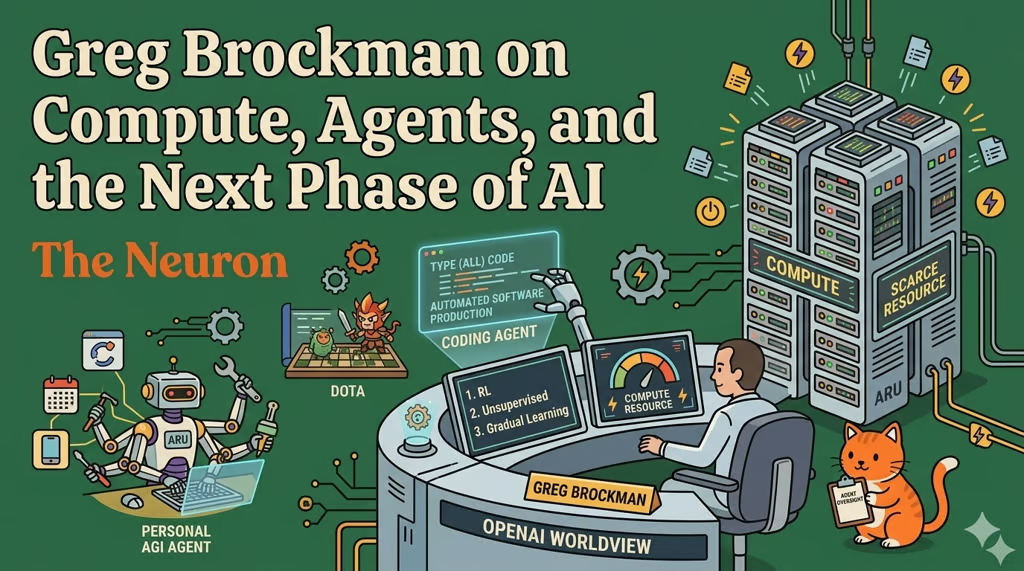


Greg Brockman went on The Knowledge Project with Shane Parrish and, intentionally or not, laid out OpenAI’s actual worldview.
Not the polished “AI will help humanity” version.
The operational version.
The version that says: compute is the new scarce resource, coding is already mostly automated inside OpenAI, personal AI agents are the real consumer endgame, and the people who learn to manage AI systems now will have a very different next decade from the people still treating ChatGPT like a spicy autocomplete box.
The interview is framed around OpenAI’s founding and the 72-hour board crisis that nearly blew up the company. And yes, there’s plenty of founder lore: the early dinner where OpenAI’s would-be founders debated whether DeepMind had already won, the Napa offsite where the first technical roadmap came together, the weekend employees rallied behind Sam Altman and Brockman, and the moment Ilya Sutskever’s reversal made it feel like OpenAI could be put back together.
But the most interesting part is not the drama.
It’s what the drama reveals about how Brockman thinks AI actually gets built.
- OpenAI Started With One Question: Is It Already Too Late?
- The Original Plan Was Weirdly Durable
- The Nonprofit Dream Hit the Compute Wall
- Dota Taught OpenAI the Scaling Lesson
- The Board Crisis Was About More Than One Weekend
- “Almost All Code” Is Already AI-Written
- The Next Job Skill Is Managing Agents
- Personal AGI Is the Consumer Endgame
- The Big Takeaway
OpenAI Started With One Question: Is It Already Too Late?
Before OpenAI was OpenAI, Brockman was leaving Stripe. He had been the company’s first engineer and helped build one of Silicon Valley’s most admired startups, but he didn’t feel like payments was the problem he wanted to spend his life on.
AI was.
So when Patrick Collison suggested he talk to Sam Altman, the expectation was apparently that Altman might convince Brockman to stay at Stripe. Instead, Altman clocked that Brockman had already made up his mind. Soon after, the two were talking about whether it was still possible to start a serious AI lab.
That was not obvious in 2015.
DeepMind had Google, money, talent, momentum, and soon AlphaGo. Brockman describes the early OpenAI conversation as basically: are we too late? Can an independent lab still recruit the best researchers and matter?
Nobody could prove the answer was no.
So they did it.
That sounds like standard founder mythology until you realize how much of OpenAI’s personality is still built around that same move: stare directly at the impossible-looking thing, ask whether it is actually impossible, and if not, start marching.
The Original Plan Was Weirdly Durable
One of the best details in the interview is that OpenAI’s early team held an offsite in Napa before the company even really existed. There were no official offers, no finalized structure, and not much more than a mission.
Brockman even made t-shirts.
That offsite produced what he describes as a three-part technical plan OpenAI has followed for roughly a decade:
- Solve reinforcement learning.
- Solve unsupervised learning.
- Gradually learn more complicated “things.”
That sounds almost too simple, but it maps surprisingly well to the arc of modern AI. First, train models on huge amounts of data to predict what comes next. Then use reinforcement learning and feedback loops to shape behavior, reasoning, and action.
Brockman’s argument is that prediction and reasoning are not opposites. They are deeply connected. His simplest version: if you can predict the next thing Einstein would say in a new situation, you are doing something much closer to intelligence than autocomplete.
That matters because it pushes against one of the most common dismissals of language models: “they’re just predicting the next word.”
Brockman’s answer is basically: yes, and you may not understand how powerful prediction becomes at scale.
The Nonprofit Dream Hit the Compute Wall
The cleanest business takeaway from the interview is this: OpenAI’s structure changed because the compute math changed.
Brockman says that by 2017, OpenAI started seriously calculating what it would take to build AGI. The answer was not “a few great researchers and a whiteboard.”
It was giant computers.
That is when the pure nonprofit structure started to look incompatible with the mission. Brockman says Elon Musk, Sam Altman, Ilya Sutskever, and he all agreed that some kind of for-profit entity was the only plausible way to raise the capital required.
This is the part of the AI story that still gets under-discussed. The frontier model race is not just about algorithms. It is about who can finance, build, power, and operate planet-scale infrastructure.
Brockman describes data centers as some of the biggest machines humanity creates. And he means machines literally: rows of racks, cables cut to exact lengths, fragile components, enormous coordination, all built so models can think longer, search deeper, write code, analyze science, and eventually run agentic workflows at scale.
The punchline: compute is becoming a political, economic, and moral allocation problem.
Who gets it? Consumers? Enterprises? Cancer research? Coding agents? Free users? Governments? Startups? OpenAI’s own next model?
That might be the real AI policy question hiding in plain sight.
Dota Taught OpenAI the Scaling Lesson
Before ChatGPT, before GPT-4, and before today’s agent race, OpenAI had a strange little proving ground: Dota 2.
Dota mattered because it was messy. Unlike chess or Go, it involved imperfect information, teamwork, real-time decisions, and a huge action space. Brockman says OpenAI expected its reinforcement learning approach to hit a wall. The algorithm was flawed. It had no elegant hierarchy. It did not plan like a human.
But they kept scaling it.
And it beat top human players.
For Brockman, the lesson was not “AI can play video games.” It was that simple algorithms plus massive compute could produce unexpectedly powerful behavior in messy environments.
That is basically the OpenAI scaling thesis in miniature.
Push the baseline until it breaks. If it doesn’t break, keep going.
The Board Crisis Was About More Than One Weekend
The interview also gives Brockman’s version of the weekend Sam Altman was fired, Brockman quit, employees revolted, and OpenAI almost became something else entirely.
The most revealing part is not the procedural detail. It is Brockman’s explanation of why conflicts inside AI companies become so intense.
If you believe you are building technology that could reshape civilization, then normal company problems stop feeling normal. Who gets decision rights? Who gets credit? Who defines safety? Who sets the deployment pace? In another company, those questions might be office politics. At OpenAI, Brockman says they take on “existential weight.”
That is a useful frame for understanding why frontier AI companies can look so unusually dramatic from the outside. The people inside are not just arguing about product strategy. Many of them believe they are arguing about the future operating system of society.
During the crisis, Brockman says competitors circled with offers, but OpenAI did not lose a single person that weekend. Employees rallied behind Altman and Brockman, the petition demanding the board resign reportedly crashed Google Docs, and Sutskever’s eventual public support for bringing the company back together became a turning point.
Still, Brockman says Ilya’s later departure was one of the hardest moments in OpenAI’s history for him. Maybe the only moment, he says, when he felt like he didn’t want to keep doing it anymore.
That emotional detail matters. The AI race is often covered like a leaderboard. But it is also a pressure cooker full of humans trying to make irreversible decisions with incomplete information.
Fun!
“Almost All Code” Is Already AI-Written
The most clicky line in the interview is Brockman’s claim about code.
When Parrish asks what percentage of OpenAI’s code is now written by AI, Brockman says it is hard to know what percent is not written by AI. The actual writing of code, he says, is essentially all AI.
That does not mean human engineers are obsolete inside OpenAI. Brockman is careful about the distinction. Humans are still better at architecture, interfaces, structure, and deciding how pieces should fit together.
But the typing? The implementation? The actual code production?
That has moved.
This lines up with the broader shift we’ve been tracking at The Neuron around coding agents like Codex and the move from “AI helps me write a function” to “AI does delegated software work.” The useful mental model is no longer autocomplete. It is management.
You describe the goal, provide context, review the work, and decide what matters.
That is a very different skill.
The Next Job Skill Is Managing Agents
Brockman’s advice to young people is blunt: lean into the technology.
Not because every teenager needs to become a prompt influencer. Please, no. But because the future he describes is one where people become managers of agents. Maybe even, in his more sci-fi phrasing, CEOs of autonomous AI corporations.
The important part is not the title. It is the operating pattern.
If AI systems can write code, search knowledge bases, run experiments, design chips, book tickets, monitor your goals, and coordinate work while you sleep, then the scarce human skill shifts. Less “Can I personally execute this task?” More “Do I know what I want, can I explain it clearly, and can I judge whether the result is good?”
That is agency.
And it is why Brockman’s most practical message is also the simplest: the people getting the most from the current generation of AI are often the people who learned the previous generation early.
AI compounds as a skill.
Personal AGI Is the Consumer Endgame
Brockman’s consumer vision is personal AGI.
He describes an AI that knows your context, understands your goals, acts on your behalf, checks in when needed, and proactively helps you get things done. If your favorite musician is in town, maybe it buys tickets. If you need health help, maybe it becomes a doctor in your pocket. If you want to build an app, maybe it turns your idea into software.
The key phrase is: your computer does work for you.
That is the line that ties together OpenAI’s enterprise strategy, consumer strategy, and coding-agent strategy. Whether the user is a Fortune 500 company or a person with an idea for an app, the product direction is the same: agentic systems that take action.
This is also why OpenAI’s future probably looks less like a chat window and more like a command layer for your life and work. We’ve already seen the early version in OpenAI’s Codex app. The broader consumer version is still being built.
The Big Takeaway
The Brockman interview is a preview of the next AI fight.
The first phase was about who could build the smartest model. The next phase is about who can build enough compute, turn that compute into useful agents, distribute those agents broadly, and make society resilient enough to absorb the change.
That is a much bigger game than chatbots.
And Brockman’s message, stripped down, is this: OpenAI believes the world is becoming compute-powered, agent-managed, and much faster. The people and companies who understand that early will not just use AI better. They will organize work differently.
Everyone else will eventually get there, too.
They’ll just be managing agents slightly later, with worse instincts, while wondering why the t-shirts were already gone.
