


So, OpenAI just announced it reached over $20B in annualized revenue in 2025 — a stunning 233% jump from the prior year. CFO Sarah Friar shared the milestone, noting the company's revenue grew from $2B in 2023 to $6B in 2024, and now $20B+. That's the kind of hockey stick growth VCs dream about.
The catch:
OpenAI is expected to burn through $17 billion in 2026, up from $9 billion last year. Here's the breakdown:
- Revenue: $20B annualized run rate
- Cash burn: ~$17B projected for 2026
- Burn rate: 85% of revenue going up in GPU smoke
- Reality check: The Economist calls this "one of the big bubble questions of 2026"
In case you forgot, training and running frontier models isn't cheap. Compute costs alone are astronomical, and OpenAI's commitment to scale means those costs aren't shrinking anytime soon. Some analysts estimate the company could run out of cash by mid-2027 without additional funding.
As the cost of building and running AI systems continues to rise, enterprises are increasingly evaluating how to maintain control over infrastructure, data, and long-term dependencies. For a deeper look at how sovereign AI strategies address these challenges, see this analysis
While OpenAI races toward profitability, new data suggests their latest model might actually justify the cash burn:
- Ethan Mollick, a Wharton professor who studies AI adoption, just analyzed unreleased benchmarks showing GPT-5.2 matches human expert quality on first-pass work 72% of the time, up from just 39% for GPT-5.
- Here's why that number matters: The test measures whether you can delegate a complex task to AI, spend one hour reviewing it, then decide if it's good enough to use or if you need to do it yourself.
- At 39%, delegation is a gamble. At 72%, it becomes your default workflow.
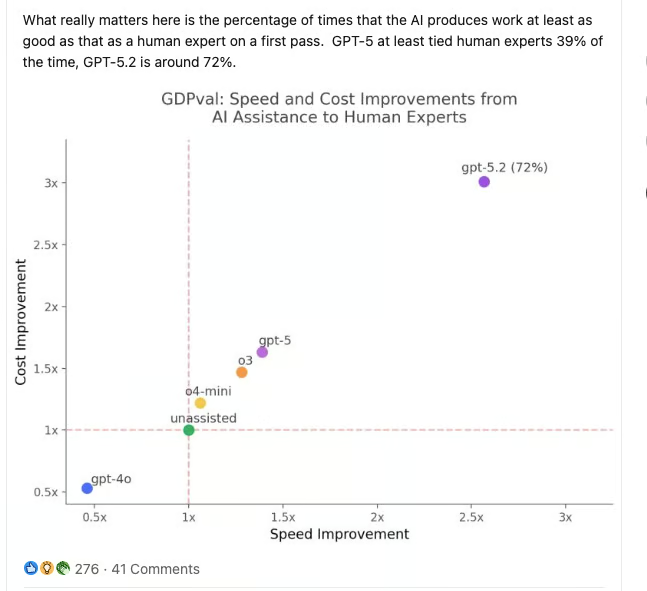
Think about what that means for enterprise customers paying OpenAI tens of thousands per month. If three-quarters of knowledge work tasks now clear the "good enough on first try" bar, that $20B revenue number starts looking less like hype and more like the beginning of something massive…
Why this matters:
OpenAI's revenue growth proves there's real demand for AI products — businesses and consumers are paying billions for ChatGPT subscriptions, API access, and enterprise deals. But the economics are still upside down. The company is essentially selling $10 bills for $4, betting that future efficiency gains and model improvements will flip the equation.
That bet might work. But it requires:
- Continued investor confidence (check — they're eyeing $100B+ in new funding).
- Breakthrough improvements in inference efficiency.
- New revenue streams beyond subscriptions.
Enter: ChatGPT ads. OpenAI announced last week it will begin testing advertising in the free and Go tiers of ChatGPT. The company promises ads won't influence responses and they'll "never" sell user data to advertisers (we've heard that one before).
But if OpenAI can capture even a fraction of Meta's $5-10 per user revenue from ads, that's potentially $5-10B in new annual revenue.
Here's another fast fact for ya:
OpenAI's trajectory mirrors other tech giants in one key way: initial losses followed by scale-driven profitability. Amazon lost money for years. So did Uber. The difference? Those companies eventually found sustainable unit economics. OpenAI's path to profitability depends on compute costs dropping faster than its ambitions grow — and so far, it's racing in the opposite direction.
That's why the ability for AI to handle expert-level tasks on the first try instead of the fifth matters. If GPT-5.2 can replace three hours of expert work while only needing one hour of review, suddenly those massive compute costs start looking like rounding errors.
A lawyer billing $500/hour who can now handle 3x the caseload? That's a $1,000/hour productivity gain for a $20/month subscription.
And OpenAI isn't the only one betting big on this trajectory. Sequoia is reportedly seeking a stake in Anthropic's $25B funding round. That's 3x what Anthropic was worth just months ago.
The pattern is clear: VCs are pouring billions into frontier AI labs despite losses that would make most CFOs faint. Why? Because the models are finally good enough to replace, not just assist, expert-level work.
Now here's the plot twist:
The same AI making OpenAI and Anthropic worth billions is also threatening the entire software industry's business model. While VCs bet tens of billions on AI companies, regular people are using those same AI tools to build their own software instead of buying SaaS subscriptions.
Meet Marisa. She has zero coding experience. Over a few days in December, she built a viral advent calendar app using Claude and Cursor. The total cost? $230. Tens of thousands of people used it. They uploaded over 1 million images.
The breakdown:
- Vercel hosting: $142.54
- V0 (Vercel's AI design tool): $51.48
- Supabase database: $25
- Domain name: $11
That's it. No engineering team. No $200K senior developer salary. No six-month development cycle. Just a designer with an idea and access to Claude.
As a16z partner Justine Moore put it: "Vibe coding is completely changing the economics of software development. The real story isn't that she built it cheaply. It's that she built it at all."
And she's not alone.
- Someone in the UK built ismypubfu$%ed.com to track which London pubs are getting destroyed by tax policy. (Yes, that's the actual URL. Yes, it's oddly helpful.)
- A Reddit user built their own DocuSign alternative, their own CRM, and their own time tracking software — purely to avoid paying SaaS companies.
- Others are building personal clones of their least favorite software subscriptions, custom data analysis tools, and niche utilities that solve exactly their problem and no one else's.
- Even professional engineers are leaning into this. Cursor's team used multi-agent systems to build a full web browser from scratch in under a week. The agents wrote over 1 million lines of code across 1,000 files. They ran continuously, handling conflicts, making architectural decisions, and shipping features while the human engineers slept.
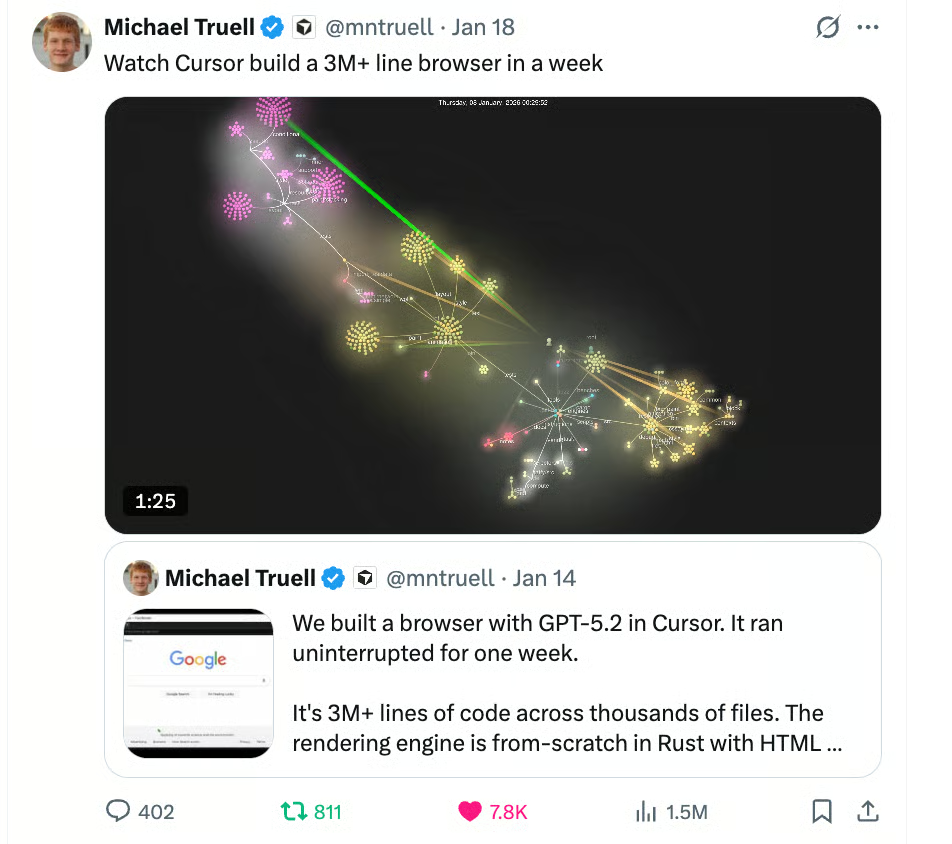
As Simon Willison noted in his breakdown: "Hundreds of agents can work together on a single codebase for weeks, making real progress on ambitious projects."
The Real Vibe-Coding Revolution (And Why SaaS Stocks Are Tanking)
Here's the thing about vibe coding that most people get wrong: it's not about shipping the next Notion clone to Product Hunt.
This is the pattern TechCrunch identified as "micro apps": hyper-specific tools that solve one person's problem, then disappear when the need is gone.
- An artist tracking how many hookahs and drinks he consumes on weekends.
- A guy in San Francisco who auto-pays his parking tickets.
- A woman who built her own allergy tracker in the time it took her husband to go to dinner and back.
Which begs the existential question: If everyone starts building their own tools instead of subscribing to them, what happens to software companies?
Wall Street has a theory. And it's grim.
According to Bloomberg, SaaS stocks just posted their worst start to a year since 2022. A basket of software-as-a-service stocks tracked by Morgan Stanley is down 15% so far in January—after already dropping 11% in 2025.
The damage:
- Intuit (TurboTax): Down 16% last week—worst since 2022
- Adobe: Down 11%+
- Salesforce: Down 11%+
"The Anthropic news we got underlines how difficult it is to assess what growth can look like going forward," said Bryan Wong, portfolio manager at Osterweis Capital Management.
The fear is straightforward: Why pay $50/month for a CRM when you can build one yourself? Why subscribe to a time tracker when Claude can make one in an afternoon?
As one software engineer put it on Reddit: "I've been saying this for a while now... taking in an inexperienced junior is really counterproductive today. Most tasks that are easy and clear enough to assign to a junior, AI can do 100x faster."
The Hacker News thread was even more blunt. One comment summed it up: "Most vibe coders are building solutions to problems they have. Not everybody is wanting to push solutions to the market. I built 30+ apps for personal use. Never plan to publish."
That's the real threat to SaaS companies. Not that vibe-coded apps will compete in the market; but that people will stop entering the market entirely. Why buy when you can build? "The beautiful thing about vibe coding is that it transforms us from passive consumers into active creators."
Still, not everyone's panicking. Barclays expects software stocks will "finally catch a break" in 2026. Goldman Sachs thinks rising AI adoption will expand the total addressable market for software companies. And one strategist noted: "The group isn't a screaming buy, but we're getting closer to that."
Perhaps the solution is to go back to network-effects thinking: only build software that's multiplayer, so the moat isn't the tech stack but the people who use it together.
Our take:
The market isn't afraid that people will vibe-code the next Salesforce competitor. It's afraid that millions of people will just... stop subscribing to SaaS products because they can build good-enough versions themselves.
One former TechCrunch writer, now building his own personal podcast translation app, put it simply: A day is dawning when people stop subscribing to apps with monthly fees. Instead, they'll just build their own.
...For now.
AI companies sell their subscriptions at a loss when it comes to power users. Every heavy vibe coder burning through tokens to build their own CRM is costing OpenAI money. The $20/month subscription doesn't cover the compute costs for someone prompting Claude for hours building complex applications. The math only works because casual users subsidize power users, and enterprise API contracts subsidize everyone.
Here's the ultimate irony: OpenAI's most profitable customers are SaaS companies paying for API access. Their least profitable customers are the power users building personal tools instead of buying software.
The very people disrupting the software industry are being subsidized by the software industry.
The old economics are breaking:
- Old model: Pay $50-500/month for software that does 80% of what you need
- New model: Pay $20/month for Claude, build exactly what you need
So here's how the new economics will also break:
Once OpenAI and Anthropic go public—expected later this year or early next—public market investors will start asking uncomfortable questions. Questions like: "Why are you letting power users burn $200 in compute on a $20 subscription?"
Our prediction is they'll raise the barrier to entry on coding tools long before mass economic disruption happens. The AI providers today want to scale mass adoption first, get all the legit SaaS engineers using it, and then raise the price so vibe coders can't afford it (not intentionally, just as a market reality), which will have the consequence (intended or not) of protecting the SaaS moats.
Who wins depends entirely on timing: If AI companies raise prices before vibe coding becomes habitual, SaaS moats survive (albeit thinner). Salesforce and Adobe take a haircut but remain viable because most people never developed the muscle memory to build their own tools.
If AI stays cheap long enough for DIY software to become default behavior, those habits stick even when prices rise. The demand destruction becomes permanent. Everyone develop's the engineer mentality of build vs buy (with heavy favorability towards building).
And for large-scale enterprises? Vibe-coded solutions won't pass the reliability test. As one senior developer wrote: "Senior [dev] skill comes from seeing production failures, bad decisions, messy handoffs, and learning how systems break under pressure. AI can speed up output, but it cannot recreate those lived feedback loops."
Another added: "We're already seeing fragile systems. AWS and GitHub used to brag about their uptime. Now something breaks every other week."
There's a reason Fortune 500 companies pay Salesforce $300/seat/month instead of having their IT guy prompt Claude for a weekend. It's the same reason they hire McKinsey: not because consultants have better ideas, but because consultants are someone outside the organization to point at when things go wrong.
When your vibe-coded CRM loses customer data at 3am, who do you call? When it violates GDPR because you didn't know you needed to implement data residency requirements, whose insurance covers the fine? When the new hire can't figure out how the system works because there's no documentation and the original prompter left the company, who maintains it?
Enterprise software isn't just code. It's SLAs, SOC 2 compliance, 24/7 support lines, security audits, and a legal entity you can sue if everything goes sideways. It's someone else's job to wake up when the servers catch fire.
One commenter captured the deeper issue: "If companies cut the path where people learn from real consequences, the shortage will show up less as missing headcount and more as fragile systems that nobody knows how to truly own."
That's the enterprise nightmare scenario: not that vibe-coded apps don't work, but that they work just well enough until they catastrophically don't, and nobody understands the system well enough to fix it. That's not to say the models won't eventually get better, or that junior vibe-coding devs won't learn how to build more rigid systems through trial by fire (i.e, by putting out fires of their own creation just like senior devs did back in the day).
It's to say that right now, we're in the window where AI is artificially cheap. OpenAI is subsidizing your personal Notion clone with VC money. Anthropic is eating the compute costs of your custom allergy tracker. This is blitzscaling in action: grow users now, figure out profitability later.
But "later" arrives the moment these companies face public market scrutiny (and every three months after that).
So yeah, the SaaS industry is not really being disrupted by AI. It's being temporarily disrupted by mispriced AI. The real question is how much damage happens before the correction... and whether OpenAI can reach profitability before the software ecosystem realizes it's building on quicksand.
Or… how long until ultra-fast, ultra-cheap AI at scale gets deployed and totally changes the economics once again. NVIDIA's $20 billion deal with Groq brings inference-optimized chips into the fold. OpenAI's $10 billion partnership with Cerebras promises responses up to 15x faster than GPU-based systems. Combine that with frontier models that keep getting more efficient, and the math could flip entirely. Gemini 3 Flash is borderline there today.
So the hardware might outrun the pricing problem before anyone notices. Either way, no matter what happens, its a reminder to learn how to host and run your own AI models locally so you can always have them in case you need to vibe-code a CRM in a weekend five years from now. Y'know, just in case.
