


Microsoft just took one of the most useful tricks in modern AI and moved it into the software millions of people already use every day.
That is the real story behind the March 30 rollout of Critique and Council in Researcher and the broader push around Copilot Cowork in Frontier.
If you build agentic systems for a living, none of this feels especially exotic. Running multiple frontier models on the same task, comparing outputs, and having one model refine another is already a familiar pattern for power users. Plenty of people have been doing versions of this manually in agent frameworks, automation stacks, and custom workflows for months.
But power users are not the market.
The market is everyone else: the person living in Outlook, Teams, Word, Excel, and PowerPoint who does not care what an evaluator loop is, is not about to spin up an n8n workflow, and just wants the software they already pay for to help them think better and get more done.
That is what makes this launch so smart. Microsoft is normalizing an advanced behavior.
From power-user trick to product default
“We wanted to translate those in a way that was uniquely Microsoft,” Steve Gustavson, CVP of design and research for Cowork, business applications, and agents at Microsoft, told The Neuron.
That “uniquely Microsoft” part matters. Anthropic’s Claude Cowork helped show what an agentic work surface could feel like. But Microsoft’s version has a different advantage: it lives inside the stack where knowledge work already happens, with the cloud permissions, document graph, enterprise context, and compliance posture big organizations actually require.
That changes the math.
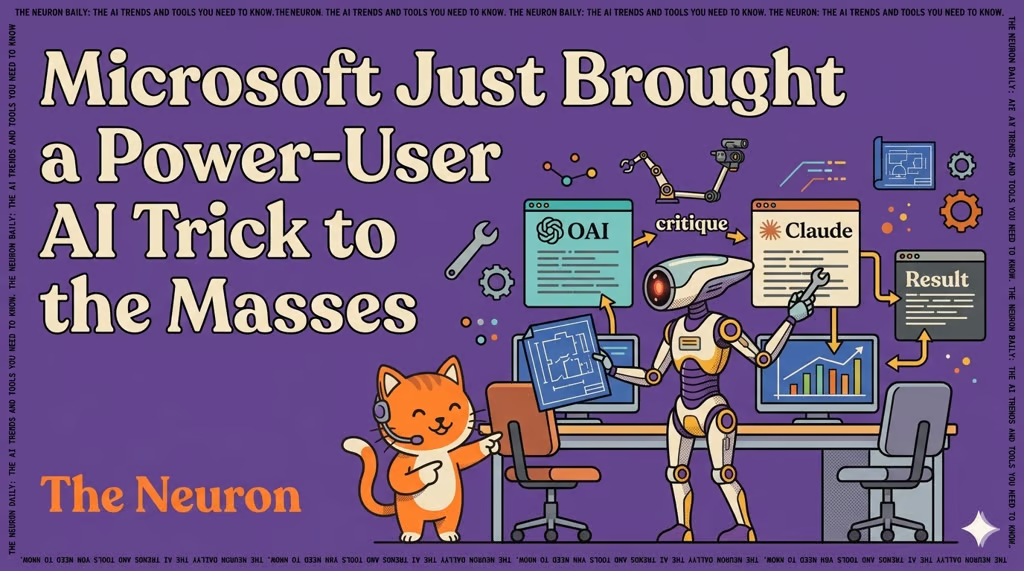
Per Microsoft’s launch post on Researcher, Council lets users compare outputs from OpenAI and Anthropic models side by side, complete with a cover note showing where the models agree, where they diverge, and what each one contributes. Critique is more sequential: one model generates and analyzes, the second model reviews, synthesizes, and sharpens the result. In the current implementation Microsoft described to The Neuron, OpenAI handles the initial content pass and Claude handles the editorial one.
In plain English: Microsoft just built “don’t trust one model blindly” right into the product.
That is a bigger unlock than it sounds.
Most people do not need more AI magic. They need better defaults. They need systems that quietly do the smart thing without requiring them to study prompting strategy on weekends. Critique and Council do exactly that. They take techniques that have mostly lived in the hands of developers and AI tinkerers and turn them into accessible product choices for novice users.
To a power user, this looks incremental. To everyone else, it is a trapdoor.
The shift from chatting to delegating
And Cowork is what turns that shift from interesting to important.
“We believe people are going to want to shift from chatting to actually delegating real work,” Gustavson said.
That line gets to the heart of what Microsoft is trying to do. Copilot is no longer being framed as a chatbot that helps you draft something and then politely steps aside. It is being framed as an AI teammate that can act: research, synthesize, create assets, send emails, coordinate meetings, and keep moving while you do something else. Microsoft’s current Cowork documentation makes the same point in product terms. Cowork can create documents, gather context across Microsoft 365, draft communications, schedule meetings, and pause for approval before sensitive actions.
In the product demo Gustavson showed The Neuron, Cowork analyzed his past communications, built a profile of how he writes, generated a markdown guide to his style, queued up a PowerPoint for a leadership meeting, and prepared to email the result to his team, all from one running task. The detail that stands out is not that AI can make a deck. It is that the system is starting to feel like a coordinated workspace for delegation.
Trust is the whole game
And Microsoft knows trust is the hinge.
“A lot of them really love seeing this because they really want to make sure that they can trust where’s the information coming from, how is the agent thinking about it,” Gustavson said of Frontier users.
That is where the design story gets interesting. For the past decade, enterprise software design was largely about building clean, structured workflows. AI blows that up. Now the question is how much reasoning, planning, and uncertainty you expose to users before the whole thing becomes overwhelming. Gustavson called this “the new design frontier,” and he is right. The winners in AI are going to bring more to the party than the smartest models. They will be the companies that best translate those models into interfaces normal people can trust.
Why Microsoft’s distribution matters more than novelty
Microsoft’s move here also says something broader about the state of competition.
The last year of AI product development has been great for consumers. Better models, faster iteration, more ambitious product ideas, and more pressure on every major player to turn raw intelligence into usable software. That pressure is now spilling out of the model layer and into the workflow layer. As we wrote in our recent explainer on building AI agents, the real unlock is systems that can actually do work.
Microsoft clearly sees that. So does OpenAI.
In ourmost recent Around the Horn digest, we covered reports that OpenAI is pushing toward a desktop “superapp” that could combine ChatGPT, Codex, and Atlas into one destination. Anthropic has been pushing from the other direction with agentic products that feel more like collaborators than chatbots.
Everybody serious is converging on the same idea: the next big AI surface is a place where models think, compare, execute, and hand work back in useful form.
Microsoft just happens to have an unfair advantage. It already owns a huge share of the workday.
That does not mean Microsoft automatically wins. Power users will always want more control. Developers will still find edges and limitations. And some of this will feel obvious to the people already living at the frontier. But that is also why the launch matters. The future always looks underwhelming to the people who arrived early.
This is how markets actually shift
For everyone else, this is different.
This is what it looks like when advanced AI workflows stop being niche techniques for the most technical users and start becoming part of default enterprise software. The breakthrough is not that Council exists. The breakthrough is that a novice user can now access a version of council, critique, and delegated execution inside the same Microsoft 365 environment they already trust and work in every single day.
That is among Microsoft’s smartest moves in AI because it closes the gap between what the edge has known for a while and what the mass market can finally use.
“We want Copilot Cowork to be sort of the center of the universe where people come to work safely and securely,” Gustavson said.
That is an ambitious goal. It also happens to be the right goal.
The companies that win this next phase of AI will be the ones that bring frontier workflows to normal people without making those people feel like they need to become developers first.
Microsoft just made a serious move in that direction.
