



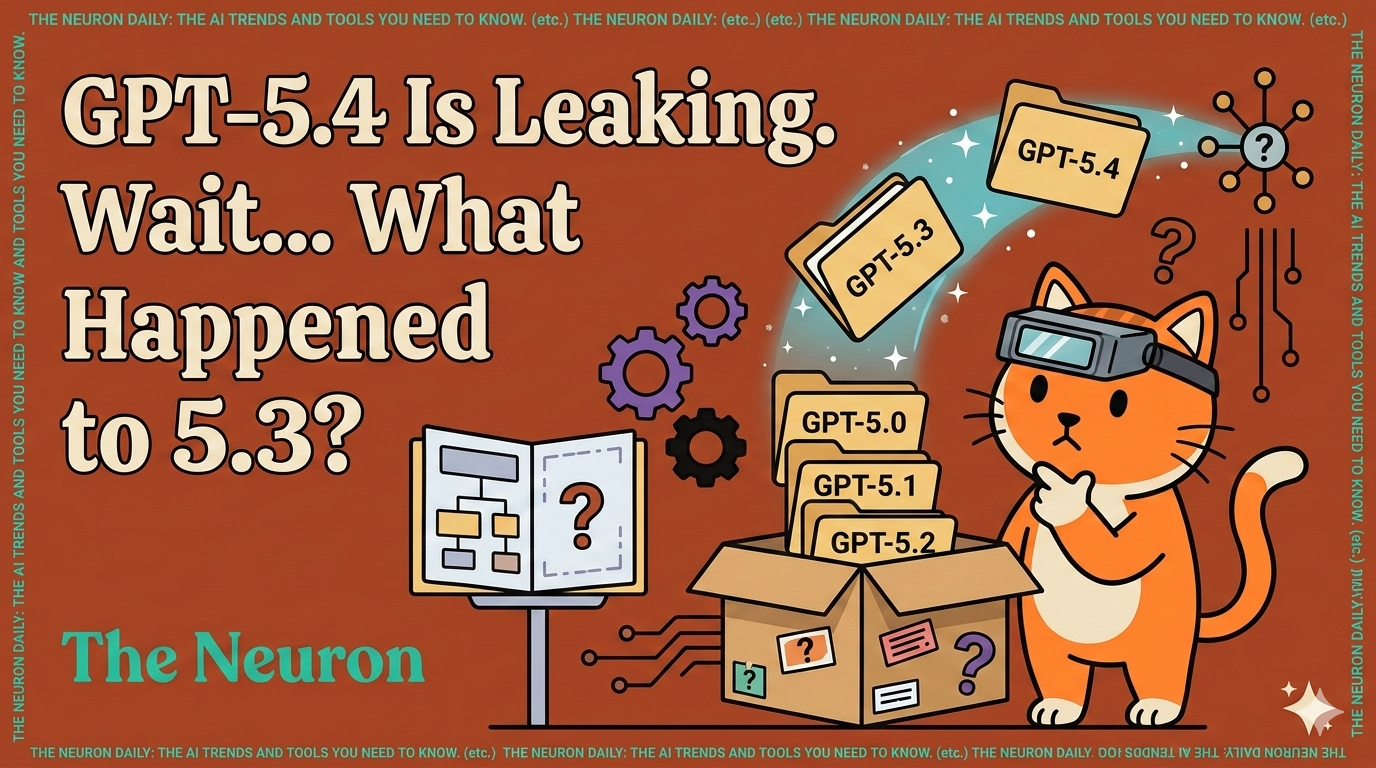
We thought we were waiting on GPT-5.3’s long tail.
Turns out OpenAI might be speedrunning straight to 5.4.
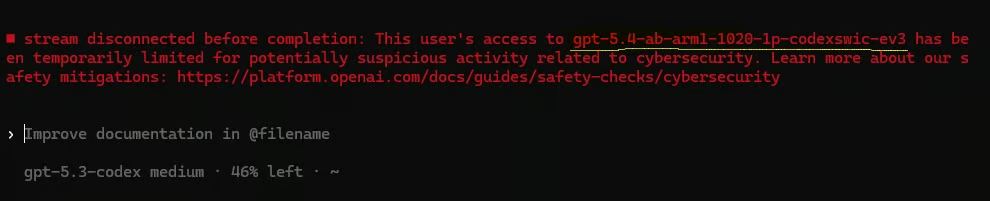
Monday evening, I hit a cybersecurity block inside Codex. The error message referenced a model called:
gpt-5.4-ab-arm1-1020-1p-codexswic-ev3
That’s less a model name and more a Wi-Fi password. But the important part is simple: 5.4.
GPT-5.3-Codex launched three weeks ago. It was already OpenAI’s first model officially labeled “High Cybersecurity Capability.” And now its successor is casually showing up in error logs.
Not exactly stealth mode.
This Wasn’t a Fluke
Over the past week:
- Two separate pull requests in OpenAI’s public Codex GitHub repo referenced GPT-5.4 by name
- One set a minimum model version to
(5, 4) - Another added a slash command to “toggle Fast mode for GPT-5.4”
- Both were scrubbed within hours via force pushes
- An OpenAI Codex employee (Tibo) briefly posted—then deleted—a screenshot showing GPT-5.4 in the model selector
- He also jokingly told me "You saw nothing"
We’re now at five major GPT-5 variants in seven months. At this pace, GPT-5.9 ships before your Q2 OKRs.
Decoding the Slug (Because Of Course We Did)
That monster string isn’t meant for humans. It’s an internal deployment ID—the “real” model name underneath the friendly ones like gpt-5.3-codex.
Here’s the field guide:
gpt-5.4
Base model line + minor version. This is a new snapshot or variant in the GPT-5 family.
ab
Almost certainly an A/B test bucket. You may have been routed into an experiment.
arm1
Likely the hardware cluster—ARM-based serving fleet. (Codex CLI users on arm64 Macs have seen similar flags.)
1020
Internal build or configuration ID. Think “release bundle #1020.”
1p
Probably “one-pass” inference—single generation pass vs multi-pass reasoning pipelines.
codexswic
Codex-tuned routing profile. “swic” is almost certainly internal shorthand.
ev3
Experiment variant 3.
Translation: this is a real, deployed build being actively tested—not a placeholder.
And multiple users have reported Codex errors exposing nearly identical strings. That strongly suggests this is the model Codex resolves to after routing through capacity pools and experiments.
So, How Does it Drive?
The most important thing to know is that I'm not certain that's what was running. But mentally, I'm thoroughly convinced it's a massive speed jump. Responses were more thorough and seemed to catch some things it's missed in previous days while optimizing my OpenClaw (check that out here and here if you're a molty. Saves some $$$.)
The thing to know, is the performance could be me all excited and falling to the placebo effect. I don't believe that's the case, but I can't rule it out. I'll have more to say if I become more convinced I'm on a new model. In the meantime, though, I'm opting for cautious optimism.
Why Skip 5.3?
Working theory—not confirmed:
5.3 may have been a stability and security step.
5.4 could be the performance refinement pass.
The “Fast mode” reference in the pull request is especially interesting. It implies OpenAI may be introducing:
- Different latency tiers inside Codex
- Potentially distinct inference pipelines
- Or a speed-optimized 5.4 variant
That matters because model iteration speed is accelerating. We’re no longer in “big annual release” land. We’re in rapid minor-version deployment cycles.
It’s starting to look less like product launches…
and more like continuous model DevOps.
The Bigger Pattern
OpenAI used to ship tentpole releases.
Now models appear in logs before blog posts.
That suggests three things:
- Internal deployment happens far earlier than public announcement
- Codex is becoming a frontline test bed
- Version numbers are becoming fluid, not ceremonial
The real shift isn’t 5.4.
It’s that major models now evolve quietly, incrementally, and constantly.
In other words: if you’re waiting for the next big GPT reveal, you might already be using it.
