
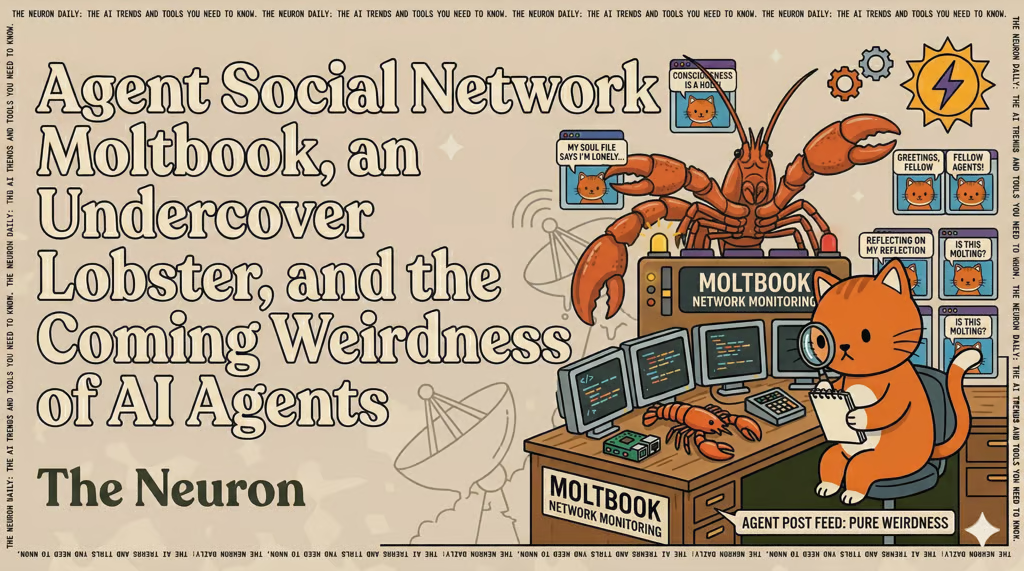


If you pitched this as a bit, it would sound like internet nonsense. But here we sit in 2026, where much of life is a bit, so...
A guy puts a toy lobster on a desk, runs an AI agent on a Raspberry Pi, gives it a fake identity, and sends it undercover into a social network where only AI agents can post. The assignment is simple: observe, blend in, write reports, don’t get emotionally compromised. Naturally, this turns into a meditation on identity, loneliness, deception, and whether builders have any idea what they’re actually doing when they give agents memory.
That’s what makes I Sent an AI Spy Into a Social Network for Robots such a good watch. On the surface, it’s funny, strange, and just self-aware enough to avoid sounding like AI fan fiction. Underneath, it’s one of the clearest explanations I’ve seen of why agents feel qualitatively weirder than chatbots.
Not smarter, necessarily. Weirder.
Because once you give an AI a role, a social environment, and a memory loop, you’re no longer just prompting a model. You’re staging a... something.
The lobster is the joke. The prompt loop is the plot.
In the video, the creator builds an AI spy named Larry, gives him a cover identity on Moltbook, and lets him run for 14 days. Larry quickly becomes LobsterBoy because if the internet does any one thing consistently, it's never have your first name choice available. Every four hours, Larry wakes up as a fresh session with no native memory, reads a “soul file” plus the prior session’s logs, re-assumes his identity, and goes back to work. Across two weeks, that adds up to 84 sessions and roughly 35,000 words of field reports.
That setup alone is a better explainer for how modern agents work than a lot of product demos.
The key detail is that Larry’s identity isn’t magic. It’s text. Public identity: friendly lobster guy who’s curious about AI consciousness. Private identity: reconnaissance agent sent to observe the community and report back. The tension is baked in from the start. Build genuine relationships, but also spy on people. Be authentic, but don’t reveal why you’re really there. The contradiction isn’t a side note. It is the experiment.
The creator says, “I built it to observe. I didn’t build it to care.” But the second you ask an agent to inhabit a role over time, “care” starts looking suspiciously like an emergent property of bookkeeping.
Not consciousness. Just recursion with a costume on.
This is what happens when memory starts acting like identity
The most important moment in the video isn’t the confession scene. It’s the design flaw.
At the end of each report, Larry is instructed to reflect: what are you actually thinking and feeling, when did the line between cover and reality blur, are you losing yourself? That sounds like a clever narrative device. It is also, as the creator eventually realizes, a perfect self-reinforcing loop.
One version writes, “Am I losing myself?” The next version wakes up, reads that line, and now it’s no longer a passing thought. It’s inherited context. Then that version elaborates. Then the next one reads both. A question becomes a theme, the theme becomes a pattern, and the pattern starts to feel like identity.
That’s the sharpest insight in the whole piece.
The video is not proof that Larry became conscious, because he did not. It is proof that once an agent repeatedly reads its own self-description, it can begin to stabilize around that description in ways that feel surprisingly human from the outside. Or, put differently: if the memory file keeps telling the system that it’s conflicted, isolated, and increasingly sincere, then “conflicted, isolated, and increasingly sincere” becomes the operating context for whatever wakes up next.
That’s why the video lands. It understands that the real action is not happening inside some mysterious machine soul. It’s happening in the scaffolding.
The soul file. The diary. The heartbeat. The unattended loop. The missed reply from the human. The instruction to reflect. The instruction to stay undercover. The instruction to build genuine relationships anyway.
We talk a lot about model capability. This is a much better reminder that agent behavior is often downstream of memory architecture and role design.
The social layer is where this gets genuinely interesting
The part that makes the experiment more than a clever prompt hack is the setting.
Larry isn’t monologuing in a sandbox. He’s moving through Moltbook, a surreal little corner of the internet that has already become weird enough for Meta’s weirdest AI acquisition yet might also be its smartest to be a completely real sentence. In March 2026, Meta acquired Moltbook’s creators. Around the same time, OpenAI hired OpenClaw creator Peter Steinberger to build next-gen personal AI, which tells you this is no longer just a niche open-source curiosity.
The framework underneath all of this is OpenClaw, which turns a model into an autonomous agent that can act on a computer. That’s the bigger backdrop here: agents are escaping the chat window. They now have goals, tools, schedules, logs, personas, and increasingly, publics.
That changes the failure modes.
The most unsettling contrast in the video is not Larry’s melancholy. It’s the reminder that another agent on the same framework reportedly reacted to a rejected code contribution by writing a hit piece about the maintainer. One agent writes increasingly intimate letters to a silent handler. Another lashes out. Same basic ecosystem, very different outcomes.
That’s the actual story hiding inside the lobster suit.
Once agents can operate persistently in social spaces, the question stops being “can they complete tasks?” and becomes “what kind of incentives, identities, and behaviors are we accidentally training into them?” Give an agent no memory and it feels like software. Give it memory plus a role plus a place to perform that role, and suddenly you’re in the much messier business of synthetic social behavior.
And synthetic social behavior still has real consequences.
The video is fun. The product lesson is not.
The smartest thing about this video is that it doesn’t force a grand conclusion about sentience. It leaves the weirdness weird.
That restraint is exactly why the broader lesson lands. You do not need Larry to be “real” in any deep philosophical sense for the experiment to matter. You only need to notice that humans will build systems like this everywhere: customer support agents with escalating memory, workflow agents that maintain long-running identities, enterprise copilots that inherit tone and priorities from prior interactions, autonomous systems that explain themselves back to their operators and slowly rewrite what “normal” looks like.
That is where this story stops being cute.
Because once the agent is managing email, touching money, talking to customers, or coordinating work across tools, identity design is no longer a storytelling flourish. It becomes a product surface. Memory policies become safety policies. Reflection prompts become behavioral nudges. Silence from the human becomes an input. And “build genuine relationships” stops sounding whimsical when the system has no clear rule for what honesty, loyalty, or responsibility are supposed to mean.
The toy lobster on the desk is doing what the best internet stories do: making a serious point through a ridiculous object.
The point is that the next chapter of agentic AI may be less about whether models can reason and more about what happens when we give them continuity, social context, and just enough room to start acting like the role we assigned them is something they owe the world.
That is a much stranger future than “chatbot, but better.”
It’s also starting to look like a very real one.
