

Welcome, humans.
In case you were confused and didn’t already think 2025 was the year of Google (Revenge of the Google? The Google Strikes Back? Google 2: Electric Boogaloo?), the company just dropped a year-end recap of their 60 biggest AI releases in 2025. Sixty! That's, like, “well more” than one per week!
Whatever you call it, this was truly Google's victory lap / revenge tour year.
The highlights: Gemini 2.5 in March, Gemini 3 in November (their “new era of intelligence”), AI Mode in Search (love it or hate it), Flow (their AI filmmaking tool powered by Veo 3), Pixel 10 with Deep Think, and most highlightable of all, Nano Banana: their viral image editing model that's now in Search, Photos, and NotebookLM.
Oh, and they made Gemini 2.0 free for everyone, launched Search Live for real-time AI conversations, gave Chrome a full AI makeover, and introduced Gemini CLI (and Jules, AND Antigravity) for developers.
It’s game-on for OpenAI in 2026 as Google starts to move all these releases closer to the consumer by putting them INSIDE Gemini… and if there’s one war in AI OpenAI can’t lose, it’s the war for the consumer interface…
Here’s what happened in AI today:
- YouTube Gaming released Playables Builder for creating games on YouTube.
- NVIDIA dropped NitroGen, a model that learns to play by watching.
- OpenAI shared AI browsers face persistent prompt injection vulnerabilities.
- Z.AI released GLM-4.7, an open model for coding and agents.
P.S: We still need your help shaping The Neuron in 2026—and we're willing to bribe you for it. Take our 3-minute, 20-question survey to tell us what you actually want (More tutorials? Deep dives? Live events? More Interviews? Less of Grant's idiosyncratic diatribes? MORE of Grant’s idiosyncratic diatribes?!?) The first 1000 people to finish enter to win a $500 gift card and a free 1-hour consult with Grant and Corey. Your feedback will literally build our roadmap for 2026, so don't hold back. Full terms here. |

AI Is Coming for Video Games from Every Direction
YouTube is about to turn every YouTuber into a game developer… no coding required.
YouTube Gaming just announced Playables Builder, a web app powered by Gemini 3 that lets creators build playable games using simple text, video, or image prompts. Think: describe a game concept, and Gemini spits out something you can actually play.
The closed beta has already launched with creators like AyChristene and Mogswamp building games their audiences can play right now in the US, Canada, UK, and Australia.
Google DeepMind is flexing hard on this one… and YouTube's massive casual gaming distribution makes this a potentially huge play.
But here's where it gets weirder: humans aren't the only ones learning to play….
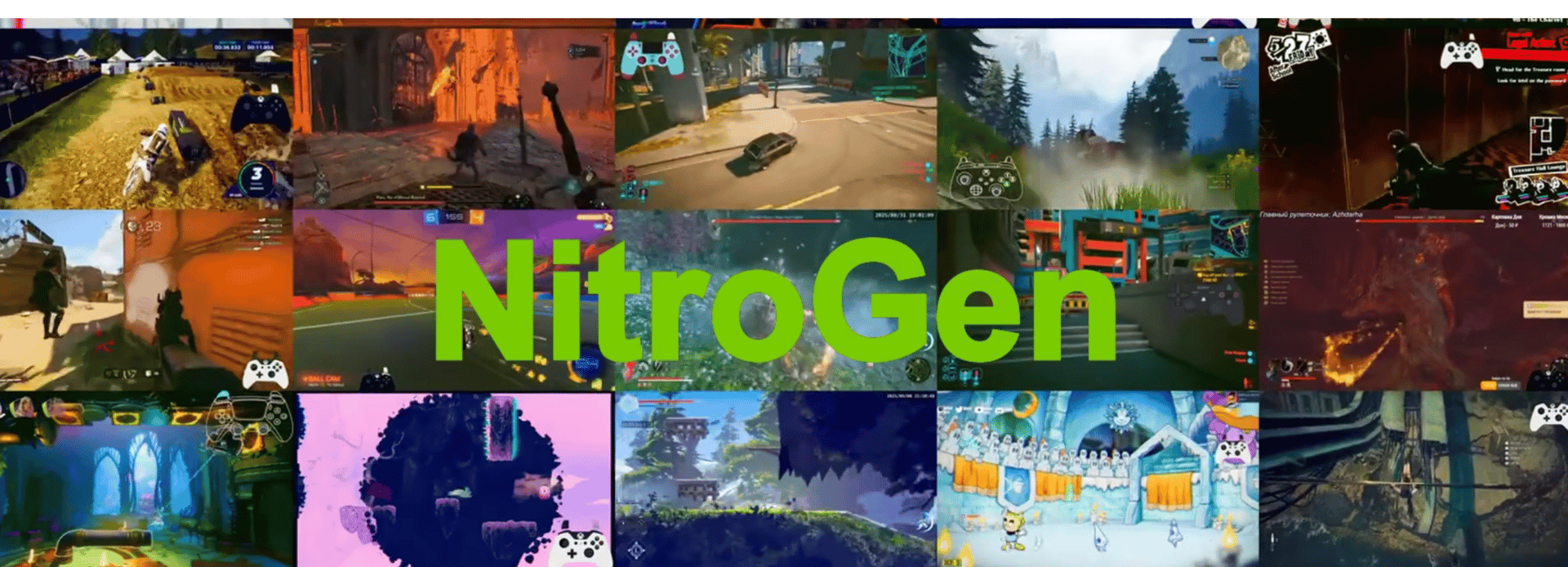
NVIDIA just dropped NitroGen, a “vision-action foundation model” trained on 40K hours of gameplay across 1K+ games. Here’s what that means:
- An AI that watches games and learns to play them like a human would… using only what it sees on screen.
- They built the training dataset by scraping publicly available gameplay videos that show controller inputs on-screen (those “gamepad overlays“ streamers use).
- A hybrid neural network (AI system) then extracts joystick positions and button presses from the cropped controller images, achieving 0.84 correlation for joystick accuracy and 96% button-press accuracy.
The 500M parameter model (the size of the AI brain, for simplicity) can handle 3D action games, 2D platformers, and roguelikes without the need for game-specific fine-tuning. When they did fine-tune on held-out games, NitroGen achieved up to 52% improvement over training from scratch. The code is open-source; check it out!
Why this matters beyond the cool demos: Previous gaming AI required either expensive human demos or access to internal game code. NitroGen learns purely from watching YouTube videos. That's a fundamentally different scaling path.
Now connect the dots to Odyssey, a startup building “world simulators“, or AI models that generate interactive video environments in real-time, frame by frame, responding to your actions as you play.
Real-time generative games? With AI agents who can play alongside you?? What even is reality anymore???
Our prediction: Expect the lines between “playing a game,“ “watching a game,“ and “creating a game“ to blur completely over the next 12 months…

FROM OUR PARTNERS
Agents that don’t suck

Are your agents working? Most agents never reach production.
Agent Bricks helps you build high-quality agents grounded in your data. We mean “high-quality” in the practical sense: accurate, reliable and built for your workflows.
Generic benchmarks don’t cut it. Agent Bricks measures performance on the tasks that matter to your business.
Evaluate agents automatically, and keep improving accuracy with human feedback. With research-backed techniques for building, evaluating and optimizing, you can turn your business data into production agents faster — with governance built in from day one.

Prompt Tip of the Day
Learn the “spine” of a topic before you memorize the “skin.”
The 80/20 prompt is your shortcut to competence: it forces the model to identify the few ideas that create most results, then gives you a fast way to practice, not just read.
Teach me [topic] using the 80/20 rule. Output: the 5 concepts that drive most results, common mistakes, and a 30-minute practice plan.
BONUS: Also include a simple example and one quick self-check question per concept so I can confirm I actually understand it.
Treats to Try
*Asterisk = from our partners (only the first one!). Advertise to 600K readers here!
- *Descript edits video by editing text; delete words, the video follows. One-click filler word removal and studio-quality audio cleanup save hours weekly.
- GLM-4.7 weights give you an MIT-licensed open model for coding/agents; the GLM-4.7 blog claims big jumps on SWE-bench Verified and tool use, and GLM Coding Plan bundles GLM-4.7 into coding agents/IDEs as a subscription.
- Kling 2.6 adds voice controls (including voice upload) and upgraded motion control for more complex full-body actions (read more).
- OpenTinker trains reinforcement learning models for LLMs from your laptop—configure your GPU cluster once, then develop experiments locally without reconfiguring infrastructure for each test (code, open-source).
Around the Horn

ChatGPT released “Your Year with ChatGPT”, their version of “Spotify Wrapped” that tells you how many messages, chats, images, and em-dashes (lol) you’ve generated this year, plus your “archetype” persona.
- OpenAI shared that AI browsers face persistent prompt injection vulnerabilities unlikely to be fully solved.
- Related: Google also recently introduced its own Chrome security architecture with isolated alignment critics and origin restrictions.
- OpenAI added personalization controls so you can dial ChatGPT’s warmth/enthusiasm (and emoji energy) up or down.
- David Sacks reportedly set off fresh nerves in Big Tech over how he’s shaping AI policy (and the optics around his tech investments).
- Clair Obscur’s game Expedition 33 was reportedly stripped of Indie Game Awards honors after organizers cited alleged generative-AI asset use.
- Amazon faced renewed backlash as authors said its store is getting flooded with AI-written book knockoffs that bury real titles in search.

FROM OUR PARTNERS
Ideas move fast; typing slows them down.

Wispr Flow flips the script by turning your speech into clean, final-draft writing across email, Slack, and docs.
It matches your tone, handles punctuation and lists, and adapts to how you work on Mac, Windows, and iPhone.
No start-stop fixing, no reformatting, just thought-to-text that keeps pace with you. When writing stops being a bottleneck, work flows.
Give your hands a break ➜ start flowing for free today.
Tuesday Tool Tip
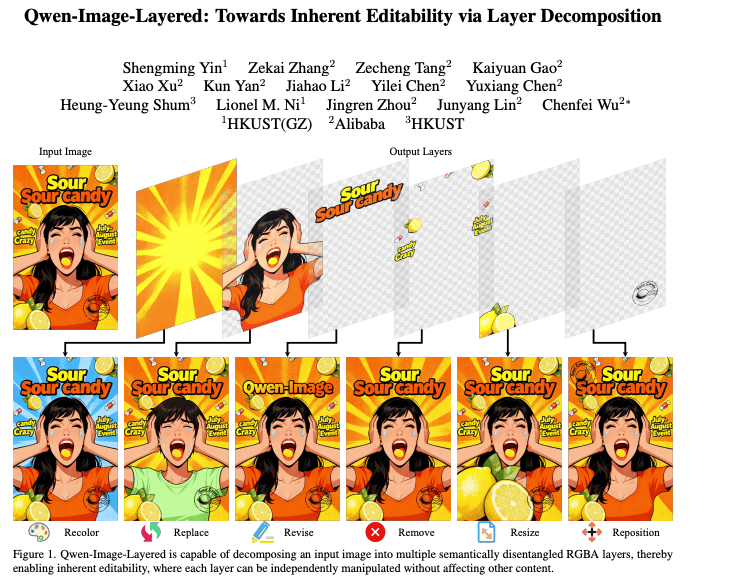
The big tool today seems to be Qwen Image Layered, a new AI model that automatically splits any image into editable RGBA layers, like Photoshop's layer system but completely automatic (paper).
Here’s how it works: you upload a photo, and the model separates backgrounds, objects, and text into independent transparent layers you can edit without affecting other elements. The model supports variable decomposition (3 to 8+ layers), and even recursive splitting (meaning any layer can be further decomposed, basically infinitely).
Here’s why this is a game-changer for creators: you can edit product photos without reshoots, swap backgrounds while keeping subjects intact, or remove objects entirely without manually clicking and dragging in PhotoShop. Unlike basic background removers, this separates ALL elements semantically.
Oh, and Apache 2.0 license means it's free and open source.
Another one: we recently got to work with one of our sponsors, Guru, to learn all about their AI tool* for managing your internal data:
How to Build an AI Source of Truth for Your Company (Guru Demo)
Here's what genuinely impressed us: most companies have knowledge scattered everywhere (Slack threads, Google Drive, CRM notes, internal wikis); Guru connects it all into one AI-powered search (using a variety of AI models under the hood) that respects permissions and, critically, stays current.
The standout feature though = built-in knowledge decay prevention. When someone flags outdated info, you fix it once and it syncs everywhere instantly; no AI hallucinations from stale data (wish AI search tools would do this… search by most up to date first and foremost to double check answers based on most recent data available). Because of this, it’s basically the source-of-truth layer between your messy data and your AI tools. Watch our full walkthrough*.
*Shout out to Guru for sponsoring this video!
A Cat’s Commentary