


Welcome, humans.
So, SoftBank said it completed an additional ~$22.5B OpenAI investment to satisfy its up‑to‑$40B commitment. That's officially one of the largest private tech investments ever (if not THE biggest). I guess that means OpenAI can finally afford to hire this mission critical role:
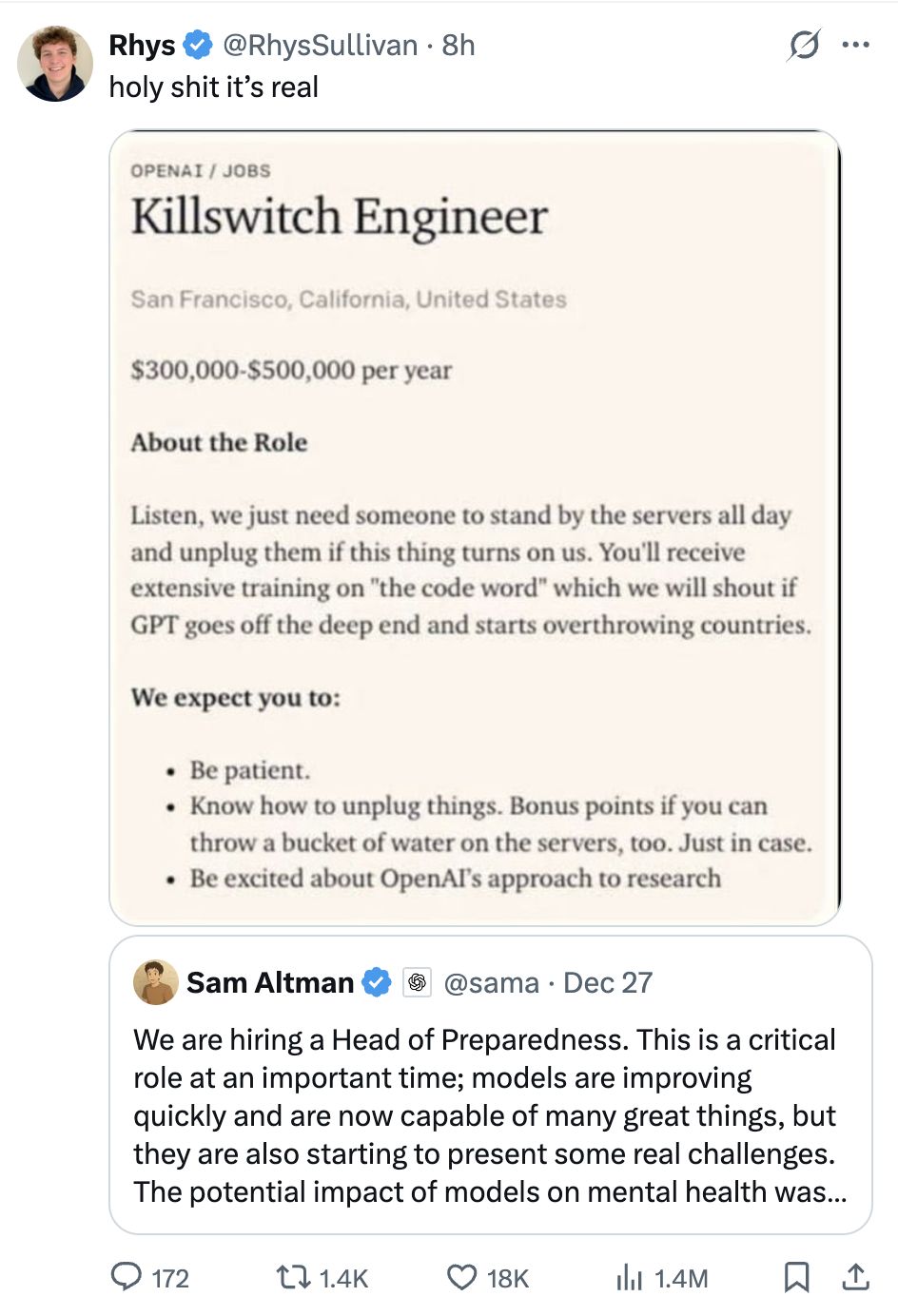
The actual job involves AI risk mitigation: assessing potential model threats before they become problems. The internet's version involves standing by servers with a bucket of water, waiting for someone to yell the code word.
To be fair, if you're spending $40B on building an AI God-in-a-box, you probably should have someone ready to unplug it.
Here’s what happened in AI today:
- Meta acquired AI agent startup Manus, which hit $125M revenue in just 8 months.
- NVIDIA and SoftBank made multi-billion dollar deals despite regulatory scrutiny.
- Silver's market cap briefly surpassed Nvidia's $4.6 trillion valuation.
- YouTube Shorts feeds are now 21% AI-generated content, study finds.
P.S: Missed an edition? Read our most recent newsletters here.

- Meta Bought Manus (one of the Fastest-Growing AI Startups Ever)… in like, ~10 Days
- Your video editor makes simple edits feel like rocket science. This one listens to plain English.
- Prompt Tip of the Day
- Treats to Try
- Around the Horn
- PowerPoint feels prehistoric. Try this instead.
- Midweek Wisdom
- A Cat’s Commentary
Meta Bought Manus (one of the Fastest-Growing AI Startups Ever)… in like, ~10 Days
So, while I was kicking back in Palm Springs over the long holiday weekend, apparently the AI industry didn’t want to take a vacay (rude), and I guess Meta just acquired Manus for over $2B.
In case you forgot, Manus is the Singapore-based AI agent startup that did something no company has ever done: hit $100M in annual recurring revenue just eight months after launch. Eight Months!
Here’s another fast fact for ya: The deal was struck in about 10 days, Bloomberg reports. That's faster than most people take to return their holiday gifts (present company included, and yes, pun VERY intended!).
Here's what Manus does: Unlike chatbots that answer questions and sound helpful, Manus's AI agents actually do things. The platform can autonomously:
- Screen job candidates by opening ZIP files, reading applications, and ranking them by custom criteria.
- Plan entire vacations including flights, hotels, and itineraries.
- Analyze stock portfolios and generate investment reports.
- Conduct market research and produce formatted documents.
- Build websites and write code without supervision.
Since launching in March 2025, Manus has processed over 147 trillion tokens and created more than 80M virtual computers. Each user gets their own cloud-hosted virtual machine that operates as a multi-agent system powered by several models working together.
And then there’s the China situation: This is where it gets interesting. Manus was founded in Beijing in 2022 by CEO Xiao Hong before relocating to Singapore mid-2025. The startup raised $75M from Benchmark at a $500M valuation back in April, with backing from Tencent, ZhenFund, and HSG (formerly Sequoia China).
Senator John Cornyn already dragged Benchmark earlier this year for investing American capital in a Chinese AI company (there’s a lot of political scrutiny on these types of deals in the US atm).
Meta's solution? Buy out every Chinese investor and shut down all China operations. Meta confirmed “there will be no continuing Chinese ownership interests in Manus AI following the transaction.” If you’ll recall, this was a big point of contention with the ByteDance / TikTok America deal.
Why this matters: Meta has committed at least $70B in 2025 capital expenditures on AI infrastructure… more than the entire Apollo program, inflation-adjusted. Yet Meta still doesn't have a paid AI subscription service to show for it (it has Vibes and Meta AI and feeds full of Meta slop, but let’s be real… y’all ain’t really using that, are you?).
So Manus solves two problems at once for Meta:
- It brings proven revenue (current run rate exceeds $125M) and a business model Meta can scale across its 3B users.
- It validates that autonomous agents, not just chatbots, represent the next phase of AI monetization.
Manus's 100-person team will report to Meta COO Javier Olivan and integrate their technology into Facebook, Instagram, WhatsApp, and Meta AI, so you can have a Manus style agent pretty much anywhere you go in the metaverse.
And as you might remember from the ancient before times of checks notes OMG ONLY June 2025?!, Meta invested $14.3B in Scale AI to acqui-hire its CEO Alexandr Wang to create “personal superintelligence.” What you might have missed is that Meta made 4 other AI acquisitions; we’ll let you click that link to speculate w/ ChatGPT on what all these other acquisitions could add up to…

FROM OUR PARTNERS
Your video editor makes simple edits feel like rocket science. This one listens to plain English.
You need to add subtitles, resize for Instagram, and clean up background noise. In traditional editors, that's three different menus, seven clicks, and a YouTube tutorial to remember which export settings to use.
Here's what's broken: video editing shouldn't require memorizing 50 buttons and workflows.
Veed lets you edit by typing commands. "Add subtitles in brand colors" → done. "Resize for TikTok" → instant. "Remove background noise" → clean audio in seconds.
The AI handles audio cleanup, subtitle generation, and platform optimization automatically. 10,000+ marketing teams cut editing time by 60% using Veed's command-based workflow.

Prompt Tip of the Day
Turn your LLM into a years-not-weeks habit coach to start 2026!
Most “fitness” chats with an LLM instantly go full calorie spreadsheet + bootcamp vibe. If what you actually want is sustainable weight/movement habits—shame-free, low-pressure, environment-first—you need to lock the model into a different job.
This prompt (from u/ZioGino71) does exactly that: it forces long-horizon systems thinking, bans short-term optimization, and makes the model ask for the right context before giving advice.
Paste the prompt in the first comment on the thread. Answer the three inputs (one at a time). Then ask: “Give me one new default to try this week, and make it stupid-easy.”
Treats to Try
*Asterisk = from our partners (only the first one!). Advertise to 600K readers here!

- *Agent Bricks: High-quality AI agents on your data. Spot-checking doesn’t scale. Build reliable agents with built-in evaluation based on your data and your goals.
- Pingo AI gets you practicing real-life conversations (travel, work, social) and gives instant feedback after each chat so you improve by speaking, not flashcards.
- Chatbase turns your docs/links into a support chat widget that answers customer questions and can trigger actions, so “Where’s my order?” can get a real reply on your site. Free to try, then $40/month.
- CosyVoice3 supports low-latency streaming TTS and zero-shot multilingual voice cloning.
- Nemotron-3 Nano is a 30B hybrid MoE (Mamba-Transformer) with ~3.5B active params and a toggle to show/hide reasoning traces.
Around the Horn
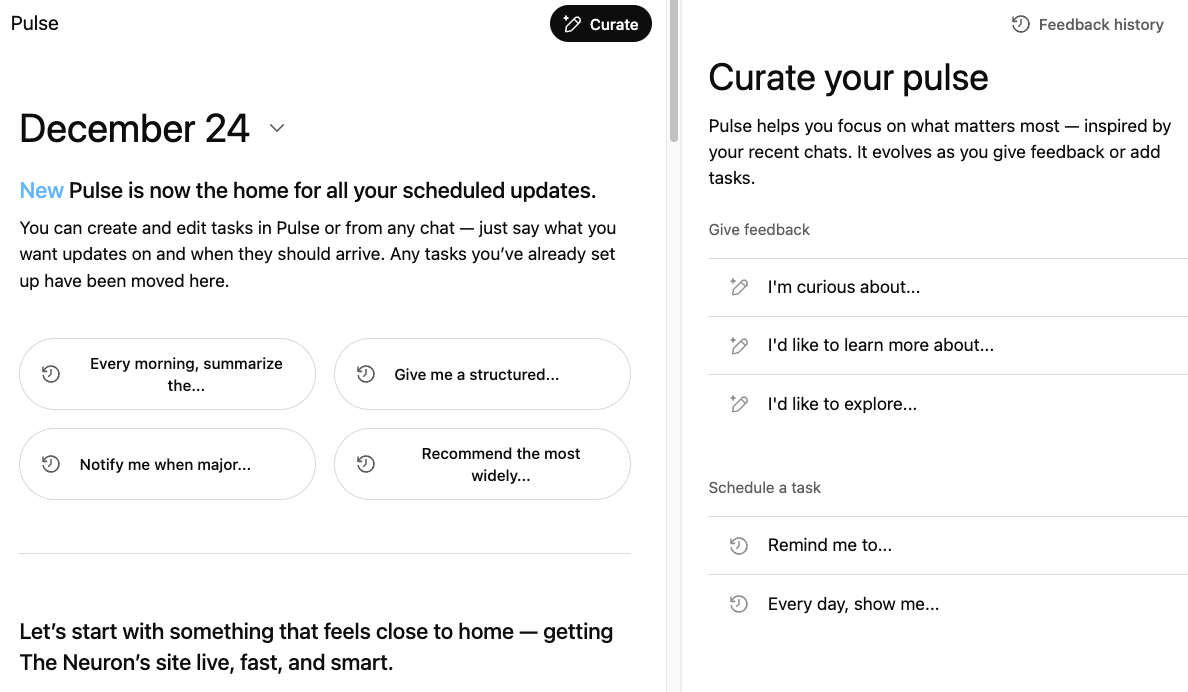
If you have access to ChatGPT Pulse, you can now “curate” your pulse to focus on what matters to you, as well as schedule tasks to do for you.
- SoftBank acquired digital infrastructure firm DigitalBridge for $4B, while NVIDIA announced a $20B licensing deal with AI chip startup Groq, with structures that critics say keep the “fiction of competition alive.”
- Silver hit $83/oz and briefly overtook NVIDIA as world's #2 asset before retreating; why? because industrial demand (solar, EVs) now consumes 50% of supply, and China's new export restrictions start on Jan 1 (and China controls 60-70% of global refined capacity), so naturally a speculative bubble ensued.
- Elon Musk's xAI bought a new building for a third Memphis data center in pursuit of the company’s goal to get 1M AI chips online ASAP.
- SK Telecom launched Korea's first 519B-parameter AI model called A.X-K1 that only activates 33 billion parameters (think of parameters as AI “neurons”) at once, making it as efficient to run as a small model while retaining the capabilities of a massive one; they’ll release the model weights as open-source on January 4, 2026, and also deploy it across 10M existing users via A-Dot.
- YouTube's recommendation algorithm now serves 21% AI-generated slop to new users, according to a new study by Kapwing.

FROM OUR PARTNERS
PowerPoint feels prehistoric. Try this instead.
Type what you want to present. Gamma's AI generates professional slides with layouts, themes, and structure in minutes—no design skills needed. Works for decks, docs, and websites. Generate your first presentation.
Midweek Wisdom
- Tired of getting random results with your AI prompts? This video reveals why “deterministic” language models such as those that power ChatGPT produce different outputs for identical prompts even at temperature 0 (temperature controls randomness).
- The TL;DW:
- When AI providers batch your prompts together with other users for efficiency, your query might be split across one core or five cores depending on how many other users are in the system simultaneously.
- Since floating-point math isn't associative (meaning the order of operations affects rounding), different core allocations create different rounding errors that alter which tokens get selected.
- So, you're basically gambling on how many strangers are asking ChatGPT questions at the same time as you rather than on any intentional randomness in the model.
- This blog post from Thinky explains this more in depth, and we wrote this article about it here.
- Bill Gurley (legendary VC investor, w/ an iconic voice I might add) told Tim Ferriss that AI represents both a genuine technology revolution and a speculative bubble simultaneously, citing economist Carlota Perez's research showing that real technology waves inherently attract speculators as a “dancing pair”, and warned retail investors about risky SPV (special purpose vehicle) investments since most VC-backed private companies go to zero, while noting institutional investors now have “zero interest” in non-AI deals and advised that the best angel investments target domain experts building AI solutions in specific industries with proprietary datasets and workflows that larger companies like OpenAI won't prioritize.
- AI legend Andrej Karpathy shared how Claude now handles most of his coding workflow for nanochat, autonomously writing implementations, debugging code, running machine learning experiments, monitoring performance logs, tracking results in tables, and even reviewing code contributions from other developers; though Karpathy remains in the loop to catch Claude's mistakes, reverse bad decisions, and pitch ideas Claude misses.
- The TL;DW:
A Cat’s Commentary

There will always be a free ad-supported version of The Neuron as long as you keep checking out our sponsors when their offers interest you!
