


Welcome, humans.
So, I’m starting to understand why Disney sent a cease-and-desist to Google last week… you can pretty much generate whatever unhinged background you can think of in Google Meet …starring Disney Characters.
How do I know? Because our video team spent the better part of our weekly meeting yesterday generating buff Disney characters dressed like Santa Clause arm wrestling each other and dying of hysterical laughter. Exhibit A:

Meet “Jacked” Skellington from Nightmare Before Christmas rolling up in my Google Meet Background
How is this possible, you ask? In Google Meet, click the video camera (Video Settings), select > Background and Effects, then > Generate Background. From there, you can type a whole lot of nonsense, and more often than not, Gemini will do it…
Idk what kinda guardrails Google Meet should or shouldn’t add to the Generate Background Feature, but as of right now, as long as you’re not requesting a real person’s likeness, Gemini can probably generate it!
JOIN US: In 6 hours (10am PST | 12pm CST), we're going LIVE with Tom Occhino, Vercel's Chief Product Officer, to get a demo of their vibe-creation tool v0 in action.
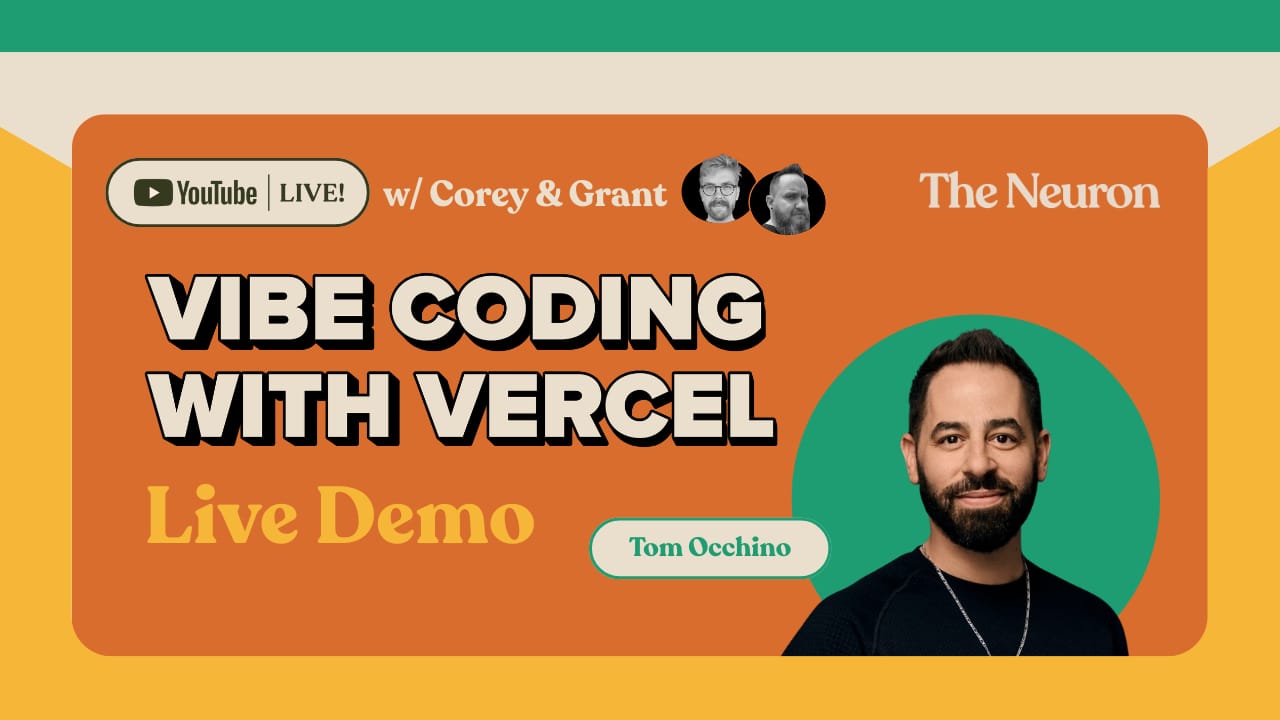
Tom will build a working app from scratch using v0, explain how AI-assisted development actually works in practice, and answer all your burning questions about how to actually deploy your own app.
And if you're already shipping code with agents, this is your chance to see what deployment looks like when you skip the infrastructure headaches. Don’t miss out!
Here’s what happened in AI today:
- Google launched Gemini 3 Flash as its cheap default fast model.
- OpenAI reportedly eyed a $750B valuation.
- xAI launched a Grok Voice Agent API for $0.05/minute.
- OpenAI launched ChatGPT app submissions for apps inside ChatGPT.
P.S: We need your help shaping The Neuron in 2026—and we're willing to bribe you for it. Take our 3-minute, 20-question survey to tell us what you actually want (more tutorials? Deep dives? Live events? Less of Grant's idiosyncratic diatribes? The first 100 people to finish enter to win a $500 gift card and a free 1-hour consult with Grant and Corey. Your feedback will literally build our roadmap for 2026, so don't hold back. Full terms here. |

- Is Gemini 3 Flash the “intelligence too cheap to meter” moment for AI?
- AI and IoT (AIoT) are converging to redefine industrial operations, enabling smarter, faster, and more autonomous decision-making.
- Prompt Tip of the Day
- Treats to Try
- Around the Horn
- Ideas move fast; typing slows them down.
- Thursday Trivia
- A Cat’s Commentary
Is Gemini 3 Flash the “intelligence too cheap to meter” moment for AI?
NEWS BRIEF: Get our full coverage of Gemini 3 Flash here.
So yesterday Google launched Gemini 3 Flash, and is now rolling it into the Gemini app and AI Mode in Search as the default “fast” brain. Why does this matter? Because it’s pretty dang cheap AND performs better than Gemini 2.5 PRO.
How cheap are we talking? Gemini 3 Flash costs $0.50 per 1M input tokens and $3 per 1M output tokens. And that’s while posting big-bench numbers like…
- 78% on SWE-bench Verified (real world software tasks).
- 90.4% on GPQA Diamond (hard science questions).
- 33.7% without tools on Humanity’s Last Exam (…a really hard exam, lol).
Why this matters: New Vanguard data showed AI-exposed wages rose 3.8% over the past two years (vs 0.7% elsewhere), because companies are paying more for workers who can work alongside cheap AI, not paying less because AI replaced them.
Meanwhile, open source is closing the gap and getting cheaper to run, which means Google's bet on “speed-per-dollar” is also a bet that the developers who learn to work with Flash-priced
Now here's the tension: if AI becomes too cheap, companies will be more tempted to replace entry-level workers instead of training them. Recently, AWS CEO Matt Garman heard business leaders say they could “replace all of our junior people” with AI, and called it “the dumbest thing I've ever heard.” His reasoning? "How's that going to work when ten years in the future you have no one that has learned anything?"
In other words: intelligence too cheap to meter only works if you still have humans who, y’know, know how to use the meter.

FROM OUR PARTNERS
AI and IoT (AIoT) are converging to redefine industrial operations, enabling smarter, faster, and more autonomous decision-making.
Recent findings from a global study explore how leading manufacturers and energy organizations are leveraging AI and IoT to drive efficiency, accelerate innovation, and enhance competitive advantage.
Industrial leaders are entering a new era where AI and IoT are no longer separate initiatives but deeply integrated pillars of operational and business ecosystems. As Operational Technology (OT) and Information Technology (IT) teams converge, these technologies are powering:
- Higher efficiency and automation
- Smarter, data-driven decisions in real time
- More agile, resilient operations across industries
Learn how this convergence is shaping the next generation of industrial transformation, and what your organization can do to stay ahead.

Prompt Tip of the Day
A recent Reddit thread said all effective prompt frameworks basically contain these 6 building blocks:
- Role: Who is the AI (e.g., “You are a finance teacher“).
- Goal: What you want (e.g., “Explain compound interest“).
- Context: Background info the AI needs.
- Constraints: Rules/limits (e.g., “No jargon, use examples“).
- Output: Format you want (e.g., “Give me 3 bullet points“).
- Verification: How to check quality.
The post itself is a bit of a mess, but one suggestion in the thread to make a framework to decide when all of these are needed was quite clever.
Before prompting, ask: What's at stake?
- Low risk (brainstorming) → Use simple structure (Role + Goal).
- Medium risk (work tasks) → Add reasoning controls (Context + Constraints).
- High risk (legal, financial, medical) → Layer in full Verification + human review
And in my own experience, I’ve found when you're frustrated with an AI output, you're usually missing one of three things:
- A specific quality threshold (“100% fidelity“ or “maximally useful“).
- Concrete structural example (“here's how to start it / do it like so: [example]“).
- Explicit verification criteria (“spell out every acronym“ or “define each term“).
Treats to Try

- Apple ML-Sharp (feature above) turns one photo into a scene you can move the camera around.
- Solo helps you build and run agents in Kubernetes, plus connect and secure all your cloud services and APIs in one platform.
- Innate makes MARS, a desktop robot you can program and control from your phone to build robotics projects at home; it includes sensors (stereo camera, LiDAR), a precision arm, and open-source software (sign up for early access on Discord).
- Bitrig turns your “build me this app” texts into a working Swift app on your phone—free to try, then $25/month.
- Tongyi DeepResearch does the googling + reading + summarizing for your hardest questions.
- Keplar interviews customers for you and hands you the “here’s what they actually want” summary (raised $3.4M).
- Gambo builds complete games for you—describe what you want (like “tennis match“ or “tank battle“), and it generates the code, art, sounds, maps, and adds monetization with ads.
- Opal landed inside the Gemini web app’s “Gems” manager, turning prompts into editable step-by-step mini-app workflows you can rearrange and share.
- Grok Voice Agent API helps you build voice agents that speak dozens of languages, call custom tools, and search real-time data across X and web (like a Tesla assistant that searches X for road trip recommendations and plans your full route with stops)—$0.05/minute.
Around the Horn
- OpenAI’s new round (in which Amazon might invest $10B) could value the company at $750B, with it aiming to raise “tens of billions” according to The Information.
- Greptile claimed AI coding tools pushed dev output up 76% in 2025 (4,450 → 7,839 lines/dev) while median PR size jumped 33% (57 → 76 lines changed), and it flagged mem0 as the top “AI memory” package at 59% share.
- OpenAI launched FrontierScience, a new benchmark for scientific research tasks, and said GPT‑5.2 scored 77% on Olympiad-style questions but only 25% on open-ended Research tasks (room to grow!).
- Amazon said AI chief Rohit Prasad is leaving, and Andy Jassy tapped longtime AWS infrastructure exec Peter DeSantis to lead a unified AI org spanning Nova models, custom silicon, and quantum computing.
- OpenAI opened submissions for ChatGPT apps, launching an in-product app directory and an Apps SDK (beta), with the first approved apps expected to roll out gradually in the new year.
- NOAA deployed a new generation of global forecast models (including AIGFS / AIGEFS) plus a hybrid ensemble (HGEFS), scheduled to go live as of Dec 17.
- China built its own prototype EUV lithography machine in a Shenzhen lab (sources said former ASML engineers helped; if you don’t know, ASML = the only company who can make the most cutting edge version of these machines), aiming for working chips by 2028… though sources told Reuters 2030 is more realistic

FROM OUR PARTNERS
Ideas move fast; typing slows them down.

Wispr Flow flips the script by turning your speech into clean, final-draft writing across email, Slack, and docs. It matches your tone, handles punctuation and lists, and adapts to how you work on Mac, Windows, and iPhone.
Give your hands a break ➜ start flowing for free today.
Thursday Trivia
One is AI, and one is real. Which is which? Vote below!
A.

B.

Which is AI, and which is real?
Which is AI, and which is real? The answer is below, but place your vote to see how your guess everyone else (no cheating now!)
A Cat’s Commentary
Trivia answer: Okay, I never do this, and I promise not to do it all the time, but they’re BOTH AI… A is ChatGPT image, and B is Nano Banana Pro (can’t share it unfortunately); same prompt: “ultra photorealistic image of a cat sitting on a windowsill in a christmas-themed room, looking like it was taken in 1975 with appropriate camera technology at the time.“
