




Welcome, humans.
Turns out, robots are really good at installing solar panels. Like, suspiciously good.
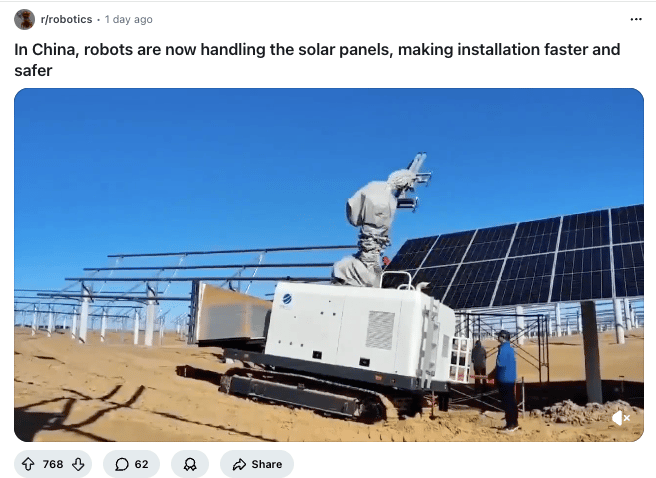
Chinese solar farms are now using robotic arms to handle panel installation—faster, safer, and without coffee breaks. Meanwhile, Japanese startup GITAI just field-tested construction robots that can deploy panels AND weld in outdoor conditions.
Here's the part that got my attention: the systems use flexible positioning to adapt to uneven terrain, meaning they don't need perfectly flat land. That's huge for scaling renewable energy in, you know, places that aren't parking lots.
The Reddit robotics community is torn between “this is extremely practical“ and “wait, these are the same robots we said would never work outdoors three years ago.“ Progress moves fast when there's a $500B solar market at stake!
Here’s what happened in AI today:
- OpenAI launched ChatGPT group chats for up to 20 people across all plan tiers.
- TSMC accelerated overseas chipmaking to reduce Taiwan invasion risk.
- OpenAI won't reach profitability until 2029 as platform losses mount.
- Everbloom deployed AI to convert waste fibers into new fabrics
Don’t forget: Check out our podcast, The Neuron: AI Explained on Spotify, Apple Podcasts, and YouTube — new episodes air every week on Tuesdays after 2pm PST!
P.S: We still need your help shaping The Neuron in 2026—and we're willing to bribe you for it. Take our 3-minute, 20-question survey to tell us what you actually want (More tutorials? Deep dives? Live events? More Interviews? Less of Grant's idiosyncratic diatribes? MORE of Grant’s idiosyncratic diatribes?!?) The first 1000 people to finish enter to win a $500 gift card and a free 1-hour consult with Grant and Corey. Your feedback will literally build our roadmap for 2026, so don't hold back. Full terms here. |

ChatGPT Group Chats Are Here… Here’s What We Think
OpenAI recently rolled out group chats globally after a week-long pilot in four countries. Up to 20 people can now collaborate with ChatGPT in shared conversations across all plan tiers: Free, Go, Plus, and Pro.
The feature works like you'd expect:
- Tap the people icon, share an invite link, and everyone can chat together with ChatGPT jumping in when needed.
- You can @ mention it for responses, set custom instructions for tone, and ChatGPT even reacts with emojis.
- Privacy-first design means your personal memory stays separate from group chats.
Early feedback from pilot markets shows strong adoption for specific use cases like research teams and trip planning, but questions remain about scaling beyond small groups.
Our Experience: We tested it out on one of our lives the other day, and had a about 6 of us chatting at one point. Samuel joined from Nairobi, Corey was in St. Louis, and ChatGPT calculated we were 8,150 miles apart in the chat; then we had it tell us it would take a triathlete 23 days nonstop to cover that distance.
I didn't really get the appeal at first. ChatGPT wouldn't shut up unless we explicitly @ mentioned it, which got annoying. But goofing off with friends while an intelligent AI bot chimed in? That was genuinely fun; like having a smart Discord bot or Reddit reply bot you can summon on command.
The problem? The ultimate form factor for this isn't ChatGPT… it's iMessage, where I'm already texting my friends. OpenAI needs to figure out how to get ChatGPT into my existing messaging apps, not ask me to move my entire social life into their app.
Here's why this matters: The Information recently reported that OpenAI leaders are concerned the average user won't see much difference between ChatGPT and Gemini.
More importantly, they noted that chatbots fundamentally lack the network effects that made Facebook and Instagram sticky, as those apps got better as more people joined; you can think of it as FB and IG being multiplayer games, while GPT is mostly single player… until NOW… ish.
See, OpenAI's tried building network effects before:
- Remember the GPT store? IMO it never really panned out, and now GPTs in general feel mostly deprecated with connectors and skills.
- Sora hit 1M downloads faster than ChatGPT, and it's since found a loyal yet niche following… but unless I missed it, nowhere near mass adoption.
- The new Apps marketplace just launched, and remains to be seen whether it’ll create the stickiness OpenAI needs.
IMO, the actual network effects in AI come from Projects (Claude's killer feature, which GPT also has) and Memories (ChatGPT's killer feature, which Claude also has).
Personally, I keep going back to Claude because that's where my projects with all my daily tasks live: it's my hub. For me, ChatGPT and Gemini are better for one-off questions and tasks, but Claude owns my workflow because of Projects. Other people feel the same way about ChatGPT Memories. Thanks for the memories, sorry that they’re stuck in GPT!
So really, what would it take to build real network effects into AI assistants? Here are a few ideas:
- iMessage integration: Turn ChatGPT into a bot you can call in your existing group chats, not a separate app.
- AI-first marketplace?: Imagine a Facebook Marketplace competitor where your AI agent finds items others are selling based on your preferences.
- YouTube-style playable features: YouTube recently added playable games. What if ChatGPT had persistent, multiplayer experiences you could only access through the platform? That’s something I’d group chat about.
- OpenAI's rumored hardware device: A physical device that makes ChatGPT your default interface could create lock-in, especially if there’s a multiplayer component (new communication interface to chat w/ friends?)
- Collaborative workspaces that persist: What if ChatGPT hosted persistent team workspaces that accumulated shared knowledge over time? Right now, I’d settle for a Canvas file that doesn’t get context constrained…
Why this matters: AI companies are realizing chatbots alone won't create defensible moats. The winner won't be the smartest model; it'll be whoever figures out how to embed AI into either A) the workflows and social networks we can't quit, or B) new workflows that are even better than previous ones.

FROM OUR PARTNERS
Your last video edit took 4 hours. This one will take 4 minutes.
You recorded the perfect take. Then you said “um“ 47 times, lost eye contact reading your notes, and the audio sounds like you're calling from inside a tin can.
Here's the problem: traditional video editors make you hunt through timelines finding every filler word. That's 3-4 hours of tedious clicking for a 20-minute video.
Descript flips everything. Upload your video, and AI transcribes it instantly. Delete words from the transcript, and the video edits itself. Type “remove all ums“ and they vanish. One click cleans your audio to studio quality. Another fixes your eye contact.
100+ sales teams already save 15+ hours weekly on video editing.
Edit your first video in minutes →

Prompt Tip of the Day
Get an editor and a rewrite without losing your voice.
Most “rewrite this” prompts accidentally swap your intent for the model’s. This one prevents that by forcing a diagnosis first (what’s wrong and why), then a fix, plus a few stylistic options so you can choose the version that fits the moment.
The “Critique and Upgrade My Draft” Prompt

Improve this without changing my intent.
List the top 5 issues (clarity, structure, missing info, tone).
Rewrite it.
Provide 3 alternatives: shorter, more direct, more friendly.
Draft: [paste]
BONUS: After the rewrite, give me a 1-sentence subject line (if relevant) and highlight any sentences you changed the most, with a quick reason.
Treats to Try
*Asterisk = from our partners (only the first one!). Advertise to 600K readers here!
- TwelveLabs turns your video library into something you can search and summarize in plain English (e.g., “find every clip where the CEO mentions pricing”) (raised $30M) —free to try, then usage-based.
- Koah lets you plug contextual ads directly into your chat app so you can monetize conversations without forcing subscriptions.
- Higgsfield helps you generate short cinematic videos and ads without editing everything by hand.
- Devin acts like a software teammate that can take a ticket, write the code, run tests, and open the PR for you.
- Windsurf is a code editor where you ask for a change in plain English and it applies the edits inline while you preview what you’re building.
- NotebookLM Reports turns your uploaded sources into structured outputs like a study guide, glossary, or blog-style writeup so you can go from “pile of PDFs” to “shareable doc” fast —free to try.
- Agent Skills is a repo of installable “skill packs” Claude loads dynamically (instructions + scripts + resources).
- Agent Skills docs shows how to package reusable skill folders that Claude loads progressively on demand.
- claude-mem captures what Claude Code did in your session, compresses it, and injects relevant context into future sessions so it stops forgetting.
- Foundations of LLMs is a monthly-updated, paper-linked textbook repo that covers the practical core (prompting, PEFT, editing, RAG) plus how architectures evolved.
Around the Horn
- TSMC sped up advanced chipmaking overseas to reduce global exposure to a Taiwan invasion scenario.
- Everbloom used an AI model to tune machines/chemistry that turn waste fibers into new fabrics.
- OpenAI’s platform bet is a race between distribution and economics (losses for years; profitability not expected before 2029; enormous infra commitments).

FROM OUR PARTNERS
Agents that don’t suck

Getting agents to production takes accuracy, reliability and your unique data. Agent Bricks helps you build powerful agents grounded in your data and proven to work. It evaluates agents automatically with metrics tailored to your goals. With continuous self-learning and human feedback, agents keep learning and quality keeps improving.
Intelligent Insights
- Transformer economics argued transformers weaken (but don’t erase) the Lucas Critique by generalizing across nearby policy regimes better than reduced-form regressions—while still missing key causal dynamics when shocks propagate.
- Prompt caching argued KV reuse is the real trick: once a prefix is cached, models skip recomputing attention for it—cutting cost and time-to-first-token on repeated long prompts.
- Off-policy RL mismatch argued inference/training backend mismatch turns “on-policy” LLM RL into biased off-policy updates, and proposed token-level truncated importance sampling (TIS) as a systems-level patch.
- Limit of RLVR argued 0/1-reward RLVR mostly squeezes more correct samples out of a base model rather than expanding its reasoning boundary—so the next breakthroughs likely need richer rewards and stronger exploration.
- AI consciousness argued we may never be able to test AI consciousness (so agnosticism is rational) and warned the ethically relevant line is sentience—while “conscious AI” talk can become marketing.
- Democrats’ divide argued AI is becoming a 2028 wedge issue inside the party, pitting innovation-first messaging against labor-first regulation as automation anxiety rises.
- Excel AI-proof argued Excel’s ecosystem moats + math reliability keep it sticky—so Microsoft is embedding models into Excel and making spreadsheets the substrate for agents.
- Google + Replit argued the hard part of agents is reliability and integration (not intelligence): messy data and deterministic workflows don’t mix with probabilistic systems.
A Cat’s Commentary

