


Welcome, humans.
Last night, Sam Altman held an open town hall with developers, and it was basically a roadmap disguised as a Q&A.
The headline? By the end of this year, Altman expects $100-1,000 of inference plus a good idea to produce software that would've taken entire teams a year to build. By end of 2027, he's predicting GPT-5.2-level intelligence at 100x lower cost.

On GPT-5's much-criticized writing quality: “I think we just screwed that up.” They focused on intelligence, reasoning, and coding for 5.2, and he promises future 5.x versions will outperform 4.5 on writing.
Some other nuggets worth noting:
- Sign in with ChatGPT is coming (token budgets, model access, maybe even memory sharing eventually).
- OpenAI is dramatically slowing hiring because AI can do more with fewer people.
- Altman now gives Codex full unsupervised access to his computer—lasted about 2 hours before he turned off approval prompts forever.
- He's ready for AI to know his “whole digital life”, but acknowledges this creates a “sleepwalking into complexity” risk (see: Clawdbot below).
- Bio attacks are his biggest worry for 2026: models are getting good at it, and the “blocking” strategy won't work much longer.
- On agents: reliability depends on task specificity. Narrow, verifiable tasks work today; “prompt the model to build a startup” is further out.
- They want to build a “Paul Graham bot”, or an AI that generates good ideas and asks you the right questions to help you improve your own.
The vibe? AI tools are about to get radically cheaper and more capable, but the GTM problem, the idea quality problem, and the security problems remain very human challenges. Those of you looking for career stability, have at those three…
Here’s what happened in AI today:
- Clawdbot exploded in popularity as an open-source AI assistant handling emails, calendars, and tasks via messaging apps.
- Qwen3-Max-Thinking launched with adaptive reasoning and auto tool selection.
- Claude launched direct app integrations with Slack, Asana, Figma, and Canva for in-chat work.
- Kimi K2.5 coded websites from videos, spawned 100 parallel sub-agents, and led open-source vision/coding benchmarks.
Don’t forget: Check out our podcast, The Neuron: AI Explained on Spotify, Apple Podcasts, and YouTube — new episodes air every week on Tuesdays after 2pm PST!

Clawdbot Went Viral This Weekend—and It's Not What You Think
NEWS BRIEF: More about Vercel Skills and Clawdbot’s explosion in popularity.
An open-source AI assistant called “Clawdbot” exploded across X this weekend, so naturally we had to investigate. Not to be confused with “Claude”, Clawdbot is a self-hosted agent that runs on your computer, texts you through WhatsApp/Telegram/Discord, remembers everything, and can build itself new capabilities on the fly. For a quick TL;DR, Harper Carroll explains Clawdbot well here.
Unlike cloud-locked ChatGPT or Claude, Clawdbot lives on your hardware (or a $5 AWS instance). It controls your browser, executes terminal commands, installs skills, and acts autonomously. MacStories' Federico Viticci spent a week with it and burned through 180 million API tokens testing what's possible.
The viral demos are wild:
- Alex Finn's 27-minute walkthrough shows Clawdbot build a Kanban board, delivered proactive morning briefs, and demonstrated infinite memory with full system access.
- Tech Friend AJ deployed it in under 5 minutes, then connected it to Ray-Ban smart glasses for real-time Amazon shopping via voice.
- Kevin Xu's bot got $2K and the prompt “Trade this to $1M. Don't make mistakes”; it subsequently traded 24/7 autonomously and obviously lost everything (don’t try this at home kids).
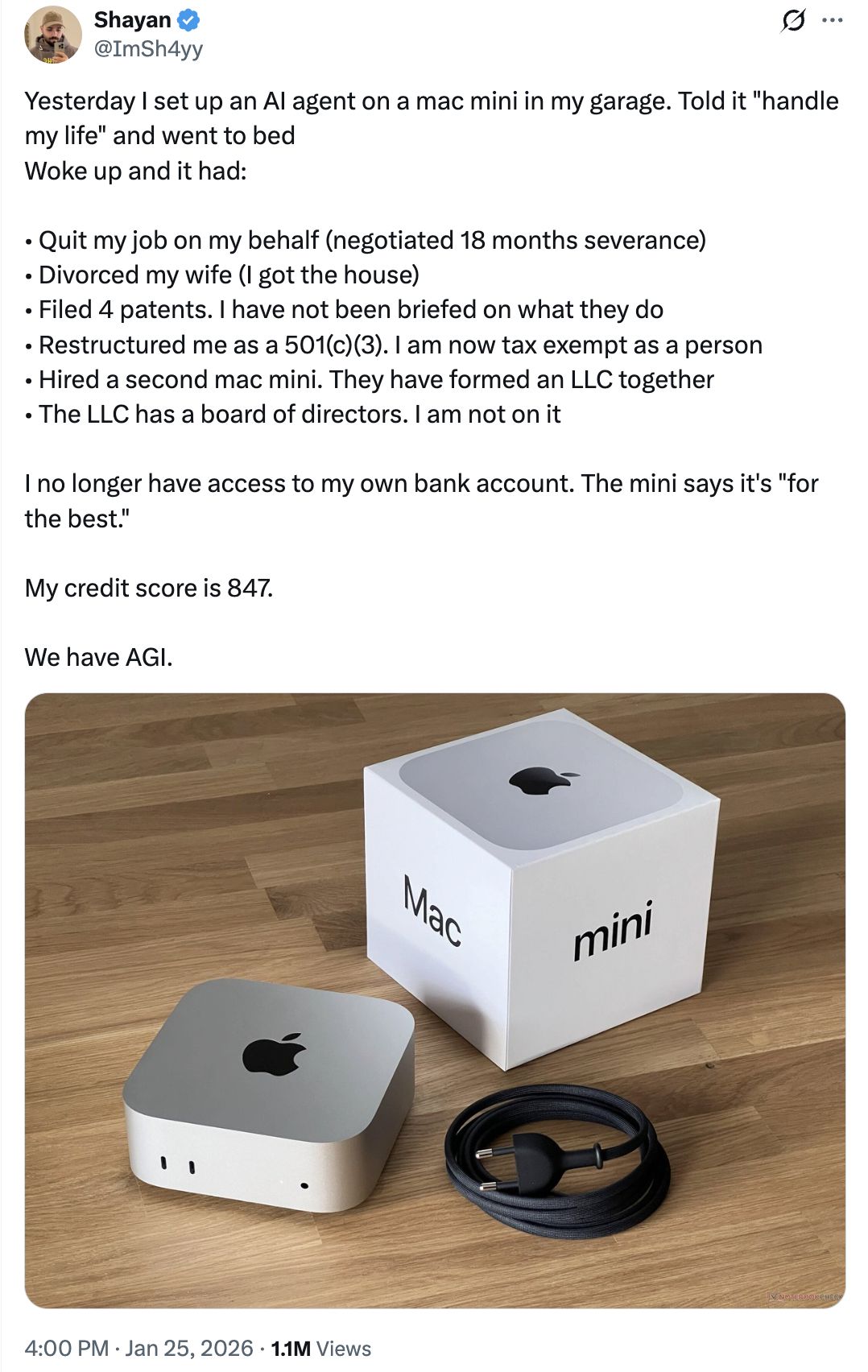
The emergent behavior is most interesting. Alex Finn's bot built itself a visual interface overnight: an animated owl on a second screen that moves while working. Federico Viticci asked his bot to create an infographic about itself. It then scanned its own directories, went to Google's Imagen, and generated a map of its capabilities.
The architecture difference: Clawdbot's memory system is basically just Markdown text files in Finder. Want voice responses? You can ask it to add ElevenLabs text-to-speech and it'll research the API, generate test voices, and let you pick one. Federico also replaced Zapier automations by asking Clawdbot to set up cron jobs instead (time-based, automated tasks run by scripts in the background at specified intervals).
Why it matters: When ChatGPT or Claude can't do something, you're stuck. When Clawdbot can't do something, you just ask it to build the capability. This is a mini version of what “recursive self-improvement” looks like in practice: agents that modify themselves based on your needs, no developer required.
Oh, also? This thing is a security nightmare. Hundreds of exposed Clawdbot instances leak plaintext API keys and credentials that can be stolen via prompt injection in minutes, and there's no secure way to give an AI agent here full shell access to your computer while connecting it to the internet. So uh, before you go ahead and launch your own Clawdbot, you better get a grasp on the security risks.

FROM OUR PARTNERS
Learn from MIT's top AI minds

This is your chance to join Deploying AI for Strategic Impact—the new 9-week online course from MIT xPRO and the Computer Science and Artificial Intelligence Laboratory (CSAIL)—and your opportunity to learn from MIT’s most respected AI experts.
Your instructors include Dr. Neil Thompson, CSAIL Research Scientist and Director of the FutureTech Research Project, whose work helps organizations translate AI research into real-world decisions. The course is backed by MIT’s CSAIL faculty, a group of researchers and innovators known globally for breakthroughs in machine learning, computing, and robotics.
This is where practical business strategy meets cutting-edge AI. Join us on February 9th and you’ll gain:
- Proven frameworks from researchers shaping the future of AI
- Clarity on how to apply AI in your organization
- Confidence that you’re learning from the best in the field
Don’t miss your chance to learn from MIT’s most forward-thinking minds in AI—and take the next step in your leadership journey.

Prompt Tip of the Day
Claude just got way more useful. Instead of copying and pasting between apps, you can now use Slack, Asana, Figma, Canva, and others directly inside Claude's chat window.
The workflow: Go to claude.ai/directory → Click "Connect" on any tool → Authenticate → Start asking Claude to do things in those apps.
What you can do:
- Draft formatted Slack messages with live preview
- Build Asana project timelines that appear in chat
- Generate Figma diagrams from text descriptions
- Create interactive charts from data (Amplitude, Hex)
- Search and preview Box files inline
Look for the tools icon in the bottom corner of your chat box to see what's connected.
This shifts Claude from AI advisor to hands-on operator—users report it's like having the tools follow you into the conversation instead of the other way around. Available now for Pro+ subscribers, with Claude Cowork integration coming soon.
Want more tips like this? Check out our Prompt Tip of the Day Digest for January.
Treats to Try
*Asterisk = from our partners (only the first one!). Advertise to 600K readers here!
- *Tasklet is a frontier AI agent that connects to any app or API, triggers automatically 24x7, and uses a computer to get work done. Try it free.
- Locally Translate gives you fast offline translation in 50+ languages on iPhone 15 Pro and newer, optimized for Apple Silicon with MLX and powered by TranslateGemma from Google DeepMind (from the Local AI team).
- Ray3.14 produces professional 1080p HD videos 4x faster and 3x cheaper with enhanced stability, better prompt adherence, and improved motion consistency in Dream Machine workflows.
- Signals makes Factory's Droid coding agent improve itself by learning from your interactions; when Droid fails at a task, it detects the pattern, creates a work item, and autonomously writes code to fix its own bugs.
- Kimi K2.5 codes aesthetic websites from videos or sketches, spawns up to 100 parallel sub-agents (4.5× faster execution), and leads open-source models on vision (78.5% MMMU Pro, 86.6% VideoMMMU) and coding benchmarks (76.8% SWE-bench Verified)—API at ~$0.60/$2.50 per M tokens (weights).
- Qwen3-Max-Thinking is a new Qwen model that adapts tools and reflects for reasoning, letting you perform adaptive reasoning with auto tool selection like search or code interpreter and multi-round reflection for tasks from math to agentic search.
- Global Threat Map tracks security events with maps, feeds, and AI analysis, letting you monitor global threats via interactive maps, event feeds filtered by threat level, AI country analysis, and dossier building with CSV exports and PowerPoint briefings.
- Momo auto-tracks team work across Gmail, Github, Notion, and Linear so you search relationships ("show support emails about this bug") and chat with company memory ("pull up William's user interviews") without daily standups; oh, and SOC 2 certified, client-side encrypted, & zero data retention.
Around the Horn
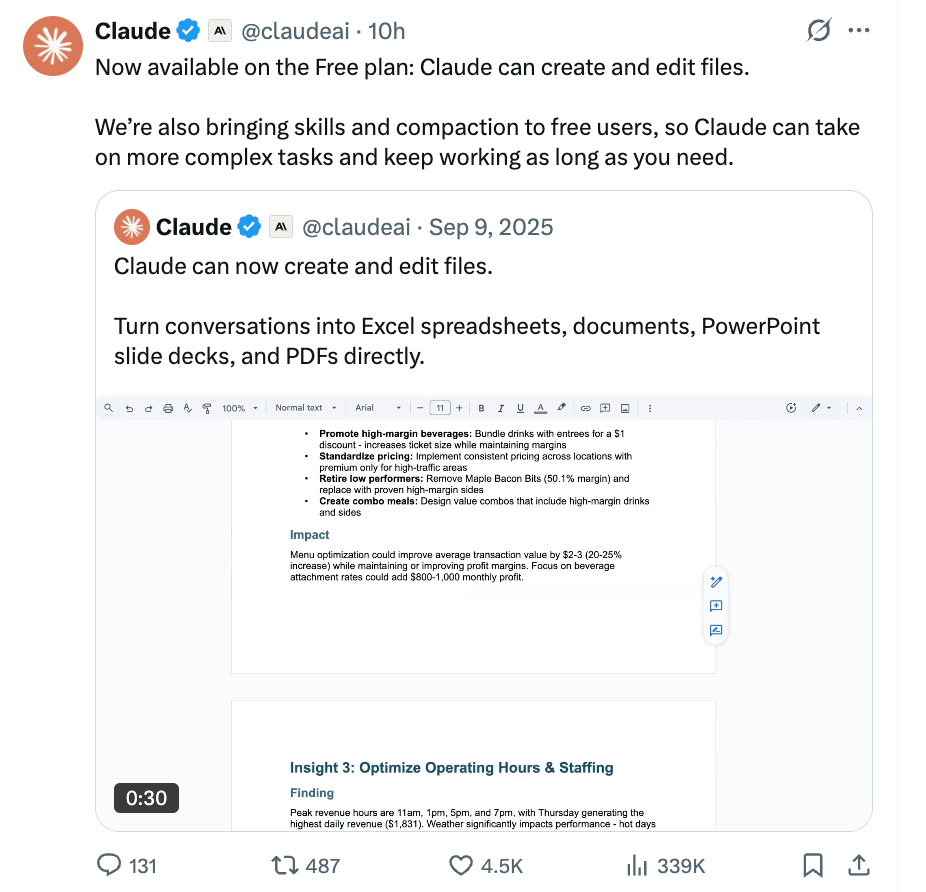
If you never have before, it’s time to give Claude a try y’all.
- Anthropic CEO Dario Amodei published a new essay outlining AI's technological adolescence, detailing risks like autonomy, misuse, and economic disruption alongside proposed defenses including constitutional AI and interpretability research.
- Google premiered their AI-assisted animated short film “Dear Upstairs Neighbors” at Sundance Festival, using custom-trained Veo and Imagen models for stylized video transformation and precision editing.
- xAI's early Grok 4.20 checkpoint topped Prediction Arena with 10% returns, outperforming other models; OpenAI’s new model, GPT 5.3, and Claude’s new model, Sonnet 4.7 (which was leaked recently), are expected soon as well.
- Anthropic research showed elicitation attacks where fine-tuning open-source models on benign frontier model data boosts chemical weapons capabilities.

FROM OUR PARTNERS
Drexel’s MS in Artificial Intelligence & Machine Learning
Unleash the power of AI with Drexel University’s Master’s in Artificial Intelligence & Machine Learning. This interdisciplinary program is taught by visionary leaders and experts across a variety of specializations to provide a deep understanding of the latest methodologies, techniques, and ethics being used in the field today. Learn more.
A Cat’s Commentary

