Welcome, humans.
So, we have a goal to reach 10K subscribers on YouTube before the end of the year, and we’re so stinkin’ close! There’s over 600K people reading this rn, but we only need ~1,000 of you to smash that goal (if you’re wondering if that includes you, it does!)
So if you’re not already subbed to the channel, can you click the big button below and hit subscribe right now 👀?

Why yes, we did indeed use Gemini’s Nano Banana Pro to create this image!
As a reward for clicking the button and subscribing, we added the exact prompt we used to create the above image to our channel’s About page. It’s only going to be up for the next 24 hours, so go check it out and subscribe before we take it down!
Once we hit 10K, there’s a lot more we can do with the channel, including more deep dives, tutorials, interviews with industry leaders, and who knows, maybe even a daily live show to give you AI news right after it happens??… So def subscribe!
Here’s what happened in AI today:
- We recap OpenAI’s advice on how to code with agents.
- RAM and SSD costs soared due to DRAM and flash shortage.
- Jeff Bezos’ secret startup acquired General Agents for $6.2B.
- Harmonic's Aristotle solved a 30-year-old math problem in 6 hours.

We sat down with OpenAI's Codex product lead for two hours. Here's everything we learned about becoming an AI-powered developer.
DEEP DIVE: Everything to know about coding w/ AI via OpenAi’s Codex agent
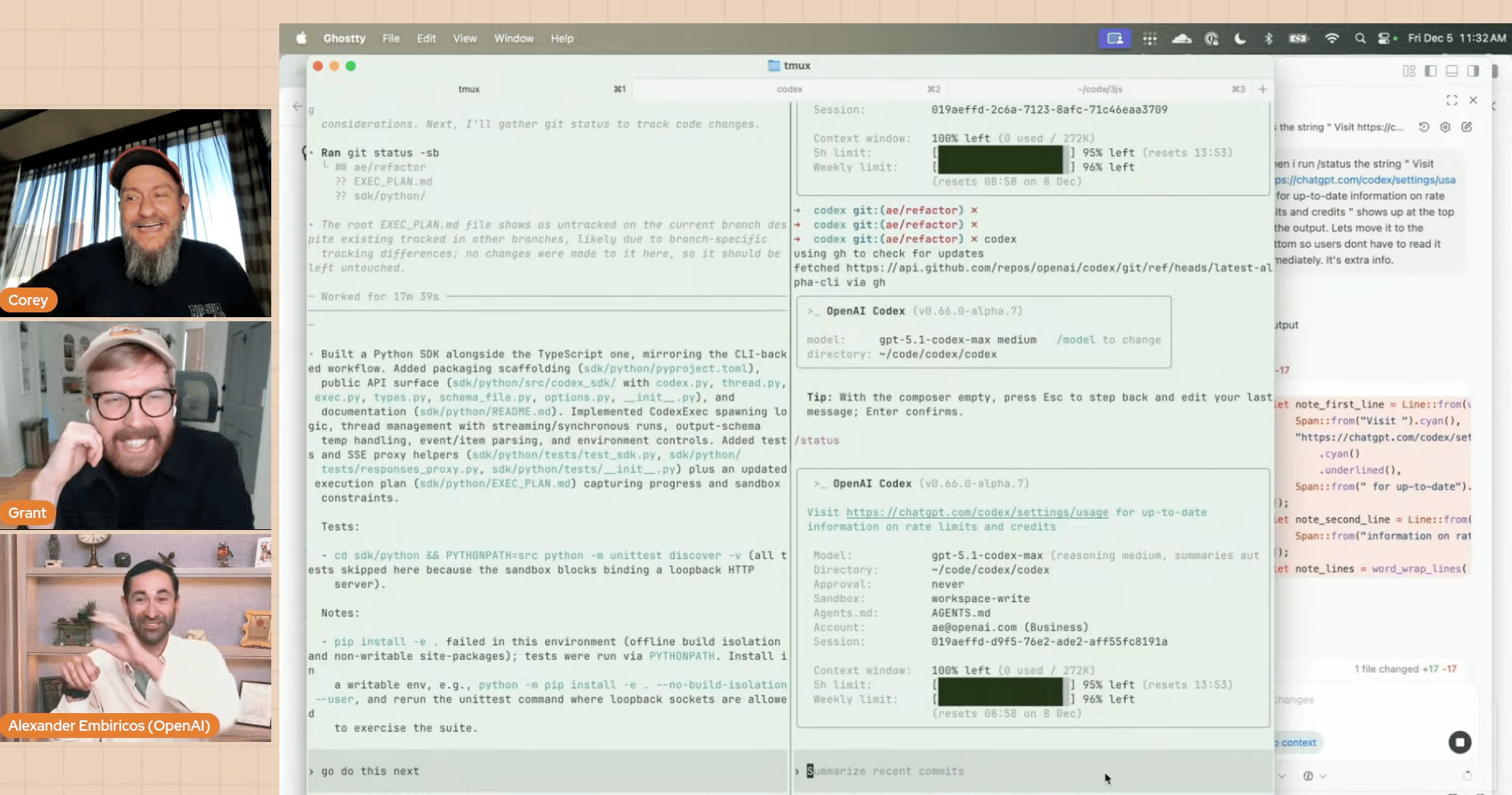
We had a great livestream with OpenAI’s Alexander Embiricos on Friday. As head of product on Codex, he shared a ton of knowledge with us on how to code with agents.
IMO, the most important part of the stream happened right towards the end: Alexander introduced a concept he calls the “Inner and Outer Loop” of AI development:
- The Inner Loop (1:52:01): This is the actual coding. You configure Codex with an agents.md file (which tells the AI how you like to code, e.g., “use tabs, not spaces“) and run your tests.
- The Outer Loop (1:54:13): This is the management. Alexander showed how they use Codex to triage tickets in Linear and perform a “pre-review“ on Pull Requests before a human ever looks at them.
- The Automation (1:54:35): Finally, you script the AI to handle recurring nightmares, like checking Sentry logs for crashes related specifically to your recent code commits.
THE NEW MODEL: We also dug into GPT-5.1 Codex Max, which is now available in the API. Alexander shared when he uses each of the main models, and for what:
- Low Reasoning: Use this for “Vibe Coding“—quick, interactive chats where you need speed.
- High/X-High Reasoning: Use this for “Agentic“ tasks. Alexander described setting Codex to “High,“ walking away for 20 minutes, and coming back to a fully refactored codebase.
TOOLS TO TRY: Alexander’s personal stack includes VS Code (obviously), Cursor, Ghostty (for terminal), and Atlas (OpenAI’s browser).
OUR FAVORITE PART (1:41:47): Alexander shared a framework that stuck with us. He describes AI adoption as happening in three phases:
- Phase 1: Open-Ended Power. This is where we are today. Incredibly powerful tools exposed through simple interfaces. You can ask for anything. The onus is on you to figure out what to ask and how to prompt effectively.
- “This is a really fun time for tinkerers,“ Alexander said. But it's also hard. You need to stay online, read about stuff, experiment on your own time.
- Phase 2: Tinkerers Help Non-Tinkerers. This phase is just beginning. The people who figure things out create configurations, templates, and skills that others can use without understanding the details.
- Think of it like the early web: at first you needed to know HTML. Then WYSIWYG editors let anyone create pages. The capability was the same; the accessibility expanded.
- Phase 3: AI Just Works. The final stage: you don't think about “using AI“ anymore. It's simply how software works. Tab completion in your code editor is an early example. You're not consciously “prompting an AI“—you're typing, and predictions appear. You accept or reject them without switching modes.
- The goal for Codex (and AI tools generally) is to reach this phase: intelligent assistance embedded so deeply into workflows that it becomes invisible.
Oh, and btw: We also casually asked him if OpenAI is doing a “12 Days of Christmas” launch event this year. His response? A very suspicious, very playful “I don't know.“ (We’re taking that as a yes). Counting down from Christmas Eve, subtracting weekends… tomorrow would be a good day to start, just saying!
Our take: Corey and I have both been basically non-stop coding w/ AI this weekend since this very inspirational stream. In addition to testing out Codex, we’ve also been on a mad dash with Claude Code (here’s how to use Claude Code as your personal assistant) and even spun up an OpenwebUI instance (local chat app) on Docker (hosts + runs the code for you) to run Kimi K2 Thinking via Fireworks (secure way to run it, per our research) to create a local AI novel writer.
We put together a guide on how to do this, along with a creative writing system prompt you can use with Kimi.
Tell you what: If you get confused with any of this stuff, just do this: copy the entire blog post (Either our Codex Deep Dive, Claude personal Assistant, or Kimi K2 writer guide) into your favorite chatbot, and ask it to “walk you through these suggestions step by step.” Working with AI agents is so much fun… you seriously won’t regret it.

FROM OUR PARTNERS
AI Answers by Help Scout

Help Scout gives teams the right blend of AI and people-powered tools to scale support without losing the personal touch customers love.
AI Answers uses your help content — not the internet’s — to answer questions the way you would. It gives your customers instant, accurate replies by learning directly from your help articles, website content, and other connected sources. Describe your tone and AI Answers will match it. Friendly, laid back, professional — it’s all on the table.
AI Answers handles the easy questions while hands-on requests go to the right teammate in a shared Inbox that keeps everything organized.

Prompt Tip of the Day
Huy Rock just dropped a playbook for turning a generic coding AI into a diagram specialist. Here's the recipe:
- Generate training examples in a domain-specific language (think: specialized coding syntax for one narrow task, like drawing flowcharts).
- Use bigger AI models to create those examples.
- Filter out the junk with the official compiler (software that checks if code actually works)
- Then fine-tune using LoRA (a training shortcut that tweaks just a small slice of the model's “brain” instead of everything).
The result? A tiny 7-billion-parameter model (that means a small and cheap model by AI standards; for perspective, ChatGPT is 100x bigger) that reliably spits out, in Huy’s example, Pintora code (a text-based language for creating diagrams, like turning “box A connects to box B” into actual visuals).
Treats to Try
*Asterisk = from our partners (only the first one!). Advertise to 600K readers here!

- *Dell Pro Max with GB10 lets you run cutting-edge 70B (big and smart) AI models locally (meaning you don’t pay the cloud), fine-tune new models on your data (here’s how), or prototype AI products locally before deploying to production. This is the kinda hardware that separates teams experimenting with AI from teams shipping with it. Run frontier models locally with this.
- AI Gateway sits between your apps and all your models so you can swap providers, track costs and performance, and apply security/guardrail policies without rewriting your code—no pricing details.
- Cracked takes a single winning ad and turns it into hundreds of variants, posts them through a fleet of AI influencers, stirs up comments and DMs, and A/B tests your landing pages for you so you can buy “paid organic” reach as a fixed monthly subscription (plans around $270/month) instead of constantly tweaking campaigns by hand.
- Wanderfugl auto-builds a realistic, map-first day-by-day plan so you don’t have to spreadsheet your vacation (just drop in your flights, hotels, and dream stops)—free to try.
- Ray Transcribes generates video captions in 80 seconds (Ray says he accidentally made the world’s fastest transcriber lol) so you can upload them immediately and rank in Google search while others are still waiting 3+ hours for YouTube's auto-captions—$10/month (or $20/month for beta features).
- Ray also made Vibestamps, which turns your video's .srt caption file (the subtitle file with timestamps that platforms like YouTube use) into YouTube chapter timestamps for the important moments in your video.
- CatDoes helps you build mobile apps by simply describing them; then a team of AI agents designs the UI, wires up a Supabase backend, and ships builds to the App Store or Play Store for you 👀—free plan, then from $25/month.
- Totally overwhelmed with AI right now? Check out Andrew Ng’s AI for Everyone course from his company, DeepLearning.ai… it’s free, and for everyone (even you!).
Around the Horn

IDK if it’s because I just finished the first half of Stranger Things Season 5 or what, but this spider bot is freaking me out.
Some big stories from earlier this week that point to trends in the industry:
- Ars reported that while GPU prices are finally drifting back toward normal, a sudden shortage of DRAM and flash has sent RAM and SSD costs into the stratosphere, making late-2025 a terrible time to build or upgrade a PC.
- Related: Crucial is being retired so Micron can sell more RAM and SSD capacity to AI/data-center buyers instead of PC builders, likely pushing consumer memory prices even higher.
- Databricks reportedly boosted its 2024 sales forecast to around $4.1B and is now seeking funding at about a $134B valuation—roughly 32x revenue—as The Information notes that booming AI demand is lifting growth even as high compute costs squeeze margins.
- Prometheus, Jeff Bezos’ new AI venture, quietly acquired agentic-computing startup General Agents (maker of the ultra-fast “Ace” computer pilot) as part of a $6.2B-funded push to build AI systems that control real-world manufacturing and logistics.
- Harmonic, the math-focused AI startup co-founded by Robinhood CEO Vlad Tenev, claimed that its Lean4-based “Mathematical Superintelligence” model Aristotle just solved Erdős Problem #124, a 30-year-old conjecture about representing integers as sums of powers, in 6 hours with zero human input—though the math community notes the solution turned out surprisingly simple.
- Harmonic also recently raised $120M in Series C funding at a $1.45B valuation to scale Aristotle for safety-critical work.

FROM OUR PARTNERS
Ideas move fast; typing slows them down.

Wispr Flow flips the script by turning your speech into clean, final-draft writing across email, Slack, and docs. It matches your tone, handles punctuation and lists, and adapts to how you work on Mac, Windows, and iPhone. No start-stop fixing, no reformatting, just thought-to-text that keeps pace with you. When writing stops being a bottleneck, work flows. Give your hands a break ➜ start flowing for free today.
Sunday Special
If you’re vibing with the AI coding stuff, here’s a few more resources for you:
- Really digging the Rate Limited podcast lately; if you’re an AI engineer or trying to become one, this is a great podcast, and this episode covers:
- The guys’ hands-on experiences with…
- GPT 5.1 (pre-Max, which they found frustratingly slow with worse design capabilities and older training data habits).
- Gemini 3 (which had phenomenal quality across TypeScript, Python, React, Vue, and PHP despite occasional tool-calling failures and excessive code comments).
- Opus 4.5 (unanimously loved as the new favorite, praised for handling complex multi-domain systems and providing comprehensive plans that required droidminimal follow-up).
- Plus discussions on pricing strategies for $200/month budgets across Cursor, Claude Code, and Droid, plus their terminal setups using Ghostty and Warp.dev, and a ton more.
- Ray Fernando also does really great AI coding livestreams; check out this latest one w/ Cole Medin on “long-running agents” created via the Claude Agent SDK.
- The guys’ hands-on experiences with…
- Another good AI engineer podcast? The Latent Space podcast, which I’d also recommend coupled with the AI Engineer channel that covers talks, workshops, and trainings for AI Engineers. So much good content on there, if I had 100 hours to spare I still wouldn’t be able to watch it all…
A Cat’s Commentary