


Welcome, humans.
Sora 2’s launch has divided the tech industry. As many have pointed out, last week, Sam said he needed the compute so we didn’t have to choose between curing cancer or giving everyone free education. But now the timeline is worried the real choice might be between curing cancer and free education ooor selling ads on top of AI slop factories.
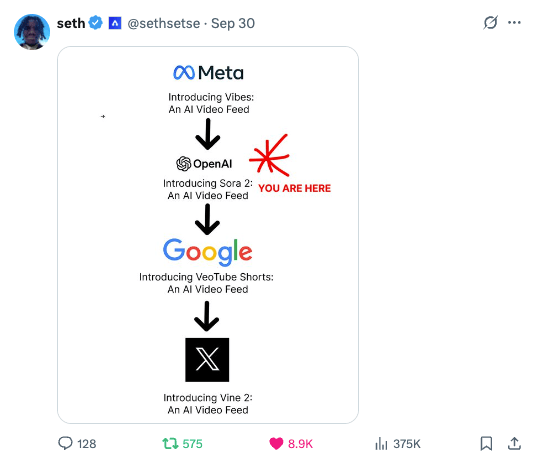
And yet… the memes be poppin’. Here’s an example of what the feed looks like. Most of the best ones are of Sam himself, like him in a cat costume (v Neuron coded), him stealing Ghibli art from Miyazaki, him stealing NVIDIA GPUs from a target (in fact there are many of these), and… whatever THIS is…
To be fair, Sam “gets the vibe” of the criticism, but still thinks there’s validity in launching fun demos and (subtext talking now) taking advantage of their virality to buy more GPUs… what, you want him ACTUALLY robbing targets to get them?
Here’s what happened in AI today:
- Ex-OpenAI/DeepMind researchers raised $300M for AI-powered robot labs.
- OpenAI secured 900K chips from Samsung/SK Hynix a month.
- Meta will use AI chatbot data for ad targeting starting December 2025.
- Google replaced Assistant with Gemini AI in Home products.
P.S: Check out our new interview with OpenAI research lead Ahmed El-Kishky! We talk all about the historic ICPC coding win, where OpenAI’s AI beat all human teams (by solving 12 out of 12 questions); Ahmed gives us the play by play like its Friday Night Lights and even shares how he uses AI in his own AI stack.

AI Scientists Just Got $300M and a Robot Army
NEWS BRIEF: Former OpenAI and DeepMind researchers raised $300M to build AI that actually runs experiments.
Periodic Labs, backed by a16z, Nvidia, Jeff Bezos, and Eric Schmidt, is solving AI's dirty secret: models crush math and code but fail at real physics and chemistry. Why? They've exhausted the internet's ~10 trillion training tokens, and the scientific literature is too noisy to learn from.
The timing is perfect: OpenAI's Chief Scientist just admitted they have an “eval deficit” and need “actual discovery” on real problems. Their new Applied Evals team judges usefulness beyond benchmarks to create “vibe researchers” (they’re working on an automated research agent, too).
But vibe researchers need something to evaluate. That's where Periodic comes in. They're building robotic labs where AI can synthesize materials, heat them up, measure their properties, and learn from what actually happens. Real robots. Real chemicals. Real physics. As Periodic puts it: “Unless you have experiment in the loop, we're just thinking. Until you try it, you're no further along.”
So, connecting the dots, this looks like: Human evaluators initiate → AI agent designs experiments → Robotic labs execute them → “Nature” itself provides a reward signal (did the experiment work?) → Data improves models.
Periodic's already helping semiconductor manufacturers solve heat dissipation problems. They’re starting with they're eventually targeting superconductors, next-gen chips, and materials that could restart Moore's Law. This is kinda like the anti-infinite slop machine (i.e. Sora 2)… an infinite SCIENCE machine.
And as Periodic says, “you never finish science”…

FROM OUR PARTNERS
AI agents are here to stay. Is your company ready?
Learn why IDC research suggests early adopters of AI are gaining a competitive edge – and why your organization needs a clear strategy. Download the new IDC white paper and discover how to gain a market advantage that keeps competitors behind.

Prompt Tip of the Day
Someone shared this free course from Microsoft on Reddit recently, which contains 18 individuals lessons, and they're pretty solid if you're looking to level up your AI skills without dropping thousands on a bootcamp.
The curriculum covers everything from prompt engineering basics to building actual AI applications. It's all hands-on with Python and TypeScript code you can run immediately.
Courses worth checking out:
- Understanding Prompt Engineering Fundamentals: Learn to craft prompts that actually work consistently.
- Retrieval Augmented Generation (RAG): Combine LLMs (AI models like ChatGPT) with your own data.
- AI Agents: Build autonomous AI that can plan and execute tasks independently.
Each lesson includes real code examples you can fork and run. The whole thing takes about 4+ hours to get through if you're moving fast.
Now, that’s just a start. Here’s a list of 77 free AI courses. It’s incredibly well organized, so if you’re overwhelmed, share the link w/ ChatGPT and ask it to interview you and learn your goals so it can recommend the best course on the list for you.
DeepLearning is another great resource with all kinds of courses available across multiple skills levels, and you can never go wrong with asking GPT to recommend the best YouTube channels, videos, and courses to you based on your goals, either!
Treats to Try
*Asterisk = from our partners (only the first one!). Advertise in The Neuron here.
- *Chatbase builds customer support agents that automatically answer your customers' questions, update their order details, and escalate complex issues to human agents when needed.
- AnswerThis searches 250M+ research papers, drafts your literature review with line-by-line citations in 2000+ formats, and spots research gaps you'd miss manually.
- Taya is an actually pretty necklace that records your conversations and transcribes them into a searchable personal journal.
- Eve is a lawyer tool for plaintiff law, where you’re trying to save time (vs bill more hours); it writes your demand letters, responds to discovery, and creates medical chronologies, turning 6 hours of casework into 30 minutes (raised $103M).
- Ask Brave combines search and AI chat in one interface, letting you seamlessly switch between finding links and getting detailed answers while maintaining privacy (free to try).
- Mosaic edits your raw video footage into multiple versions using prompts, so you can upload a podcast interview, ask it to create a highlight reel, and get several cuts to choose from before publishing.
- Eazewell uses AI to automate end-of-life planning and funeral arrangements, co-founded by NBA star Russell Westbrook (tested with 1,000+ families).
Around the Horn
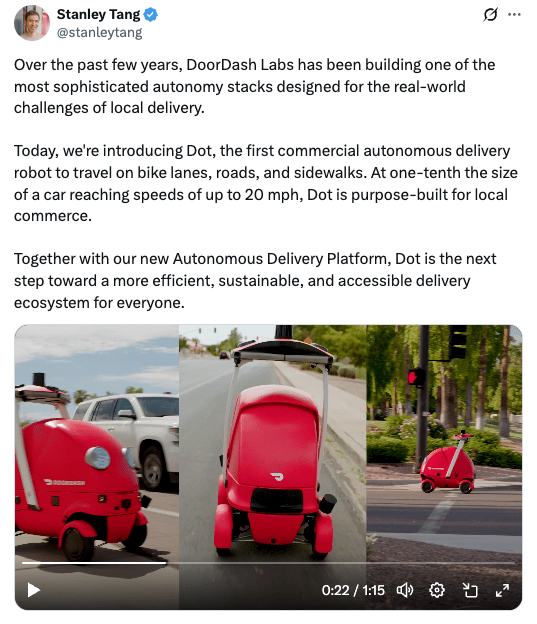
New DoorDash robot called Dot
- Thinking Machines (a.k.a Thinky) released Tinker, which lets you fine-tune language models by writing Python training loops on your laptop while they handle running them on distributed GPUs (wait list only rn).
- Waymo's robotaxi testing permit in NYC was extended to late 2025, allowing eight vehicles to operate in Manhattan and Brooklyn with human safety operators required.
- OpenAI signed agreements with Samsung and SK Hynix to supply 900,000 high-bandwidth memory chips monthly (40% of global DRAM output) for its $500B Stargate project.
- Meta announced it will use AI chatbot conversation data for ad targeting starting December 2025, affecting over 1 billion monthly users who cannot opt out except in the EU, UK, and South Korea.
- Google previewed a Gemini-powered Home speaker for spring 2026 with advanced AI capabilities including natural conversations and Matter hub compatibility, launched Gemini-powered Nest cameras and a doorbell featuring 2K resolution and contextual alerts like “Your teenage son arrived home from school.”, and replaced Google Assistant with Gemini AI in its Home app, making it 70% faster while adding natural language controls and an “Ask Home” feature that searches security footage conversationally.
- Salesforce launched Agentforce Vibes, an AI tool that autonomously creates apps on their platforms using “vibe coding” to convert natural language into enterprise-grade applications.
- Wikimedia Deutschland transformed 120 million Wikipedia entries into an AI-friendly vector database, enabling semantic search and providing verified training data amid copyright challenges.

FROM OUR PARTNERS
Your Unfair Advantage
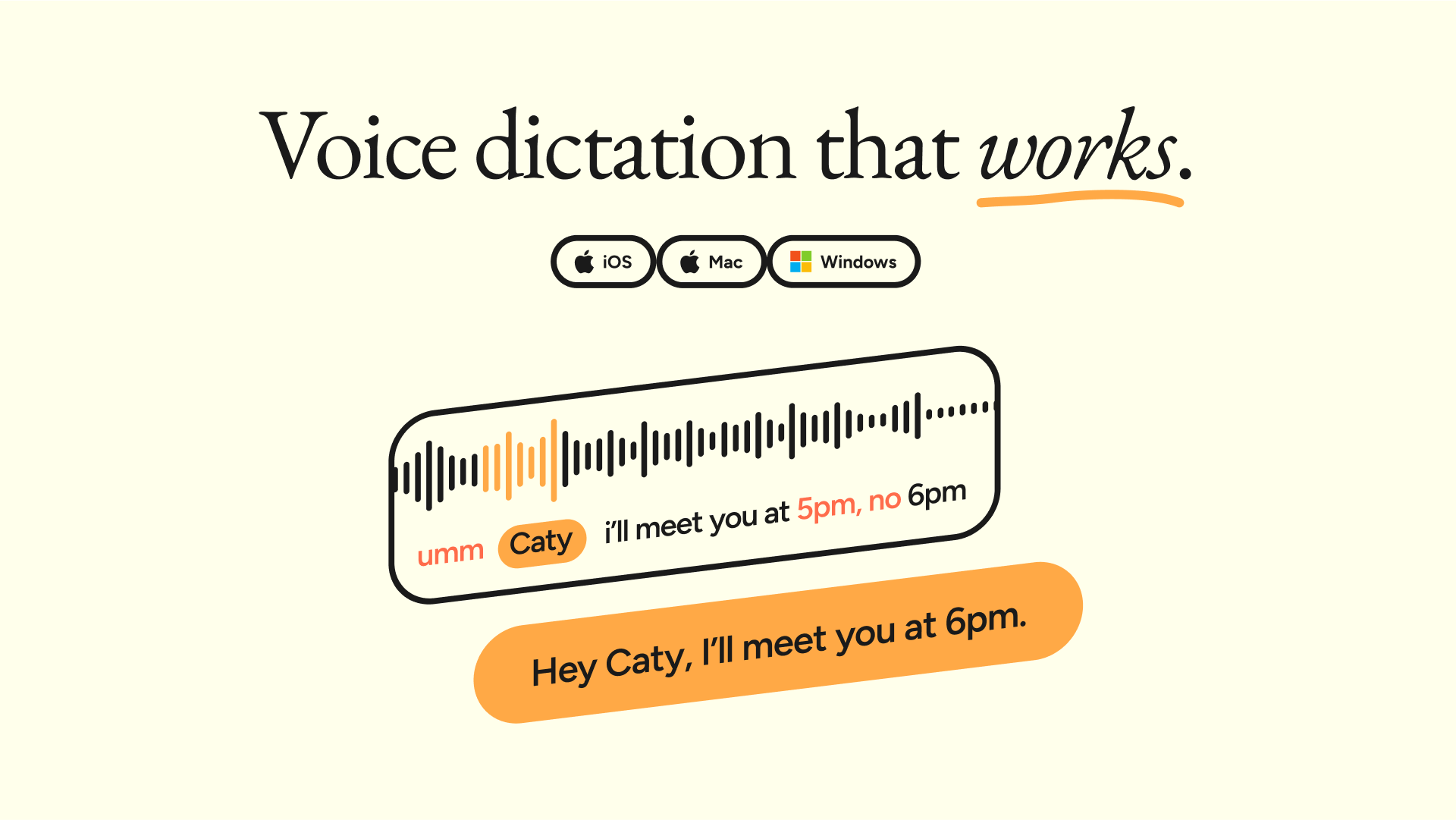
Typing slows you down. Wispr Flow turns natural speech into structured output across Gmail, Slack, Notion, and AI tools like ChatGPT or Claude. Work faster, stay responsive, and keep momentum. This isn’t old dictation software — it’s an AI-native productivity layer built for entrepreneurs, creators, and operators.

Thursday Trivia
One is AI and one is real. Which is which? (vote below!)
A.

B

Which is AI, and which is real?
Which is AI, and which is real? The answer is below, but place your vote to see how your guess everyone else (no cheating now!)
A Cat’s Commentary
Trivia Answer: B is AI (Sora 2, which is quite realistic), and A is real.
