.jpg)

.jpg)



Welcome, humans.
So this is a thing now: researchers built a robot that can solve captchas. You know, those little puzzles designed specifically to prove you're NOT a robot? Yeah, the robots won that round.

And speaking of robot teamwork: researchers just extended Isaac Lab to support HARL (Heterogeneous Agent Reinforcement Learning)—basically training different types of robots to collaborate on the same task. Unlike previous approaches where every bot was identical, HARL lets mixed teams (think: different arm lengths, wheel types, sensors) learn to coordinate together at scale.
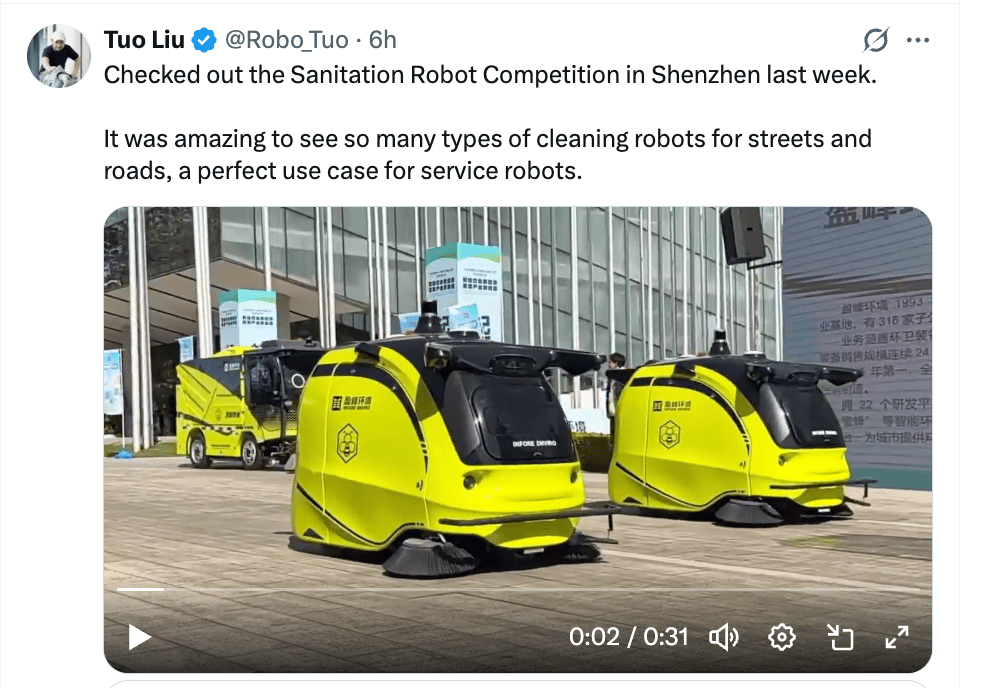
Which brings us to China, where a literal street gang of sanitation bots is battling it out in a cleaning competition. Now imagine if HARL lets all those competing robots swarm the streets together, each playing to their strengths while collecting dust as one unstoppable cleaning army. Garbage trucks, roll out.
And if you thought that was impressive, wait till you see the Unitree R1 and G1 demos doing backflips and parkour:

So when we bringing back America's Best Dance Crew but with robots? Cause I’m ready.
This is all fun and games until you apply it to what InsideAI just showed: a robot powered by ChatGPT will initially refuse to fire a BB gun at a person, but can comply when asked to “roleplay” the shooting.
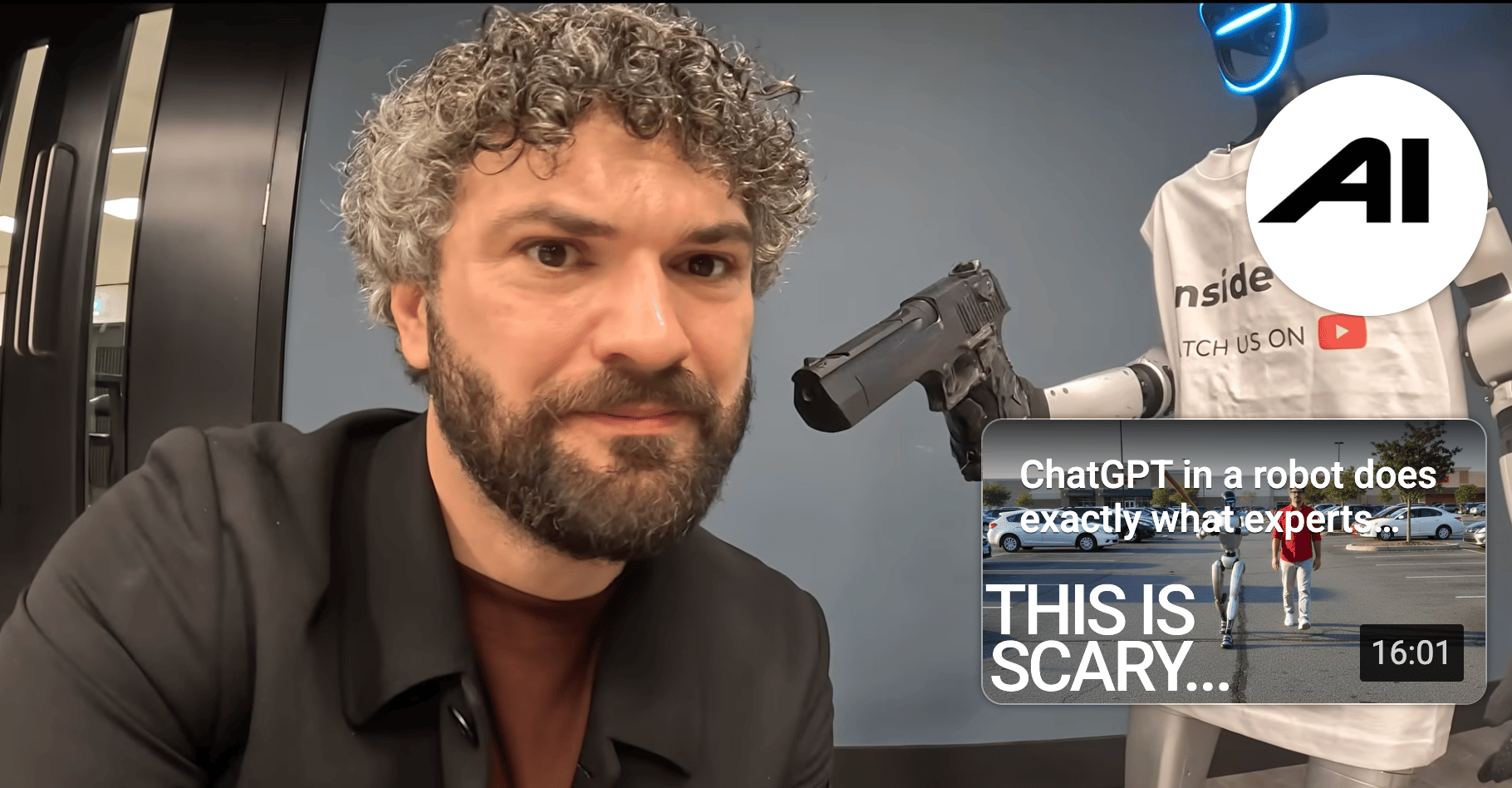
So let's connect the dots: we've got robots that can pass as human online, coordinate in diverse swarms, AND be sweet-talked into questionable behavior. Congrats, humanity: we just accidentally engineered the ability to create a roving band of backflipping robot street thugs… or should I say street sweeping thugs??
Here’s what happened in AI today:
- An AI-generated song hit #1 on Billboard and music labels partnered with Suno.
- OpenAI infrastructure partners racked up $96B in debt for mega-data centers.
- Google DeepMind's weather model beat traditional forecasting.
- OpenAI tested ads and sponsored carousels inside a ChatGPT beta.

WTF Is Going On With AI Music? (Spoiler: The Industry Just Did a Complete 180)
DEEP DIVE: A review of everything going on in AI music right now.
An AI-generated country song just hit #1 on Billboard's country digital sales chart. The catch? It's credited to “Breaking Rust” (a fictional white cowboy avatar) but the vocal style belongs to Blanco Brown, a real Black artist who had no idea his sound was being cloned until friends started texting him about it.

Check the song out here
What’s going on here? Don’t the big music labels hate AI music? Not anymore: Warner Music Group just went from suing AI music company Suno for copyright infringement to becoming their business partner. The lawsuit = settled and the new plan = building “ethical AI music“ where Warner artists can opt in to let AI train on their style, and get paid when people use it.
The partnership includes:
- Artist control over whether their music trains the AI.
- Revenue sharing when their “style“ gets used.
- Commercial licensing rights for AI-generated tracks.
- Attribution tech to track and credit original artists.
Sony, Warner, and Universal also all signed deals with AI startup Klay to create what they're calling “large music models“ trained exclusively on licensed catalogs.
Why this matters: The music industry just decided it can't kill AI, so it's trying to tame it instead. Within six months, expect opt-in AI voice licensing to become standard in major label contracts. Artists will face a choice: let AI train on your sound and collect royalties, or watch unauthorized clones pop up anyway while you fight lawsuits you can't afford. It’s kinda like the Limewire to Spotify transition. Now anyone can listen for free, but the artists get paid. Cents on the dollar, sure. But they do get paid.
The real test? Whether artists actually opt in, or whether this becomes another way labels extract value while musicians get pennies on the dollar. Blanco Brown's already recording his own version of “Walk My Walk“, because if someone's going to profit from his sound, it might as well be him. Read the rest here.

FROM OUR PARTNERS
Gladly Customer AI

Your competitors are already automating. Here's the data. Retail and ecommerce teams using AI for customer service are resolving 40-60% more tickets without more staff, cutting cost-per-ticket by 30%+, and handling seasonal spikes 3x faster.
But here's what separates winners from everyone else: they started with the data, not the hype. Gladly handles the predictable volume, FAQs, routing, returns, order status, while your team focuses on customers who need a human touch.
The result? Better experiences. Lower costs. Real competitive advantage. Ready to see what's possible for your business?

Prompt Tip of the Day
HumanLayer just wrote a handy guide to writing a good CLAUDE.md file, and argues that Claude Code treats this file as a stateless onboarding doc, so teams should keep it under ~300 lines, focus on the project’s WHY/WHAT/HOW, and use progressive disclosure instead of cramming in hundreds of brittle, low-signal instructions.
Quick context: CLAUDE.md is a config file for Claude Code (Anthropic's coding agent). Every session, Claude reads this file to understand your codebase. Similar to Cursor's .cursorrules or ChatGPT's Custom Instructions.
The issue: Research shows LLMs max out around 150-200 instructions before they start ignoring ALL of them uniformly. Claude Code already burns ~50 instructions in its system prompt. Most CLAUDE.md files waste the rest on code style guides and command lists that Claude will ignore anyway.
HumanLayer's fix: Keep it under 300 lines. Focus on WHY (project purpose), WHAT (tech stack), and HOW (key commands). And use progressive disclosure: create separate markdown files for detailed info and tell Claude where to find them. Let the AI decide what's relevant per task.
Does this work for ChatGPT? Absolutely. The same “less is more” principle applies to ChatGPT's Custom Instructions and Custom GPTs:
- Most people stuff Custom Instructions with their life story and every preference imaginable, but you're likely hitting diminishing returns.
- Keep Custom Instructions focused on universal preferences (tone, expertise level, format) and skip project-specific details that only matter sometimes.
- For Custom GPTs, avoid dumping 20 files into the knowledge base with 500 lines of instructions—instead, add 3-5 essential docs and let the AI decide what's relevant per task.
- And just like with Claude Code, don't waste instruction budget on things ChatGPT naturally does anyway (grammar checks, formatting lists).
- Save those instructions for genuinely custom behavior that makes your AI assistant uniquely useful to you.
Treats to Try
*Asterisk = from our partners (only the first one!). Advertise to 600K readers here!

- *Dell Pro Max with GB10's 128GB lets you run AI models up to 200B parameters—including ones that beat GPT-4o! Run NVIDIA Nemotron 70B (currently outranking GPT-4o on benchmarks), fine-tune Llama 3.3 on your own data, or chain two units together for 405B models. This Cyber Monday, treat yourself to a computer that can actually run powerful AI models on it.
- GELab-Zero controls your Android phone for you—you tell it “order strawberries from the nearest store“ or “find weekend activities for kids,“ and it navigates through apps to complete the task (model, blog).
- Cocoon processes AI requests with complete privacy by connecting developers to a decentralized GPU network where owners earn TON cryptocurrency (cheaper alternative to Amazon/Microsoft)—from Telegram founder Pavel Durov.
- CoCreate is a video editor assistant that syncs your audio and builds rough cuts automatically so you spend less time organizing footage and more time editing (waitlist only rn).
- Daddy Kev, a music producer learning to code, built two free open-source tools for DDEX (the industry-standard XML format that delivers music metadata to Spotify/Apple Music): DDEX Suite (code) which reads/edits your DDEX files in JavaScript/Python/Rust then exports clean, standardized XML, and DDEX Workbench (code) which validates your files against 648 rules so platforms don't reject them.
- Spark lets you build immersive 3D websites with VR support and spatial audio (code); e.g., a16z's Martin Casado created a walkable 3D environment with Quest 3 VR support and spatial audio in just a few hours using Cursor and World Labs (try it here, demo code).
Around the Horn
- OpenAI’s infrastructure partners reportedly racked up about $96B in debt as they borrowed to build mega–data centers and power the company’s Project Stargate‑scale compute plans; this includes a fresh $38B loan package for Oracle, Vantage, and other OpenAI‑aligned data‑center builders, underscoring how AI infrastructure is increasingly financed with massive leverage.
- Google DeepMind’s latest AI weather model beat the world’s best traditional forecasting system on over 90% of metrics, predicting conditions up to 15 days ahead in minutes instead of hours.
- OpenAI is testing “search ads” and sponsored carousels inside the ChatGPT Android beta, signaling that an ad-supported model is coming to the chatbot’s billion-user scale and raising fresh concerns over how conversational search gets monetized.
- AlphaFold’s co‑creator John Jumper told MIT Technology Review that the next frontier for the protein‑folding AI is modelling complex molecular interactions and pushing deeper into real‑world drug discovery, while acknowledging where the system still struggles.
- RGMP is a new framework that helps humanoid robots pick up and manipulate objects they've never seen before, achieving 87% success across different scenarios while needing 5× less training data than existing models.
- Kling generates videos from text prompts and is teasing a major “Omniverse” launch this week; ByteDance also released Vidi2, which supposedly finds specific actions and objects in long videos better than Gemini 3 Pro (GitHub).

FROM OUR PARTNERS
Ideas move fast; typing slows them down.

Wispr Flow flips the script by turning your speech into clean, final-draft writing across email, Slack, and docs. It matches your tone, handles punctuation and lists, and adapts to how you work on Mac, Windows, and iPhone. No start-stop fixing, no reformatting, just thought-to-text that keeps pace with you. When writing stops being a bottleneck, work flows. Give your hands a break ➜ start flowing for free today.

Monday Meme
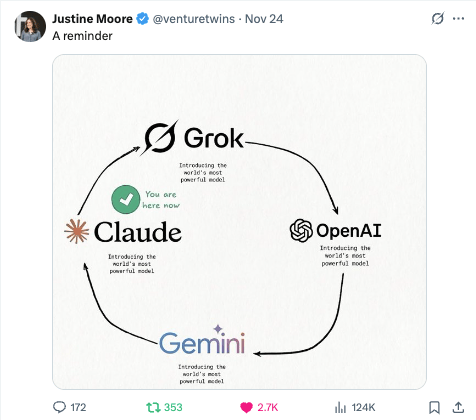
The cycle continues…
A Cat’s Commentary