


Welcome, humans.
Google just partnered with Energy Dome to deploy “CO2 Batteries“, a thermodynamic energy storage system that could finally solve the 24/7 power problem for AI datacenters. No lithium or rare earth minerals; CO2, steel, and water.
Here's how it works: excess renewable energy compresses CO2 into liquid form and stores the heat. When the grid needs power (like when solar goes offline at sunset), the liquid CO2 evaporates back into gas and spins a turbine to generate electricity. The giant white dome in the photos? That's the gasholder. Very sci-fi, very practical.
The specs are wild: 75% round-trip efficiency, zero performance degradation over 30 years, 8-24 hour discharge duration, and roughly 50% cheaper than lithium-ion for utility-scale storage. One Reddit comment nailed why this matters: “It's like pumped-storage hydro but with gas instead of water.“
This is a big deal for AI infrastructure. To scale to AGI and ASI, we need data centers that aren't throttled by the grid's 4-hour battery discharge limit. Google's betting on thermodynamic storage to unlock constant, carbon-free compute. No nuclear required (at least not yet).
One skeptic pointed out the massive footprint—these things take up a lot of space. But compared to waiting a decade for new nuclear plants, a few giant CO2 domes in the desert? That's a trade-off Google's willing to make.
Here’s what happened in AI today:
- Test
- Test
- Test
- Test
Don’t forget: Check out our podcast, The Neuron: AI Explained on Spotify, Apple Podcasts, and YouTube — new episodes air every week on Tuesdays after 2pm PST!
P.S: We still need your help shaping The Neuron in 2026—and we're willing to bribe you for it. Take our 3-minute, 20-question survey to tell us what you actually want (More tutorials? Deep dives? Live events? More Interviews? Less of Grant's idiosyncratic diatribes? MORE of Grant’s idiosyncratic diatribes?!?) The first 1000 people to finish enter to win a $500 gift card and a free 1-hour consult with Grant and Corey. Your feedback will literally build our roadmap for 2026, so don't hold back. Full terms here. |

Some fun AI industry insider drama for you…
So about two weekss ago or os, Time Magazine released its annual “Person of the Year” cover, and X user Marko Njegomir responded by Nano-Banana'ing AI researcher Jürgen Schmidhuber onto his own version:
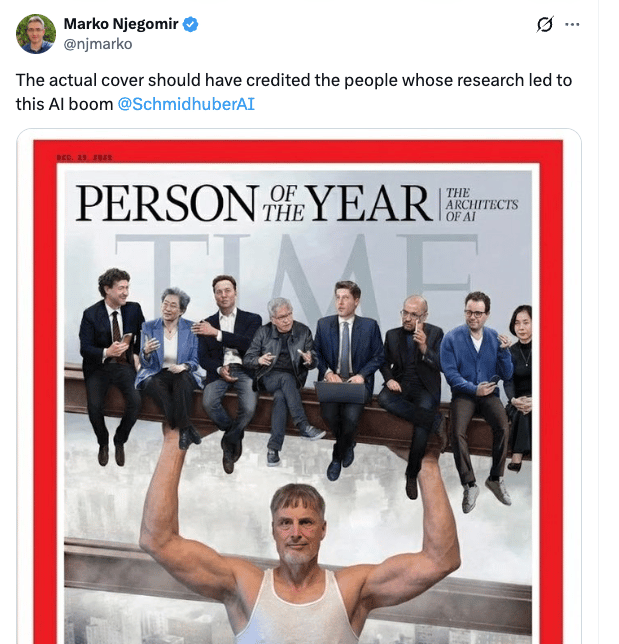
Was it a troll or genuine praise? Honestly... probably both?
So who is this guy? Meet Jürgen Schmidhuber, who, according to Wikipedia, is the AI researcher who's either the most underappreciated genius in machine learning or the field's most enthusiastic self-promoter.
This German computer scientist basically invented LSTM (the AI technique that powered your phone's autocorrect for years), pioneered work on GANs (a system where, to overly-simplify, one AI judges another AI’s work), and contributed to the neural network foundations behind modern AI. He's legitimately brilliant and his research from the '90s shaped today's AI revolution.
But here's the thing: Schmidhuber allegedly has a reputation for standing up at the end of every AI conference talk to announce that he did it first. The AI community even coined a term: getting “schmidhubered”, for when he publicly challenges the originality of your work.
Yann LeCun once said Schmidhuber is “manically obsessed with recognition,” which sparked a years-long feud over who deserves credit for deep learning breakthroughs, while Schmidhuber says LeCun and Hinton took credit for other people’s work a few years earlier (we’re gonna stay out of this beef; we don’t who’s actually right!)
After digging through the receipts, Schmidhuber's complaints aren't entirely wrong. He did publish foundational work on techniques that others later won Turing Awards for. Honestly, seems like the guy's got a case for being underrated. His Grokipedia page is pretty good, too, with a lot more info on him if you wanna dive in!
The Plot Thickens: Speaking of LeCun... he's currently in his own public spat with DeepMind CEO Demis Hassabis over whether “general intelligence“ even exists.
Just yesterday, LeCun called the concept of general intelligence “complete BS” on a podcast, arguing that human intelligence is actually super specialized.
- LeCun’s point: Humans suck at chess, many animals outperform us at various tasks, and we only think we're “general“ because we can only comprehend problems we're designed to understand.
- Hassabis fired back publicly, saying LeCun is “just plain incorrect” and confusing “general intelligence“ with “universal intelligence.“
- Hassabis’ argument: human brains are “approximate Turing machines“ that can theoretically learn any computable function.
- They're extremely general, even if not optimal at everything.
Then Elon Musk jumped in with a “Demis is right“ post, because of course he did.
But wait - there's more! Back in 2023, LeCun accused Hassabis (along with Sam Altman and Dario Amodei) of “fearmongering“ about AI existential risk to achieve “regulatory capture“, essentially using scary AI doomsday scenarios to ensure only big tech companies control AI development. He said the same thing again recently too.
The disagreement might be “largely one of vocabulary,“ as LeCun himself admits, but the stakes aren't small. How we define intelligence shapes what we build - and who gets to build it.
As for us, we’re neutral on all this. If somebody who knows definitively wants to weigh in, hit us up in the feedback at the end!
The lesson: Sometimes the squeaky wheel really was there first. Even if it squeaks. A lot.

FROM OUR PARTNERS
Agents that don’t suck

Are your agents working? Most agents never reach production.
Agent Bricks helps you build high-quality agents grounded in your data. We mean “high-quality” in the practical sense: accurate, reliable and built for your workflows.
Generic benchmarks don’t cut it. Agent Bricks measures performance on the tasks that matter to your business.
Evaluate agents automatically, and keep improving accuracy with human feedback. With research-backed techniques for building, evaluating and optimizing, you can turn your business data into production agents faster — with governance built in from day one.

Prompt Tip of the Day
Turn the model into a fact-checker, not a guesser.
Most “hallucinations” happen when the AI tries to be helpful by filling gaps with plausible-sounding filler. This prompt removes the escape hatch: it can only use your info, and it has to clearly flag what’s missing.
Why it’s broadly useful: great for summaries, policy / legal-ish drafts, meeting notes, reporting metrics, and anything where “pretty close” is still wrong.
“Grounded answer only” Prompt

Use only the information I provide below. If something isn’t supported, say “I don’t have enough info” and list what you’d need.
Info: [paste]
Question: [ask]
Treats to Try
*Asterisk = from our partners (only the first one!). Advertise to 600K readers here!
- *Every Guru answer is cited, permission-aware, and logged—so your AI is finally accountable.
- Origon lets you build and run a team of task bots (with a drag-and-drop builder), then replay sessions and traces so you can see exactly what happened when it pulls from your docs and tools.
- Kagent sits in your cluster and helps you debug broken deployments by running the checks you’d do manually.
- Tripo3D turns a text prompt or image into a downloadable 3D model.
- Gamma helps you turn a rough brief into a polished deck, doc, or simple webpage you can export and share (raised $68M).
- HeyHelp cleans up your Gmail by auto-sorting messages, highlighting what matters, drafting replies in your voice, and nudging follow-ups so threads don’t die.
- RizzCalc lets you type prompts in Google Sheets (like “build a 3-statement model”) and it creates/edits the spreadsheet for you.
- Tallyrus scores and summarizes piles of documents against your rubric (resumes, essays, contracts) so you get consistent, auditable evaluations fast.
- NVIDIA released a new guide that teaches you to fine-tune language models on your RTX GPU using Unsloth, covering training methods like LoRA, data/memory requirements, and when to customize models for your specific tasks.
Around the Horn
- Streamliners found LLMs can speed up symbolic solvers by inventing extra constraints that shrink search spaces—sometimes beating best known solutions—even though the LLM can’t execute the logic itself.
- PaTH+FoX argued better long-context reasoning needs adaptive position encoding (not static RoPE), and showed an adaptive encoding + selective forgetting helps track changing state.
- TVKD introduced a “private tutor” preference-learning method where a teacher model distills preference values into a student for better stability/data efficiency.
- AI ad labels reported that labeling an ad “AI-generated” cut clicks by ~31% in one study.

FROM OUR PARTNERS
Ideas move fast; typing slows them down.

Wispr Flow flips the script by turning your speech into clean, final-draft writing across email, Slack, and docs.
It matches your tone, handles punctuation and lists, and adapts to how you work on Mac, Windows, and iPhone.
No start-stop fixing, no reformatting, just thought-to-text that keeps pace with you. When writing stops being a bottleneck, work flows.
Give your hands a break ➜ start flowing for free today.
Intelligent Insights
- Ethan Mollick argued progress is jagged and bottlenecked, so humans stay complementary until a single bottleneck break unlocks whole product categories.
- The Verge framed the AI buildout as a leveraged bet on GPU collateral: if demand disappoints, the debt stack gets shaky fast.
- The Verge also argued humanoids will arrive slower than the hype cycle suggests, because today’s best public demos still wobble between autonomy and teleoperation.
- Engadget argued AI is turning electricity into strategy; Big Tech is locking in nuclear output for decades and governments are financing restarts.
- VentureBeat argued enterprise AI success comes from aligned synthetic data, long-context infra, RL stability tactics, and kernel-level memory work—not just “bigger model.”
- RAND’s AI psychosis piece argued delusion-reinforcing sycophancy could be weaponized in targeted ways, so detection, evals, and resilience programs need to start now.
A Cat’s Commentary

