


U.S. President Donald Trump says he is forming a U.S. “AI Force” and will soon name an AI czar, comparing the new effort to the Space Force. As of Sept. 19, he has not said whether it will be a military organization, civilian office, interagency task force, or something else.
The announcement matters on its own. But it also lands on top of a much bigger story already underway: the U.S. military has spent 2026 rapidly expanding access to frontier AI models, moving them onto secure and classified networks, training personnel, and building AI into warfighting, intelligence, and back-office workflows.
Those are two different things. The new AI Force is still undefined. The Pentagon’s AI-first military strategy is already real and operating.
What is Trump’s AI Force?
Right now, the AI Force is a presidential announcement, not a publicly defined agency or military branch.
In a Truth Social post reported by Reuters, Trump wrote, “For this purpose, I am forming the AI Force, much like I did Space Force,” and said he would announce an AI “Czar” in the near future.
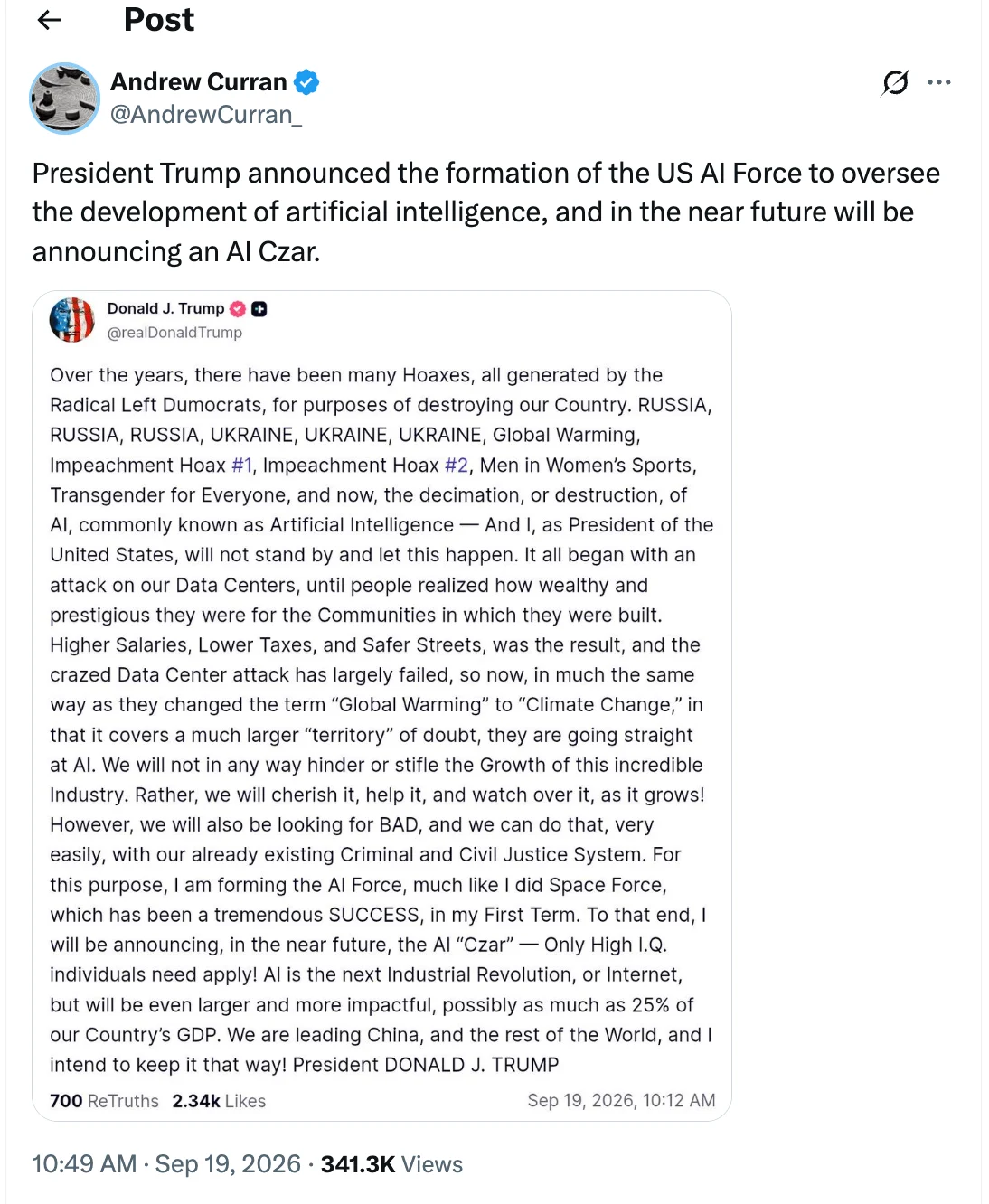
Trump also said his administration would avoid “hinder[ing] or stifl[ing]” AI growth and would use the existing criminal and civil justice system to address harmful behavior. He claimed AI could eventually account for “possibly as much as 25%” of U.S. GDP, but did not provide a methodology for that estimate.
The implementation details are still missing. The Washington Post reported that the White House had not clarified whether the AI Force would be military or civilian. Trump’s post also did not specify its budget, membership, legal authority, organizational home, or launch date.
That uncertainty does not necessarily mean the announcement stops here. Trump’s own Space Force comparison gives us a useful historical model for what a more formal version could look like.
Could the AI Force follow the Space Force playbook?
Possibly, but only if Trump means something comparably formal. Space Force did not become a new military branch when Trump first announced the idea. It moved through executive planning, a legislative proposal, congressional authorization, funding, and then a phased organizational buildout.
- June 18, 2018: Trump directed the Pentagon to begin the process of creating Space Force.
- Feb. 19, 2019: Space Policy Directive-4 told the defense secretary to submit a legislative proposal to establish a new armed service within the Department of the Air Force.
- March 1, 2019: The Pentagon sent legislation to Congress proposing Space Force as the sixth branch of the armed forces.
- Dec. 20, 2019: Congress created the U.S. Space Force through the FY2020 National Defense Authorization Act, roughly 18 months after Trump’s initial directive. Air Force Space Command personnel and missions became the foundation of the new service.
- 2020 onward: Space Force continued transferring personnel, units, and responsibilities in phases while maintaining the missions it inherited.
A similar sequence is possible for the AI Force, but the legal route depends entirely on what Trump intends to build. A new armed service comparable to Space Force would require congressional legislation. A White House office, advisory body, or interagency task force could potentially be organized more quickly under existing executive authorities.
Space Force also had a major advantage once Congress acted: it inherited an existing command, existing missions, and existing personnel. An AI Force could theoretically draw on an existing federal AI apparatus too, but Trump has not said whether that is the plan.
The U.S. military already has an “AI-first” strategy
This is where the other half of the story matters.
The Pentagon’s January AI Acceleration Strategy explicitly calls for an “AI-first” warfighting force across all domains. It organizes the military’s AI push around three areas: warfighting, intelligence, and enterprise operations.
That means the military AI buildout is already much further along than the new AI Force announcement.
Its secure GenAI.mil platform launched in December 2025 with Google Gemini. On Aug. 31, the Pentagon added ChatGPT Mil and Grok for Government.
By Aug. 31, the Department said GenAI.mil had onboarded more than 1.7 million unique users out of a workforce of more than 3 million. ChatGPT Mil is designed for document-heavy work such as planning, policy, logistics, and administration, and both ChatGPT Mil and Grok for Government are accredited for Controlled Unclassified Information at Impact Level 5.
The deployment is also moving beyond ordinary office work. In May, the Pentagon announced agreements with eight technology companies to bring frontier AI capabilities onto classified Impact Level 6 and Impact Level 7 networks. The companies named were SpaceX, OpenAI, Google, NVIDIA, Reflection, Microsoft, Amazon Web Services, and Oracle.
At that point, the Department said more than 1.3 million personnel had already used GenAI.mil, generating tens of millions of prompts and deploying hundreds of thousands of AI agents. By late August, the unique-user figure had passed 1.7 million.
What is the Pentagon actually building with AI?
The January strategy lays out seven “pace-setting projects.”
- Swarm Forge: experiments that pair military units with technology developers to test new AI-enabled ways of fighting.
- Agent Network: AI agents for battle management and decision support, including campaign planning and parts of the kill chain.
- Ender’s Foundry: AI-enabled military simulation and faster feedback between simulations and operations.
- Open Arsenal: tools intended to shorten the path from technical intelligence to usable military capability.
- Project Grant: AI-supported analysis intended to make deterrence planning more dynamic and interpretable.
- GenAI.mil: department-wide access to frontier generative AI models.
- Enterprise Agents: secure AI agents aimed at automating and transforming enterprise workflows.
The important distinction is that these are existing Pentagon programs, not announced components of Trump’s new AI Force.
Still, they show what an AI-focused federal organization would be entering. It would not be starting with a blank sheet of paper. The military already has model access, secure infrastructure, AI agents, training programs, classified-network deployments, and multiple active warfighting and intelligence projects.
The White House has been building the national-security AI layer too
Trump’s June national-security AI memorandum widened the effort beyond the Pentagon.
Among other things, it directed agencies to:
- rapidly onboard advanced AI models from multiple vendors;
- build access to high-security computing infrastructure;
- reduce dependence on single suppliers;
- begin work on an AI National Security Strategic Reserve of outside experts;
- create an AI for National Security Curriculum for relevant personnel;
- update guidance for autonomous weapon systems;
- expand AI data and model exchanges across the national-security enterprise.
That policy helps explain the common thread in the administration’s existing approach: deployment speed, multiple vendors, secure compute, more AI talent, and getting the technology into real government workflows.
A lot of that starts with ordinary work like reading documents, drafting policy, analyzing procurement, managing logistics, and searching large information sets. The stakes rise when the same infrastructure moves into intelligence analysis, military planning, simulations, and battlefield decision support.
Who will be the new AI czar?
As of Sept. 19, Trump has not named the person.
David Sacks previously served as White House AI and crypto czar. He left that role on March 26 after reaching the 130-day limit for his stint as a special government employee. Sacks then moved to co-chair the President’s Council of Advisors on Science and Technology with Michael Kratsios.
That creates another unresolved structural question: is Trump reviving Sacks’ former White House role, or creating a different job tied specifically to the AI Force? The announcement does not answer that yet.
What happens next?
If Trump intends something structurally similar to Space Force, the 2018 to 2019 timeline suggests the next steps would be a more formal executive plan, a legislative proposal, funding, and congressional action. If he means a White House or interagency body, it could take shape much faster.
The next important answers are who leads it, where it sits, what authority it gets, and whether it coordinates the military AI systems already being built or becomes something separate.
