
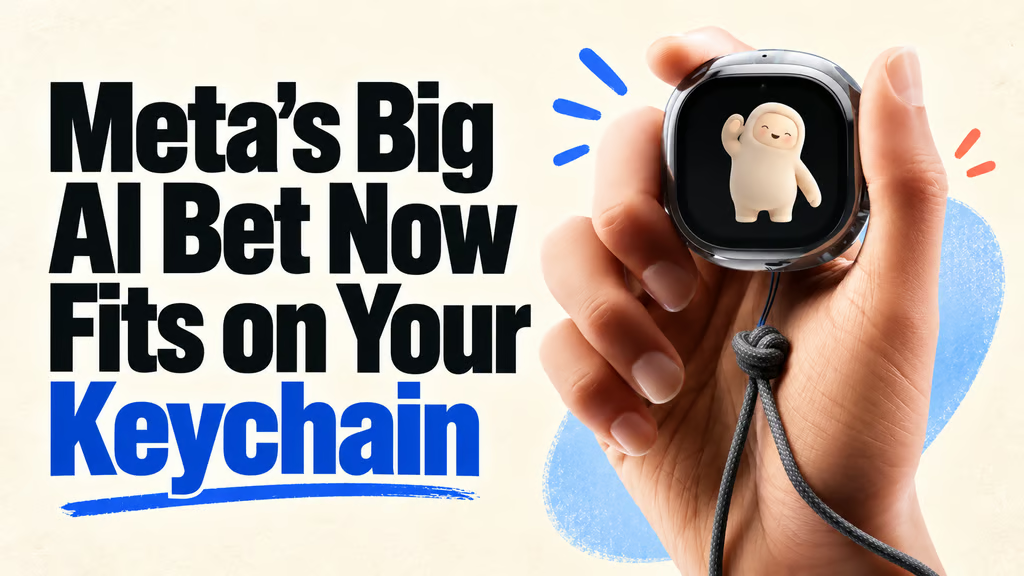


I already talk to AI through my Ray-Ban Metas. After Meta Connect 2026, I still want the tiny new gadget that lets me do it without pulling out my phone: the Muse Charm.
It’s a pocketable home for Meta’s personal AI agent, with a small screen that brings Muse’s animated character along for the ride. You can talk to it, tap a fingerprint sensor to identify yourself, and let the agent keep working after the conversation ends. Meta is targeting the holiday season for its release, but hasn’t announced a price. It’s the sort of product that sounds easy to dismiss until you realize how often you want to ask your AI something while your phone is buried in your pocket.
And the Charm was only one part of a remarkably big showing. Meta also laid out new ways to speak with Muse, let it use your computer and email, and eventually take it onto its enormous range of AI glasses. There were new glasses for different budgets, plus lightweight VR glasses on the horizon. This was Meta trying to make the personal agent feel less like an app and more like something that lives with you.
Muse is already the fun part
I’m a big fan of Muse. It’s a fun personal agent that is shockingly useful despite how simple it feels. You don’t need to build a workflow or learn an agent framework. You can tell it what you need in plain language and have an agent start helping with your life almost immediately. That low barrier matters more than another benchmark win.
The little Muse character matters, too. It gives the product a warmth that most AI assistants lack. Meta has made something people might actually want to open and talk to. Zuckerberg, Alexandr Wang, and company absolutely cooked on that part.
At Connect, Meta showed where it wants to take that relationship next. Muse Realtime Voice is meant to feel like an ongoing conversation while the agent works in the background. You’ll be able to customize its voice. Muse Realtime Avatar adds an expressive, interactive face, though the research demo shouldn’t be mistaken for a feature already in everyone’s app.
Wang also described a more capable agent behind the cute face. Muse’s Mac app can now use the computer to get work done, and its own email address is coming soon, so you can loop it into a thread or send it a task. Meta is expanding connections to shopping, travel, payments, and work apps, while Wang teased a more capable model ahead. Those are the pieces that could turn a charming assistant into one that actually follows through across your day.
Meta still owns the AI hardware conversation
The Charm is what I’m most excited to test. I want to chat with my AI without my phone and still see what it’s doing on that little screen. Full disclosure: I already wear Ray-Ban Metas, so hands-free AI isn’t new to me. What I don’t have on my current pair is the Charm’s screen or the full personal-agent experience Muse promises.
That last part may change. Meta announced Muse for its AI glasses, and Wang was even more direct on X: the “muse lil guy” is coming to all Meta glasses, with a spoken wake phrase. There’s no firm date yet, so I’m looking forward to seeing what actually lands on the pair I own.
Meanwhile, Meta keeps making the hardware case. It introduced camera-free Ray-Ban Meta Audio glasses starting at $349, Ray-Ban Meta Gen 3 at $449, and a $249 Meta Adventurer. Meta says its lineup will pass 100 AI glasses options by year-end. It also announced updates to Meta Ray-Ban Display and 100-gram Meta VR Glasses with built-in Meta AI, slated for spring 2027 at $1,299.99.
The range is the point. A personal agent gets more useful when it can move from phone to desktop to glasses to a dedicated device. Meta has a credible piece of hardware for each moment, and it knows how to make people want to wear or carry them.
The demos still have to become daily habits
Some of the most exciting Muse capabilities are promises, not broadly available products. The Charm needs to ship, the glasses integration needs to work in real life, and voice, email, and computer use need to earn users’ trust. Private Processing for AI glasses is part of Meta’s answer to the privacy question, but people will judge the finished experience, not the slide.
There’s reason to keep an eye on the details: 404 Media reported that some calls in a separate Muse phone-call test were handled by humans. That doesn’t describe the new Realtime Voice feature, but it is a reminder to ask what an “AI agent” is doing on its own and when a person is involved.
Even with that caveat, I left Connect more excited about Meta’s AI direction than I expected. Muse already makes agents feel accessible to ordinary people. Charm gives that agent a delightfully tangible home. And if Meta can carry the same useful, approachable experience onto the glasses I already wear, this could be the moment personal AI starts feeling like part of everyday life.
