



AI can write your business plan in seconds. Getting electricity to the computers running it can take years.
Liquid Energy thinks that mismatch deserves a different kind of data center: one that arrives with its own power supply, unfolds its solar panels, and gets to work.
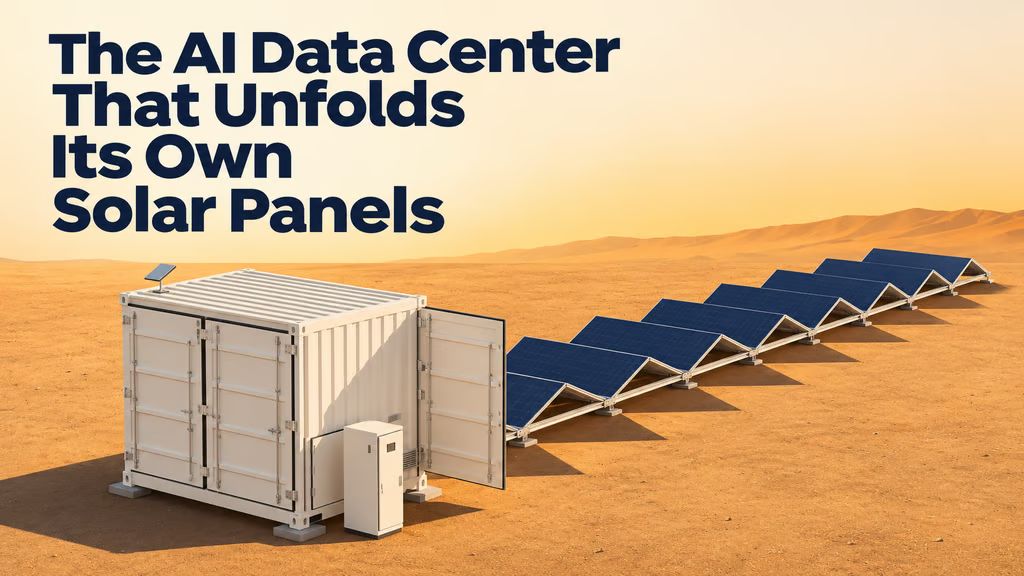
The Y Combinator-backed startup calls it NanoDC, short for Nano Data Center. Its pitch is wonderfully visual: a factory-built unit with accordion-style solar panels, batteries, onboard computing, air cooling, and a Starlink connection.
The bigger idea is just as interesting. As AI companies scramble for electricity, Liquid Energy wants to make adding inference capacity more like delivering equipment than developing a construction project.
There’s plenty left to prove. But it’s a compelling response to an increasingly awkward problem: the software industry moves much faster than the infrastructure underneath it.
A data center that brings its own electricity
In its NanoDC announcement, Liquid Energy says its solar-powered, autonomous data center can be deployed in four weeks and switched on within 30 minutes of arriving on site.
The company says each unit is manufactured as a complete system. Solar panels unfold from the structure, batteries store electricity, and what it describes as patent-pending, high-density air cooling keeps the compute hardware from overheating. Starlink supplies the internet connection.
That arrangement is designed to remove several dependencies from the deployment process: a utility connection, a water supply, and the transformers or turbine generators that might otherwise keep a project waiting.
The company’s closing line captures the concept nicely: “Sunlight in. Tokens out.”
Tokens are the chunks of information AI models process and generate. Inference is the work a trained model does when it answers a question, summarizes a document, or handles another request. NanoDC is aimed at supplying that everyday computing capacity.
On its website, Liquid Energy says it sells inference to companies of every size, promising less than eight weeks from a signed contract to the first token delivered.
That helps explain the business behind the folding panels. Customers would be buying access to computing capacity. Liquid Energy would handle the physical infrastructure that produces it.
The timelines describe different milestones, too: four weeks for deployment, 30 minutes for activation after arrival, and under eight weeks for the broader customer process. They shouldn’t be treated as interchangeable promises.
Y Combinator is backing the approach
Liquid Energy is based in Waterloo, Ontario, and belongs to Y Combinator’s Fall 2026 batch.
Its YC listing says the company has 20 units and manufacturing capacity of 2 megawatts per month, with plans to increase that to 20 megawatts per month over the following year. Those are company-reported figures; they don’t establish how much capacity is already serving paying customers.
The launch announcement says the first units are scheduled to go live in November 2026, with thousands shipping beginning in 2027.
That makes this an early infrastructure story with an ambitious manufacturing plan. The next meaningful milestone will be evidence from systems operating in the field.
Why the power supply is becoming part of the product
The problem Liquid Energy is targeting is real.
The International Energy Agency says planning, permitting, and completing new grid infrastructure can take five to 15 years. Data centers can be built in one to three years.
That creates an expensive scheduling problem. A company can finish the facility long before the surrounding power infrastructure is ready.
Other AI companies are trying to manage the same mismatch. As The Neuron has covered, an alliance led by NVIDIA, Google, and Emerald AI is pushing for data centers that adjust their electricity demand when grids need relief.
Liquid Energy’s approach is to bring generation and storage along with the computers.
The potential advantage goes beyond using renewable electricity. If the system works as advertised, it could reduce the number of outside projects that must finish before a customer can start using the compute.
Factory assembly could also make expansion more repeatable. Each additional unit would arrive with the core systems it needs, allowing capacity to grow in increments.
That’s the strategic bet: deployment speed could become an advantage customers are willing to pay for.
The accordion panels still have to earn their keep
The launch makes the concept easy to understand. The operating economics need more detail.
Solar output changes with location, season, and weather. Batteries have to cover the hours when generation falls short. The useful question is how much computing a unit can reliably deliver through those conditions—and at what cost.
The public materials reviewed don’t provide enough detail about battery endurance, per-unit compute capacity, pricing, or measured uptime to make a meaningful comparison with conventional cloud inference.
Connectivity raises another practical question. Starlink offers a way to reach sites without waiting for a wired connection, but customers will still need to understand the latency, bandwidth, and reliability available for their workloads.
The claim that NanoDC can deploy anywhere also deserves to be read as a pitch. Land access, climate, maintenance, connectivity, and local approvals still shape where infrastructure can operate successfully.
Recent coverage from FourWeekMBA and Founderland largely draws on the company’s announcements and public listings. Neither establishes independently measured commercial performance.
None of that makes the idea less interesting. It defines what Liquid Energy needs to demonstrate next.
A different way to expand AI
Liquid Energy is proposing a useful shift in how we think about AI infrastructure.
Instead of treating electricity as something a data center secures separately, it packages energy generation, storage, cooling, networking, and computing together.
For customers, the appeal would be straightforward: usable inference capacity sooner, with fewer infrastructure dependencies to manage.
Whether that becomes a durable business will depend on reliability, manufacturing execution, and the cost of producing tokens. A fast installation matters most when the system keeps delivering afterward.
Still, NanoDC offers an intriguing possibility for the next phase of AI: some of the capacity serving our models could come from factories shipping complete solar-powered systems.
And yes, part of getting them running would involve unfolding the panels.
Related reading
- Data Centers Have an Electricity Problem. This Alliance Could Help. — Another approach to the same bottleneck: making data centers more flexible electricity customers.
- Anthropic’s $3.4 Billion Power Deal Shows How Expensive AI Is Becoming — The reported generator agreement illustrates how much AI companies may spend to secure power sooner.
