


AI used to be pretty easy to locate.
You had model labs building models, cloud companies renting GPUs, startups gluing those models into apps, and the rest of the economy watching from a semi-safe distance.
That map no longer works.
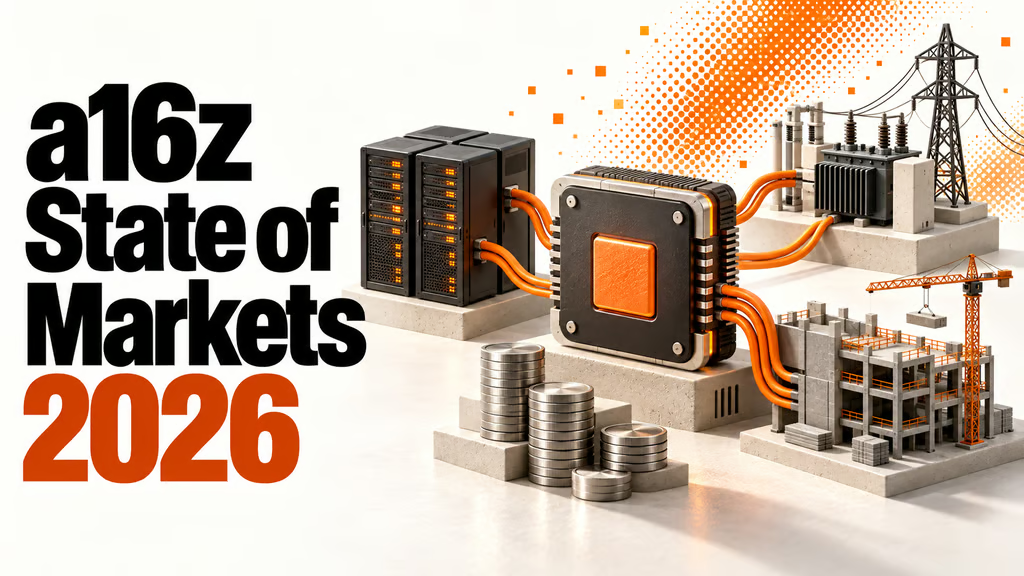
In its new State of Markets II report, Andreessen Horowitz argues technology has become what it calls the “Everything Cycle.” Tech contributed roughly 76% of S&P 500 earnings growth in 2026 through late August, according to a16z, while the AI infrastructure boom has started pulling capital toward semiconductors, power, networking, construction, debt markets, and skilled labor. (a16z)
The wildest number might be buried in one of the charts: a16z estimates technology now represents roughly 55% of U.S. capital spending.
Another chart puts hyperscaler capital expenditures at roughly $780B this year, with annual spending potentially crossing $1T soon after.
That is a lot of concrete for a technology famous for living “in the cloud.”
The report’s argument deserves a caveat up front. a16z is an investor, not a disinterested statistical agency. Its own disclosures say some data comes from third parties and portfolio companies and has not been independently verified. Read this as a well-supported thesis about the economy, rather than a neutral census of it. (a16z)
Still, the thesis is hard to ignore:
AI has become large enough that understanding AI now requires understanding capital spending, credit, electricity, labor, industrial supply chains, and physical infrastructure.
And that creates a much more interesting question than “Are AI stocks in a bubble?”
Can demand grow quickly enough to pay for all of this?
- First, you have to understand what $780B of capex actually means
- This is where the AI boom starts looking less like software
- So far, the demand side keeps bailing out the spending side
- And yet, AI usage is weirdly shallow
- AI is quietly rearranging the rest of the economy
- This also explains why the “SaaSpocalypse” story was too simple
- Some of the coolest economic data now comes from companies that barely existed a few years ago
- The AI bull case and bear case increasingly share the same facts
- What I’d watch instead of arguing about “the bubble”
- AI has to graduate from scarcity to economics
First, you have to understand what $780B of capex actually means
Capex means capital expenditure: money spent building assets that should produce value for years.
For an old-school industrial company, that might mean factories.
For the hyperscalers, it increasingly means data centers, GPUs, networking gear, cooling systems, power infrastructure, and the buildings that hold all of it.
The scale has changed quickly. One chart in the report shows hyperscaler spending jumping from roughly $241B in 2024 to $416B in 2025, then toward roughly $790B in 2026.
The important part is where that money came from.
For most of the AI boom, Microsoft, Amazon, Alphabet, Meta, and their peers could largely finance the buildout using the enormous cash flows generated by their existing businesses.
Ads paid for GPUs.
Office software paid for GPUs.
E-commerce paid for GPUs.
Cloud computing paid for even more cloud computing.
We watched this dynamic accelerate earlier this year when Microsoft, Alphabet, Amazon, and Meta spent roughly $130B in a single quarter while simultaneously telling investors they could not build infrastructure fast enough to satisfy demand. (The Neuron)
But a16z’s charts show that arrangement reaching its limit.
Capital spending is consuming an increasingly large percentage of hyperscaler operating cash flow, and free cash flow is being squeezed.
Here’s the distinction:
- Operating cash flow is the cash the core business generates.
- Capex is the cash you spend building long-lived infrastructure.
- Free cash flow is basically what remains after subtracting those investments.
For years, Big Tech printed ridiculous amounts of free cash flow.
Now a larger share of that money is being immediately recycled into data centers.
Congratulations on your record profits. Your GPU contractor will take those from you now.
Epoch AI independently reached a similar conclusion in June. Looking at Microsoft, Amazon, Alphabet, Meta, and Oracle, it estimated aggregate cash capex was growing around 70% per year versus roughly 23% growth in operating cash flow. If those trends continued, capex would overtake operating cash flow around Q3 2026. (Epoch AI)
That is why another part of a16z’s story suddenly matters so much:
Debt markets are stepping in.
This is where the AI boom starts looking less like software
Software businesses became absurdly valuable partly because the economics were so attractive.
You write the code once. Millions of customers can use copies of it. Serving one more user often costs very little.
AI has a much more physical bill attached.
Every additional unit of intelligence eventually touches chips, memory, electricity, networking equipment, cooling, land, and buildings.
And when internal cash flow stops covering the rate of expansion, somebody has to finance the difference.
a16z thinks that can work because hyperscalers still generate returns on invested capital well above their borrowing costs. In plain English: if borrowing a dollar costs you 5 cents per year, and deploying that dollar generates 15 or 20 cents of economic return, borrowing can make perfect sense.
The danger appears when the return shrinks.
KKR made almost exactly that argument from the credit side this week. It remains bullish on AI infrastructure, but warned that the buildout could require $7.6T to $8T through 2030, while AI-linked exposure could eventually approach 20% of the investment-grade bond index. KKR’s concern is less “AI will fail” and more “a huge amount of supposedly diversified capital may ultimately depend on the same small group of companies, chips, leases, data centers, and customers.” (KKR)
That changes the failure mode.
If one AI startup disappoints, one AI startup disappoints.
If the same demand assumptions sit underneath hyperscaler equity, hyperscaler debt, data-center financing, chip manufacturers, utilities, real estate, and private credit, weaker AI economics can travel through a lot more pipes.
This is what it means for AI to become a capital cycle.
So far, the demand side keeps bailing out the spending side
The strongest part of a16z’s case is that the machines being built are actually getting used.
Cloud revenue backlogs have roughly doubled year over year in the report.
Older GPUs that were supposed to depreciate into irrelevance are retaining surprisingly high rental rates and residual values.
That matters because one of the simplest arguments against giant GPU investments goes like this:
You spend billions buying today’s chips. NVIDIA releases something radically better. Your old hardware becomes economically obsolete before it earns back what you paid.
So far, demand growth has overwhelmed that problem.
Even older A100 GPUs were renting around or above their price at the beginning of the year in a16z’s data. The report’s explanation is straightforward: every improvement in AI economics creates more things people are willing to use AI for. (a16z)
That brings us to the most important concept in the whole deck: Jevons Paradox.
Jevons Paradox happens when making something more efficient causes people to consume more of it, rather than less.
Imagine taxis suddenly became 90% cheaper.
You might expect total spending on taxis to collapse.
But suddenly people use taxis for trips they previously walked, biked, drove, or skipped entirely. Companies invent delivery businesses that were previously uneconomical. Commuters change where they live.
Price per trip falls.
Trips explode.
Total demand can rise.
AI appears to be doing the same thing.
Tokens have gotten dramatically cheaper. Model routing sends easy work to cheaper models. Caching means systems avoid recomputing the same information. Older models remain useful for simpler jobs.
You might expect all of those efficiencies to reduce compute demand.
Instead, a16z shows usage accelerating.
OpenRouter, which routes requests among many different AI models, reportedly went from roughly 0.5 trillion weekly tokens at the start of 2025 to 126.2 trillion by September 2026.
Agents are especially hungry. The report’s data suggests agent-generated token usage passed human-generated token usage earlier this year.
Why?
A human might ask a chatbot one question.
An agent trying to complete that same task might:
- read instructions;
- inspect files;
- search for information;
- call another model;
- run code;
- check its own answer;
- retry when something fails;
- summarize everything for you.
One human request can turn into dozens or hundreds of machine actions.
Cheaper intelligence does not automatically mean less compute. It can mean dramatically more intelligence gets purchased.
That is probably the single strongest argument in the entire AI infrastructure bull case.
And yet, AI usage is weirdly shallow
There’s a wonderful contradiction sitting in the middle of the report.
Demand is enormous.
Adoption is also immature.
a16z says nearly 30% of S&P 500 companies now report some quantifiable AI impact, yet only around 2% disclose a metric they consistently track over time. Consumer penetration looks similarly early: around April, barely 2% of U.S. households were paying for an AI service. (a16z)
Underneath the aggregate numbers, usage is also heavily concentrated among power users.
A relatively tiny group of companies and individuals are using orders of magnitude more AI than everyone else.
That gives the bull case a fascinating shape.
The infrastructure is already strained before most people use AI deeply.
If ordinary companies eventually behave like today’s AI-native power users, current capacity could look tiny.
But the opposite possibility matters too.
Maybe the power users are unusually valuable precisely because they are unusual.
Maybe most office workers never run ten agents at once.
Maybe plenty of companies buy Copilot seats and use them twice a week.
Maybe usage spreads widely without ever approaching the intensity implied by the top 1%.
That distinction matters enormously when you are financing trillion-dollar infrastructure.
“Early” can mean enormous growth ahead.
“Early” can also mean the behavior you need to justify your forecast has not happened yet.
AI is quietly rearranging the rest of the economy
This is where the report gets more interesting than another AI market forecast.
Follow the spending outward and you start seeing AI in places that barely resemble software.
Data centers need electricians, construction managers, facilities specialists, network engineers, turbines, transformers, cooling systems, and enormous amounts of power.
a16z cites median pay for data-center facilities managers rising from roughly $82K to $134K, a 64% premium in the dataset it uses. Construction managers show a roughly 29% premium.
Utilities are spending heavily too. The deck projects cumulative utility capex exceeding $1T through 2030, although rising electricity demand comes from many sources beyond AI, including EVs, buildings, industrial electrification, and heat pumps.
Memory prices have surged.
Semiconductor supply chains remain backlogged.
Power infrastructure may now be a bigger deployment constraint than GPUs themselves.
This is the “bits to atoms” shift a16z keeps talking about.
For most of the past decade, investors loved businesses that could scale without owning much physical stuff.
Now some of the biggest technology companies in history are converting software profits into chips, substations, cooling loops, and concrete.
a16z describes that as hyperscaler free cash flow turning into semiconductor free cash flow.
That is an extremely useful mental model.
The profits have not disappeared.
They moved down the supply chain.
This also explains why the “SaaSpocalypse” story was too simple
The report applies the same logic to software.
Software stocks sold off hard in 2026, and AI became the obvious explanation: agents can write software, build internal tools, automate workflows, and potentially replace chunks of traditional SaaS.
a16z argues the actual repricing is more selective.
Roughly 75% of public software companies are profitable now, while only around 30% are growing more than 20%.
That combination matters.
Higher interest rates pushed software companies toward profitability after the zero-rate era ended. They succeeded.
But they also became slower-growing businesses.
And slower-growing businesses usually receive lower valuation multiples.
AI adds a second test on top:
Can your product remain defensible when users can increasingly build or automate around it?
The market’s answer differs by category. Cybersecurity and observability have held up better. Vertical software has generally fared better than broad horizontal SaaS. High-growth companies still receive strong valuations.
So the shift from bits to atoms does not require software to die.
It means software has to prove its economic value while an enormous new investment cycle competes for capital.
Some of the coolest economic data now comes from companies that barely existed a few years ago
The final section of a16z’s report might be my favorite.
The firm argues private technology companies are becoming economic sensors.
Think about the information being created:
- OpenRouter can see token demand across model providers.
- Stripe can see payment flows across thousands of software companies.
- Databricks can observe how enterprises route jobs between expensive and cheap models.
- Specialized inference companies can show demand for running models outside the major clouds.
- Compute markets can increasingly put an actual forward price on GPU time.
Traditionally, you might wait months for a government survey to tell you how an industry changed.
Now a routing platform can show you an explosion in AI usage almost live.
That creates a weird new macroeconomic dashboard where private infrastructure providers can sometimes see shifts before public statistics do.
It also creates another caution.
Those companies see their own customers.
Their data can be enormously informative without perfectly representing the entire economy.
The report itself acknowledges versions of this limitation throughout, especially where portfolio-company or company-reported data is involved.
Which brings us back to the question hanging over all 90 pages.
The AI bull case and bear case increasingly share the same facts
This is the part I find most useful.
You do not need two different sets of numbers to construct the bullish and bearish versions of this story.
The same facts support both.
Hyperscalers are spending enormous amounts because demand is enormous.
Bullish.
Hyperscalers are spending so much that free cash flow is collapsing and borrowing is rising.
Risky.
Older GPUs are retaining value because compute demand remains strong.
Bullish.
That makes huge parts of the financial system increasingly dependent on continued compute demand.
Risky.
AI adoption remains surprisingly shallow.
Huge runway.
Or unproven future demand.
The debate comes down to time.
How quickly does usage broaden?
How quickly do enterprise deployments move from experiments to recurring production workloads?
How quickly does cloud backlog turn into revenue?
How quickly do AI products generate cash relative to how quickly the infrastructure underneath them depreciates, requires upgrades, or needs refinancing?
We already know hyperscalers can build very expensive computers.
The next phase is proving those computers can earn very expensive returns.
What I’d watch instead of arguing about “the bubble”
Bubble debates tend to become theological pretty fast.
A few measurable signals will tell us much more over the next 12 to 24 months.
1. Capex growth versus operating cash flow.
If AI spending keeps compounding faster than the cash generated by the businesses funding it, outside financing becomes increasingly important. Epoch’s crossover is one useful marker. (Epoch AI)
2. Cloud backlog turning into actual revenue.
Signed contracts are evidence of demand. Cash arriving is stronger evidence.
3. Prices for older compute.
If old GPUs keep holding value even as newer generations arrive, demand is absorbing technological obsolescence. If rental rates suddenly collapse across generations, something changed.
4. The power-user gap.
The entire demand thesis gets stronger if ordinary companies begin using agents and AI with the intensity currently concentrated among the top users.
5. Credit spreads and financing structures.
KKR’s warning is worth remembering: AI infrastructure can look like many different investments while ultimately depending on the same economic engine. Watch who is borrowing, who guarantees the borrowing, and who owns the assets if demand disappoints. (KKR)
That is also why previous Neuron coverage of the hyperscalers has kept circling back to the same strange picture: record demand arriving alongside deteriorating free cash flow. Our Q1 Big Tech capex breakdown
Both can be true for a surprisingly long time.
AI has to graduate from scarcity to economics
a16z’s report makes a compelling case that AI infrastructure is already affecting enough industries to qualify as a genuine macroeconomic force.
The buildout is changing where capital goes.
It is changing what kinds of workers command premiums.
It is changing semiconductor economics.
It is changing utility investment.
It is changing the credit market.
It is changing what investors expect from software.
And somehow, according to the report’s own adoption data, most people are still barely using the stuff compared with the power users.
That combination explains why this cycle feels so confusing.
The physical economy is being rebuilt around demand that appears both enormous and immature at the same time.
The next year should tell us whether those two facts resolve in the direction a16z expects.
If deeper AI adoption spreads from the top 1% outward, today’s infrastructure frenzy could eventually look remarkably rational.
If it does not, the industry will have financed a gigantic amount of future demand before discovering how much of that future was actually coming.
That is the number I want next year’s State of Markets report to answer:
How much closer did the average user get to the power user before the capital bill came due?
