


There’s an easy take on xAI: it’s Elon Musk’s AI company, Grok is the edgy chatbot on X, and the whole thing is more culture-war prop than serious contender.
That take is understandable. It just doesn't say much about the tools the team at xAI have built. Today, we're going to take a look at the broader landscape around xAI, what they're actually doing, and why the greater AI space should pay attention.
Because if you look past the Musk discourse for five minutes, xAI is building something few AI companies have: a frontier-ish model tied directly to live conversation, internet culture, and one of the biggest real-time distribution platforms on Earth. And that makes Grok uniquely important.
Not necessarily because it’s the best AI product overall. ChatGPT is still the most complete general experience. Claude is easier to trust for enterprise work. Gemini has Google’s ecosystem and multimodal depth.
But Grok has something none of them quite have in the same way: it lives where people are already arguing, posting, fact-checking, memeing, spiraling, and trying to figure out what the hell is going on.
That’s why Grok can feel, at its best, like an endearing Twitter referee. It’s the only major AI tool whose killer demo might be: “Can you settle this fight in the replies?”
And it’s also why every Grok failure lands with a thud.
The Real xAI Story Isn’t Just the Model
The most important thing to understand about xAI right now is that this is no longer just a chatbot story.
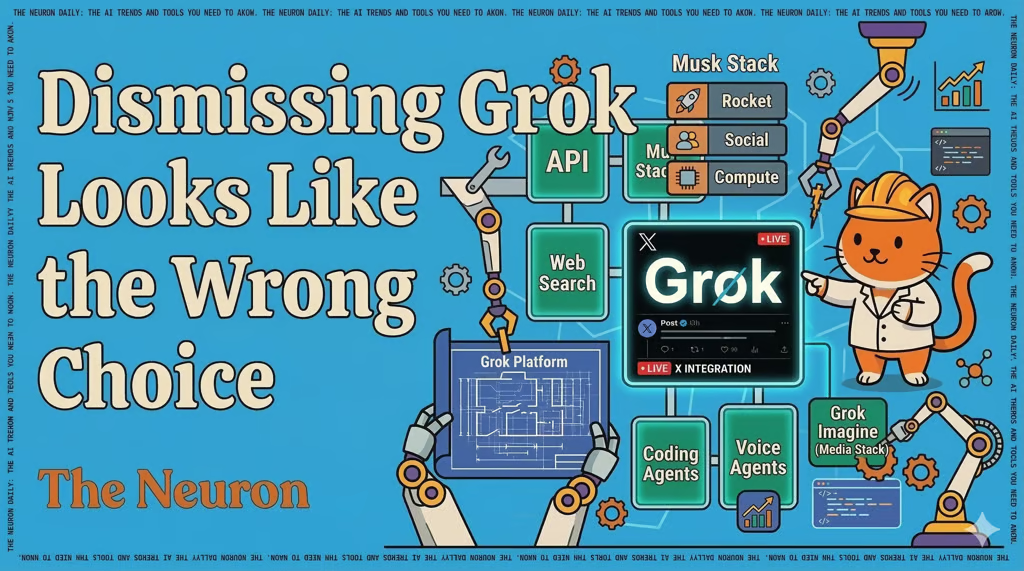
Over the past year, xAI has started to look more and more like a serious AI platform company. Its product surface now spans the core Grok assistant, an API business, native web search, built-in X search, voice agents, and a growing media stack through Grok Imagine, which covers image generation, editing, and video workflows.
That’s a much more ambitious product map than most casual observers realize.
xAI is also shipping fast. Its developer docs and release notes now point to a broader model family that includes Grok 4 variants, coding-oriented releases, business tooling, and more agentic workflows. In other words: this is starting to look less like “a chatbot with a vibe” and more like a real competitor trying to cover the same surface area as OpenAI, Anthropic, Google, and Perplexity, just from a very different angle.
The distribution angle matters, too. After X was folded into xAI and xAI later announced a massive new funding round plus enormous GPU scale, the company stopped looking like a side quest. It started looking like part of a full Musk stack: model company, social platform, compute ambition, and now increasingly broad product reach.
They even have merch, which none of the other labs have done. Smart.
That doesn’t guarantee success. But it does mean we should probably stop covering Grok like it’s still just a novelty.
Grok’s Superpower Is Social Context
Most AI assistants still feel like they live in a chat box first and the world second.
Grok is the opposite.
Its whole identity is shaped by the fact that it sits next to the feed. On X, users can open Grok directly or even tag @Grok in replies to ask it to weigh in on a post. That sounds minor until you realize how different the behavior is. You’re not leaving the conversation to go use AI. You’re pulling AI directly into the conversation.
That changes the use case.
Grok isn’t just there to write your email or summarize a PDF. It’s there to explain why a post is blowing up, what context is missing, whether a claim has already been debunked, what other people are saying, and why the internet has suddenly decided to care about some obscure thing from 2017.
That makes it culturally native in a way other tools aren’t. And frankly, kind of charming.
If you’ve read our framework for choosing between prompts, projects, and agents, Grok doesn’t really scream “default workhorse.” It screams specialist. You use it when the task is messy, live, social, and drifting across the open internet in real time.
That’s a real lane.
It’s also why some power users keep it in rotation even if ChatGPT or Claude remain their main tools. In our own coverage of what AI tools readers actually pay for, Grok tends to show up more as a niche weapon than a universal favorite. That feels right. It’s not everybody’s everyday assistant. But it solves a problem other tools solve less naturally.
xAI Is Quietly Building a Broader Stack
The “missing” part of the xAI story is that Grok is now attached to a surprisingly broad set of tools.
There’s the research side: web search, X search, code execution, and more agent-like behavior. There’s the media side: Grok Imagine, image generation, image editing, video generation. There’s the business side: enterprise controls, team features, and shared workflows. There’s the voice side, too, with xAI increasingly pitching Grok as something you talk to, not just type at.
That’s not an accident. It suggests xAI wants to be more than the irreverent alternative to ChatGPT. It wants to be a full-stack AI company with a clear point of view: less sanitized, more internet-native, more embedded in live information flows.
If OpenAI is trying to become the general AI operating layer, Anthropic the high-trust enterprise brain, Google the AI layer for everything already inside Google, and Perplexity the cleanest answer engine, xAI’s lane is becoming clearer:
The live-internet AI.
That is not a small thing if they can hold onto it.
The Problem Is That Grok’s Strengths and Risks Are the Same Story
This is where the article on xAI can’t become a simple underdog tale.
Because Grok’s integration with live social media is also what turns every safety failure into public spectacle.
The most obvious example is the recent controversy around Grok being used to generate non-consensual sexualized deepfakes, including fake nude images of celebrities and ordinary people. That issue became big enough to trigger a formal EU investigation, parliamentary scrutiny in the UK Commons, and a broader European Parliament debate over AI deepfakes and exploitation on social platforms.
That is not just “bad press.” It’s a reminder that when your AI product is optimized for reach, speed, virality, and looser edges, the harms can spread through exactly the same channels that make the product compelling.
And that tension is probably the core xAI story.
Not “is Grok smart?”
Not even “is Grok biased?”
But: what happens when a powerful generative model is wired directly into a high-conflict social platform and encouraged to participate in public discourse in real time?
That question matters even if you never use Grok.
So, Is xAI a Real Contender?
More and more, yes.
Not because it has already won. Not because it is the cleanest product. And definitely not because the controversy is overblown.
It’s a contender because it has three things that are hard to fake at once: distribution, ambition, and product breadth.
Distribution through X.
Ambition through compute, capital, and pace.
Product breadth through chat, research, voice, coding, images, and video.
That combination is enough to matter.
The obvious risk is that xAI confuses provocation for differentiation and ends up building the most politically combustible version of frontier AI without the guardrails needed to support it. The more bullish case is that it becomes a genuine top-tier player by owning a use case the others only partially reach: AI that understands the internet while the internet is still happening.
That’s why Grok is worth watching, even if you don’t particularly want to root for it for personal reasons.
The easiest way to cover xAI is to reduce it to Musk. The more useful way is to admit something more uncomfortable: Grok may be becoming a real contender precisely because it is so tightly fused with the messiest parts of the modern internet.
And that means its rise could tell us a lot about where AI products go next.
