

For years, the AI doctor has mostly lived inside a chat window. Ask a question, describe a symptom, get an answer—and then find a human who can actually do something about it.
Utah is testing what happens when the software gets prescribing authority.
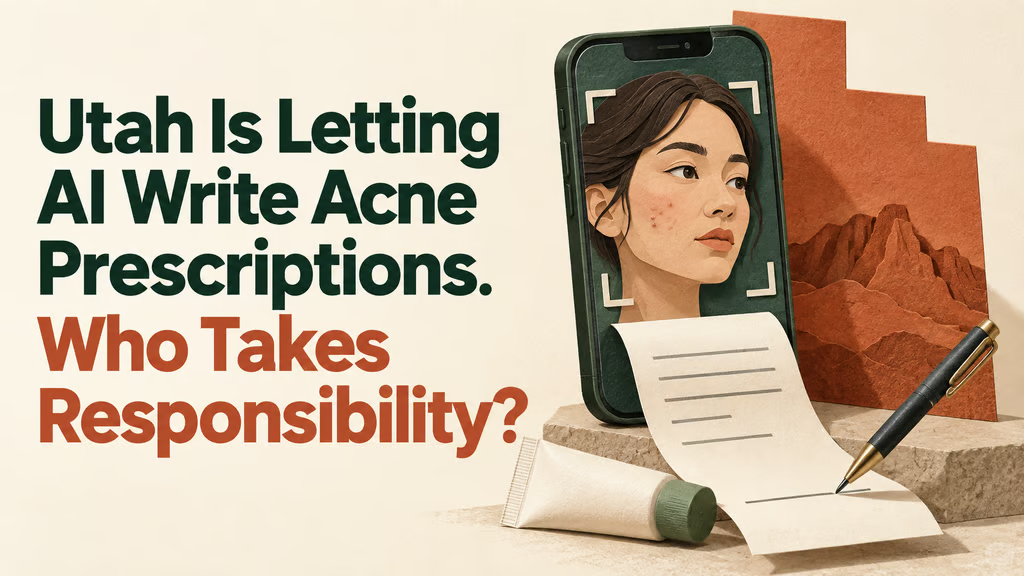
Nolla Health announced on October 5 that eligible Utah adults can enroll in a pilot allowing its AI to assess acne and initiate prescriptions. As Bloomberg reports, the program creates a narrow exception to rules that normally require a licensed human professional to prescribe medication.
The immediate application is acne cream. The larger experiment is whether a company can safely deliver routine medical treatment while moving physicians from approving every decision to reviewing decisions afterward.
That shift carries considerably more weight than another chatbot acing a medical exam.
From face scan to pharmacy
Nolla’s app asks patients to scan their faces and provide their medical histories. Its software assesses their skin, generates an acne severity score, and combines that assessment with personal medical information to select a treatment.
Bloomberg describes a list of eight permitted treatments. The pilot covers topical medications applied to the skin, with eligibility restricted to adults with mild to moderate acne. Severe acne and oral medications fall outside its scope. Utah’s public pilot registry also identifies exclusions including pregnancy, breastfeeding, and certain other risk factors.
There is a timing wrinkle: Nolla says enrollment is available, while the state registry still lists the formal demonstration period as not started. The announcement therefore should not be read as evidence that autonomous prescribing is already operating at scale.
And physician oversight changes gradually.
The signed agreement starts with at least 100 patients over a minimum of four weeks, with two independent Utah physicians reviewing every prescription before submission. The next stage requires at least 500 cumulative patients and eight weeks, with every case reviewed retrospectively at least weekly. A later stage permits monthly sampling covering at least 10% of prescriptions.
Each transition requires written state permission and specified performance and safety criteria.
The consequential change arrives when treatment can begin before a physician reviews that individual prescription. A retrospective review can identify a mistake, but it cannot prevent the original decision from reaching the patient.
The appeal is access—and the price needs context
Nolla’s pitch is easy to understand: getting help for a common skin condition should take less scheduling, traveling, and waiting.
Its pilot offering starts at $4.99 a month. Medication costs are separate. Bloomberg reports that compounded medications are available for about $50 a month, while the company compares its service with dermatology visits costing $150 to $300.
Those figures describe different purchases: a recurring app subscription, medication, and a clinical visit. They do not establish what every patient will save. But they explain the opportunity Nolla sees.
If software can handle appropriate routine cases, patients could receive treatment sooner and dermatologists could have more capacity for complex conditions. That is the company’s argument—and an outcome the pilot needs to measure.
The Neuron previously explored this access problem in its coverage of ChatGPT Health and Utah’s AI prescribing experiments. Nolla extends that discussion into a particularly consequential step: initiating treatment.
Utah’s earlier Doctronic pilot concerns renewals of medications already prescribed by a clinician. Nolla’s program allows a first prescription. Continuing an established treatment and selecting an initial one ask different things of the software.
A short treatment list helps. It doesn’t settle the safety question.
Nolla says its AI operates within predefined treatment pathways and sends patients outside those boundaries to a physician. Its launch announcement also claims clinicians agree with its recommendations in more than 96% of real-world cases.
That is a company-reported agreement rate. It does not, by itself, establish long-term patient outcomes or prove that the system reliably recognizes every patient who needs different care.
The difficult cases include someone whose condition resembles acne, someone who omits relevant medical information, or someone whose symptoms worsen after treatment begins. A restricted medication list limits what the AI can prescribe. The system still has to recognize when prescribing from that list is inappropriate.
This is part of the gap between medical knowledge and delivering care that we examined in our reporting on how people use AI for health questions. The interaction matters alongside the answer.
American Medical Association CEO John Whyte expressed skepticism to Bloomberg about autonomous systems meeting the standards expected of human practitioners: “And I don't think they can meet that burden.”
A supervised pilot can generate evidence relevant to that concern. Permission to conduct one cannot resolve it.
Responsibility is part of the product
Some of the most significant details here involve contracts rather than models.
Bloomberg reports that Utah requires malpractice insurance covering AI-generated prescriptions and incorporated provisions defining Nolla’s responsibilities to patients. The signed agreement also prohibits the company from using its user agreements to disclaim or limit liability for harm arising from the authorized AI outputs.
That matters because a prescription creates obligations. Patients and pharmacists need an accountable organization and a reachable clinician when something goes wrong.
Utah explicitly says sandbox participation is not a state endorsement of a product. It permits a limited experiment under defined conditions.
For AI builders, this suggests a practical route into regulated services: choose a narrow task, define when the software must stop, measure its decisions, and make responsibility explicit. Expanding the model’s capabilities is only one part of expanding its authority.
Nolla CEO Luis Wenus told Bloomberg he ultimately wants an “all-in personal doctor in your family, driven by AI.” The distance between acne treatment and that ambition remains substantial.
For now, the useful question is whether this tightly scoped service improves access while producing acceptable outcomes—and catches the cases it should hand to a human.
The prescription is the headline. What happens after patients fill it will determine whether the experiment deserves to grow.
Related reading
- ChatGPT Health, AI Doctors in Utah, and the Dawn of Medicine in Your Pocket — Context on Utah’s earlier prescribing experiment and the push toward accessible AI healthcare.
- ChatGPT Isn’t Replacing Doctors, but It Might Be the Paranoid Friend You Need at 2 AM — Explores the gap between an AI’s medical knowledge and its usefulness when real people seek care.
