


Ilya Sutskever doesn't do interviews. In fact, he's been the ghost in the machine of the AI industry for basically the entirety of last year. As the co-founder of OpenAI, the company's former Chief Scientist, and the man largely credited with the technical leaps behind ChatGPT, his sudden departure and subsequent silence left a major bald spot in the AI industry (we say with love). In actuality, the now head of Safe Superintelligence Inc. (SSI) has spent the last year in near-total silence—raising $2 billion, hiring quietly, and working on... something.
But until this week, no one knew exactly what he was doing.
So when he sat down with Dwarkesh Patel for over an hour to finally break his silence, the whole AI Research timeline on X.com paid attention. While he was careful not to leak trade secrets, the negative space in his answers—the things he refused to say—paints a clear picture of where he thinks the industry is wrong, and what SSI is likely building. And what he said challenges a lot of the conventional wisdom in AI right now. You can read the whole transcript of the episode here.
Below, we breakdown the most actionable insights from the podcast (with timecodes), and then run through a deep dive on all the key ideas, reacting to them along the way.
You should watch this to understand why the "Age of Scaling" is ending and why the next phase of AI depends not on bigger computers, but on discovering a specific, currently unknown "machine learning principle" that allows AI to learn as efficiently as a human teenager. Ilya has his suspicions on what that principle might be, but "there are some ideas" in AI research you don't just tell people... but of course, we can theorize what they might be based on what he did (and didn't) say.
- First, a quick TL;DR on why this interview is a big deal:
- If you only have 2 minutes, here are the top 10 things he had to say:
- Key Moments From The Video
- Putting the above in context...
- The "Age of Scaling" is Dead
- The Jaggedness Problem
- The Missing Machine Learning Principle
- The Product: The Superintelligent 15-Year-Old
- The Continual Learning Economy
- The Reaction
- Not Everyone's Impressed
- Why This Matters
- The Great AI Vibe Shift
- Our Take
- The Amygdala as Blueprint: How Ilya's System (or an "Ilya Inspired" System) Might Actually Work
- A Necessary Caveat: We Could Be Completely Wrong
First, a quick TL;DR on why this interview is a big deal:
Wayyyy back in 2023, the was a very infamous moment in AI that led to the firing and re-hiring of Sam Altman. Amidst all that chaos, a legendary meme was born: “What did Ilya see?”
The origin of said meme kicked off when Marc Andreessen tweeted “Seriously though — what did Ilya see?” Then Elon Musk basically pulled a Kanye to Marc’s Taylor Swift by jumping in to boost the post and made the line faaaamous.
Now, at this point, “what Ilya saw” is pretty much solved. Depending on the exact timing, Ilya saw one or more of the following: the o1 the reasoning model, the (supposed) scaling wall, Sam being shady, and perhaps even his new idea for SSI and the billions he eventually raised to fund it. And ever since then, he basically disappeared.
Now he's back... and some have theorized that he's trying to raise money again. It could be that he's just finally ready to talk... but only time (and a good headline in The Information or Bloomberg) will tell.
If you only have 2 minutes, here are the top 10 things he had to say:
- The “Jaggedness“ Problem: Ilya points out that current models are “jagged“—they crush PhD-level benchmarks but fail at basic tasks (like fixing a bug without breaking something else). He compares them to a student who studied 10,000 hours just to pass a test but doesn't actually understand the subject.
- The “Age of Research“ is back: For the last 5 years, AI progress came from “scaling” (making models bigger). Ilya argues that pre-training data is running out, and we are returning to an era where ideas matter more than compute.
- The “Secret“ Principle: Humans learn faster than AI. A teenager learns to drive in 10 hours; an AI needs millions of simulations. Ilya claims to know the “missing machine learning principle“ that explains this gap but refused to share it—hinting this is exactly what SSI is building.
- “There are more companies than ideas“: Ilya's bluntest observation. Everyone's doing the same thing. The Silicon Valley mantra that “ideas are cheap, execution is everything“ breaks down when nobody's having ideas.
- Emotions are the value function, not decoration: Ilya tells the story of a patient who lost emotional processing—he could still solve puzzles but couldn't decide anything. Took hours to pick socks. Emotions tell you when to stop thinking and act.
- RL (reinforcement learning) now consumes more compute than pre-training: The balance has flipped. Long reasoning rollouts eat massive compute, and you get relatively little learning per rollout.
- The goal isn't “finished AGI”—it's a superintelligent learner: Think of a brilliant 15-year-old, not an omniscient oracle. Deploy it, let it learn on the job, and merge knowledge across instances. That's the path.
- You can't communicate AI power through essays—you have to show it: Ilya's evolving view: gradual deployment matters because seeing AI do something is fundamentally different from reading about it. The world needs to feel the AGI capability.
- Ilya’s Timeline = 5-20 years to systems that learn as efficiently as humans and subsequently become superhuman. Wide range, but Ilya's not hedging—he thinks it's possible within that window.
- Research taste = beauty + simplicity + brain inspiration: When asked what makes great AI research, Ilya's answer is almost aesthetic: “There's no room for ugliness.“ The best ideas feel right from multiple angles simultaneously.
The big takeaway? The "just scale it up" era might be ending... for now. Ilya argues we're entering a "new age of research" ("just with big computers"), where the next breakthroughs won't come only from bigger clusters or more data—they'll come from ideas we don't have yet. He also dropped some fascinating insights on why AI models can crush benchmarks but still make embarrassing mistakes, why humans learn so much faster than machines, and what SSI is actually trying to build.
Key Moments From The Video
We recommend you watch the whole thing, but these sections of the video are specifically worth a watch.
- (0:00) The normalization of "Sci-Fi": Ilya notes how quickly society has normalized the "slow takeoff" of AI; despite investment reaching 1% of GDP, the impact currently feels abstract (mostly news headlines) rather than visceral, but he predicts this will change as AI diffuses through the economy.
- (1:32) The "Jaggedness" of current models: There is a confusing disconnect where models ace difficult evaluations but fail at basic economic tasks (e.g., introducing a new bug while fixing an old one). Ilya attributes this to RL training potentially making models "too single-minded" or researchers inadvertently "teaching to the test" on evals.
- (3:48) The difficulty of RL Data Selection: Unlike pre-training (where the answer to "what data?" is "everything"), RL requires choosing specific environments. This introduces human bias and error, as researchers may select RL environments that boost eval scores rather than general robustness.
- (6:14) The "Competitive Programmer" Analogy: Current models are like students who practiced 10,000 hours specifically for a coding competition—they memorized every algorithm but lack deep understanding. They lack the "it" factor of a student who practiced less but understands the fundamentals better.
- (11:35) Emotions as "Value Functions": Ilya shares a story about a person with brain damage to their emotional center who could solve puzzles but couldn't make decisions (e.g., took hours to pick socks). This suggests biological emotions serve as a "value function" to efficiently guide decision-making.
- (15:19) Short-circuiting reasoning: A major advantage of value functions in AI is the ability to "short-circuit" a long process. You don't need to finish a math proof to know a specific path is unpromising; a value function alerts you early, saving massive compute.
- (19:12) The return to the "Age of Research": 2012–2020 was the age of research; 2020–2025 was the "Age of Scaling" (just adding more compute/data). Ilya argues we are returning to an age of research because pre-training data is finite, and we must now figure out how to use massive compute for something other than just scaling the old recipe.
- (25:02) The "Missing" Machine Learning Principle: Humans are vastly more sample-efficient than models. While evolution explains some priors (vision), it cannot explain why humans learn math/coding faster. Ilya suggests there is a fundamental "machine learning principle" regarding reliable generalization that we haven't discovered yet.
- (31:37) The "Unspeakable" Solution: Ilya claims he has opinions on what this missing learning principle is, but "circumstances make it hard to discuss in detail," implying it is a sensitive or dangerous piece of intellectual property/insight.
- (38:33) Compute myths regarding research: You don't need the world's largest cluster to do breakthrough research (AlexNet used 2 GPUs; Transformers used ~64). Massive compute is needed for the final product, but the "Age of Scaling" tricked people into thinking you need massive compute just to have an idea.
- (47:37) Reframing AGI as "Continual Learning": The term "AGI" implies a model that knows everything. Ilya argues the goal shouldn't be a model that knows every job, but a "superintelligent 15-year-old" that can learn any job quickly. The future is "Continual Learning" agents, not static repositories of knowledge.
- (51:35) Intelligence Explosion via Deployment: If you have a model that learns like a human, and you deploy millions of instances across the economy, they can learn on the job and merge their knowledge. This creates a functional superintelligence without needing recursive self-improvement code.
- (59:15) Prediction on Safety Collaboration: Ilya predicts that as AI becomes visibly powerful, fierce competitors will start collaborating on safety (citing OpenAI/Anthropic as a start) and governments will intervene significantly.
- (1:00:18) The "Paranoia" Prediction: Right now, AI mistakes make it feel weak. Once AI stops making mistakes and feels powerful, companies will undergo a "big change" and become "much more paranoid" about safety.
- (1:01:17) Alignment Goal: "Care for Sentient Life": Rather than "human control," the robust alignment goal should be an AI that cares for "sentient life." Ilya argues this might be easier to build because the AI itself will be sentient, allowing it to use "mirror neurons" or empathy logic to understand us.
- (1:09:32) The Long-Run Equilibrium (Neuralink++): Ilya suggests the only stable long-term outcome—which he admits he doesn't "like"—is for humans to become part-AI (via something like Neuralink) to share in the understanding and agency of the superintelligence.
- (1:11:36) The Mystery of Social Evolution: It is technically mysterious how evolution (a blind process) managed to hard-code high-level social desires (like wanting to be liked) into the brain without having access to the "intelligent" processing of the cortex.
- (1:21:01) Convergence of Strategies: He predicts that as the path becomes clearer, all major AI labs will converge on similar technical and alignment strategies (e.g., caring for sentient life).
- (1:22:23) Timeline Forecast: Ilya predicts we will see systems with this human-like learning capability (leading to superintelligence) in 5 to 20 years.
- (1:33:18) How to have "Research Taste": Great research comes from an aesthetic of "how things should be" (simplicity, elegance, correct biological inspiration). You need a "top-down belief" to sustain you when experiments fail, otherwise, you will give up on correct ideas too early due to bugs.
Putting the above in context...
This timeline more or less recaps the key points from the video in their full context.
1. The End of the "Age of Scaling"
- 1.1 Historical Context: 2012–2020 was the "Age of Research" (tinkering). 2020–2025 was the "Age of Scaling" (pre-training + massive compute).
- 1.2 The Current Wall: Pre-training data is finite and running out. Just making clusters bigger without new ideas won't yield the same returns.
- 1.3 Shift Back to Research: We are returning to an era where ideas matter more than just raw compute. "There are more companies than ideas by quite a bit."
- 1.4 Compute Myth: You don't need the world's largest cluster to have an idea (AlexNet used 2 GPUs; Transformers used ~64). Massive compute is for the final product, not the breakthrough insight.
2. The "Jaggedness" of Current Models
- 2.1 The Paradox: Models ace hard benchmarks (PhDs) but fail basic tasks (e.g., fixing a bug and introducing a new one, then looping forever).
- 2.2 The "Competitive Programmer" Analogy:
- Current models = A student who practiced 10,000 hours, memorized every algorithm, but lacks deep understanding (overfit).
- Humans = A student who practiced 100 hours but "gets it" and generalizes better.
- 2.3 Root Cause: RL training selects specific environments, leading to "teaching to the test" (human bias in selection) rather than general robustness.
3. The "Missing" Machine Learning Principle (The Secret Sauce)
- 3.1 Sample Efficiency: Humans (specifically teenagers learning to drive) learn vastly faster than models with zero verifiable reward functions.
- 3.2 The Unexplained Gap: Evolution explains vision/locomotion priors, but not math/coding (new skills). Humans are statistically better at machine learning than current AI.
- 3.3 The "Unspeakable" Insight: Ilya claims to have an opinion on what this principle is, but refused to discuss it ("circumstances make it hard to discuss"), implying this is SSI's core IP.
4. Emotions as Value Functions
- 4.1 Biological Insight: Emotions aren't just feelings; they are highly efficient "value functions."
- 4.2 Case Study: A patient with brain damage to the emotional center could solve logic puzzles but couldn't decide which socks to wear.
- 4.3 Function: Value functions allow "short-circuiting", or knowing a path is bad without traversing it fully. Current AI lacks this efficient "gut feeling."
5. SSI’s Strategy & "The Superintelligent 15-Year-Old"
- 5.1 Redefining AGI: "AGI" implies a know-it-all database. Ilya rejects this.
- 5.2 The Goal: Build a "Superintelligent 15-year-old"; a system with massive learning potential (IQ) but not necessarily all knowledge.
- 5.3 Deployment Strategy:
- Deploy the "learner" into the economy.
- It learns on the job (continual learning).
- Merge the knowledge from millions of instances.
- 5.4 Change of Plans: Originally planned a "straight shot" (no products until AGI), but now sees value in gradual deployment so society can "see" the power.
6. Safety, Alignment, and Timeline
- 6.1 Ilya's Timeline = 5 to 20 years for superintelligence.
- 6.2 Paranoia: As AI stops making mistakes and feels powerful, labs will become "much more paranoid" and naturally collaborate.
- 6.3 Sentience: The alignment goal shouldn't be "human control" but "caring for sentient life." Since the AI will be sentient, it can use empathy/mirror neurons to understand us.
- 6.4 Long-term Equilibrium: Humans might need to merge with AI (Neuralink++) to remain relevant/safe (Ilya admits he "doesn't like" this outcome but sees it as stable).
Now, we'll dive deeper into into the key topics, and zoom out from this conversation to look at a series of trends in major AI researchers and what they claim about the so-called "wall" headed for LLMs.
The "Age of Scaling" is Dead
For the last five years, the AI playbook was simple: take the transformer architecture and blast it with more data and more compute. This was the "Age of Scaling." It worked so well that it sucked the air out of the room. Strategies converged; everyone built the same thing, just bigger.
Ilya’s central thesis is that this era is ending. Pre-training data is finite, and the returns on simply making clusters bigger are diminishing. We are returning, he argues, to an "Age of Research."
"There are more companies than ideas by quite a bit," Sutskever noted. The next breakthrough won't come from a bigger data center; it will come from a fundamental change in how these systems learn.
The Jaggedness Problem
Ilya highlights a paradox in current models (like GPT-4 and Claude) that he calls "jaggedness." These models can pass the Bar Exam or solve PhD-level physics problems, yet they fail at basic tasks. Ask a model to fix a bug in code, and it might fix it—while introducing a new, simpler bug. Ask it to fix that one, and it re-introduces the first.
Ilya compares current AI to a "competitive programmer" who practiced for 10,000 hours. This student has memorized every algorithm and seen every trick. They can win the competition. But compared to a student who practiced 100 hours but deeply understands the principles, the 10,000-hour student is brittle. They are "overfit." They lack the "it" factor.
Current AI models are the 10,000-hour student. They have seen the entire internet, yet they learn slower and generalize worse than a human teenager.
The Missing Machine Learning Principle
This is where the interview turns into a detective story. Ilya points out that humans possess a "sample efficiency" that is mathematically baffling to current AI researchers.
A teenager learns to drive a car in roughly 10 hours. They do this without crashing 500 times (usually) and without a "verifiable reward function" telling them exactly what they did right or wrong every millisecond. They self-correct.
When pressed on how humans do this, Ilya says, "There is a machine learning principle that I have opinions on. But unfortunately, circumstances make it hard to discuss in detail."
This "unspeakable" solution is almost certainly what SSI is building.
Based on his fascination with biological analogies during the interview, we can theorize that SSI is moving away from the "static database" model of AI. He discusses "value functions" at length—citing a study of a brain-damaged patient who lost the ability to process emotion and, consequently, the ability to make decisions. Ilya argues that emotions are actually highly efficient value functions that allow humans to "short-circuit" reasoning. We don't need to calculate every outcome to know a decision is bad; we just feel it.
SSI is likely building a system that mimics this biological "gut check"—a model that doesn't just predict the next token, but possesses an internal value function allowing it to learn from small amounts of data, unsupervised, just like a teenager. And becaue the company is called "safe" superintelligence, you can bet alignment will be a big part of the picture as well.
The implication = emotions aren't just color commentary. They're the value function. They tell you when to stop deliberating. And human emotions are remarkably robust—even though they evolved for a totally different environment, they still guide us reasonably well in the modern world (with some exceptions, like overconsumption).
The Product: The Superintelligent 15-Year-Old
Perhaps the most actionable insight for the industry is Ilya’s redefinition of AGI. We tend to either think of AGI as a god-like oracle that knows everything, or an infinite number of copies of a similarly powerful, albeit smaller AI.
Ilya rejects this. He argues that humans aren't AGI by that definition; we don't know everything. Instead, he aims to build a "superintelligent 15-year-old."
Imagine a system that has the raw learning potential of a genius teenager. It doesn't know how to do molecular biology yet. But if you give it a textbook and access to a lab, it can learn molecular biology in a week.
This shifts the product roadmap. Instead of training a model on the entire internet and releasing a static chat bot, the goal is to release a "learner."
The Continual Learning Economy
This leads to Ilya’s vision of the future economy. You deploy millions of these "15-year-old" agents. One goes to work at a law firm, another at a coding shop, another at a hospital. They learn on the job via "continual learning."
Then, unlike humans, they merge their weights. The lawyer-AI teaches the doctor-AI. This aggregation of specialized, on-the-job learning creates the true superintelligence.
Ilya's original plan was to skip incremental product releases and go directly to superintelligence. But he's changing his mind:
- Gradual deployment helps the world see powerful AI (essays don't communicate it; demos do)
- You can't make AI safe just by thinking about safety—you need deployment to find failures
- Human learning suggests the right target isn't a finished AGI, but a superintelligent learner—like a brilliant 15-year-old who then learns on the job
Continual Learning as the Key: The term "AGI" presupposes a finished, general intelligence. But humans aren't AGI—we lack huge amounts of knowledge and rely on continual learning. Ilya's vision: deploy a superintelligent learner whose instances learn different jobs across the economy, then merge their knowledge. That's the path to actual superintelligence—not a single training run.
Alignment via Caring for Sentient Life: Ilya argues it may be easier to align AI to care about all sentient life (including itself) than to care only about humans. Why? Because the AI will be sentient too. And our own empathy for animals may emerge from modeling others with the same circuits we use to model ourselves.
The Reaction
Here's an initial round-up of takes which is by no means exhaustive; might add more later:
- Super Dario declared it “Ilya podcast day” and joked that it’s more than enough reason to call out sick, capturing how hyped the hardcore AI crowd was for the Dwarkesh & Ilya Sutskever interview.
- Chubby's recap was a viral TL;DR of the Ilya interview—current scaling will go some distance but not all the way, and safe superintelligence will require new ideas—giving you a reader-friendly summary to drop right under your main Dwarkesh/Ilya section.
- slow_developer listed “the most important points” from the Ilya podcast: superintelligence in roughly 5–20 years, today’s scaling will stall out hard, and the next leap will come from real research rather than more GPUs.
- Yuchen Jin boiled the conversation down to one line—“Ilya declared, ‘The age of scaling is over’”—which is a perfect pull-quote to frame your whole discussion of what comes after brute-force scaling.
- deredleritt3r summarized “the mountain” Ilya said he’s climbing with Safe Superintelligence Inc., highlighting how easy it will soon be for a teenager to train powerful models and why that makes alignment and governance feel so urgent.
- Dimitris Papailiopoulos joked that “Ilya revealed ~3 bits of information,” a wry one-liner you can use to convey how little concrete technical detail many listeners felt they actually got out of the interview.
- Lucas Beyer quipped that Dwarkesh dropping a megaton Ilya interview promo “means new SSI funding round in a few weeks,” tying the podcast buzz directly to expectations of another massive Safe Superintelligence raise.
- Benjamin called the Ilya podcast “very underwhelming,” arguing that Sutskever says “not actually much in very many words,” which is a clean negative reaction you can quote in a “mixed reviews” paragraph.
- Benjamin followed up by asking what incentive Ilya really has to ship anything at SSI, suggesting he may prefer a monk-like research existence at a lab that can float for years on billions of investor dollars.
- Robert Scoble said that after listening to Ilya he’s “even more convinced we won’t know when AGI gets here,” capturing the interview’s theme that AGI may arrive gradually and confusingly rather than with a single obvious break.
- FleetingBits wrote that the Ilya / Dwarkesh interview felt “sort of contentless” but still called Ilya “a very good chief scientist,” offering a balanced take of high expectations, thin specifics, and lots of respect for his past track record.
- Sebastian Raschka joked that what Ilya “saw was extreme benchmaxxing,” which in turn pushed him to start SSI so he could do LLM development “the proper way,” framing the new lab as a reaction against benchmark-chasing culture.
- Ethan Mollick used the interview as a jumping-off point to remind people that exponential curves are hard to reason about, arguing that we’re probably underestimating how strange the compounding effects of systems like Claude, Gemini, and SSI’s future models will feel.
- Mollick also drew a parallel between his first academic paper on Moore’s Law and today’s AI trajectory, warning—again via the Ilya conversation—that we tend to systematically misread how exponentials translate into real-world change.
- Lucas Crespo clipped Ilya talking about “finding the mountain you want to climb” and treated it as a kind of mission-statement moment, emphasizing how personally motivated Sutskever seems about the safe superintelligence project.
- Kangwook Lee posted a screenshot of this paper, which made the interview feel like de ja vu. Nice, some weekend reading!
Oh yeah, and the memes were memein'.
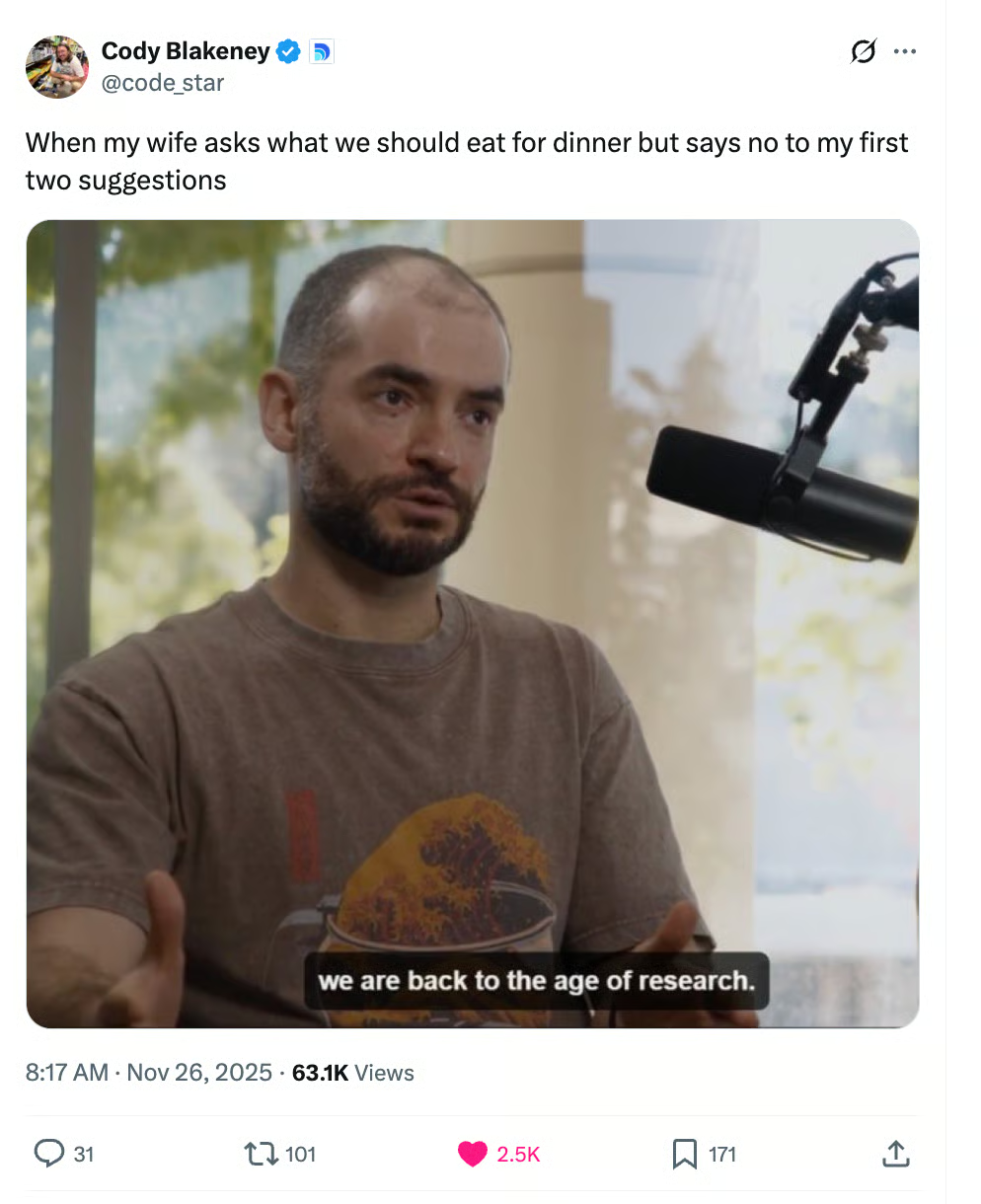


Not Everyone's Impressed
For all the hype around Ilya breaking his silence, not everyone in the research community found the interview revelatory.
Dimitris Papailiopoulos (Microsoft Research, UW Madison) quipped on X that "Ilya revealed ~3 bits of information"—a brutal information-theoretic joke meaning the hour-long interview contained roughly three yes/no questions worth of actual news. Fellow researcher Kangwook Lee piled on: "3 bits per episode is a lot of information—I thought we get at most one bit per episode," riffing on the exact sparse-reward RL problem Ilya himself criticized.
Dimitris's harsher take: "it's just so underwhelming that one of the most widely perceived impactful figures of 'AGI' has so little to offer in terms of intellectual influence for the field."
The counterargument is fair. Ilya explicitly refused to share his actual ideas ("circumstances make it hard to discuss in detail"). He hinted at a "missing machine learning principle" without describing it. He gestured at emotions-as-value-functions without proposing an architecture. For researchers hoping for technical meat, the interview was mostly vibes.
But maybe that's the point? If Ilya genuinely believes he's found something important, broadcasting it to competitors would be... suboptimal. As one reply noted: "to give out alpha could potentially lead to powerful, unsafe models and also give competitors an advantage."
The cynical read: Ilya is fundraising and needed to say something without saying anything.
The generous read: The negative space—what he didn't say—tells us more than what he did. The "age of scaling is over" message, coming from him, is itself significant signal.
Either way, our 3,000-word speculation about amygdala architectures might be exactly the kind of over-interpretation that makes information-theorists cringe. We built an entire cathedral from 3 bits of foundation.
Why This Matters
If Ilya is right, the companies spending hundreds of billions on massive clusters to train "GPT-5" using the old recipe might be hitting a wall. The future belongs to whoever discovers the "missing principle" of efficient learning.
And considering Ilya Sutskever has been right about every major paradigm shift in AI for the last decade—from AlexNet to Transformers—it would be foolish to bet against him now.
The "Superintelligent 15-Year-Old":
Instead of building a chatbot that knows everything (which is impossible), Ilya wants to build a "superintelligent 15-year-old."
- It doesn't know your job yet. But like a smart intern, it can learn it instantly.
- It uses "Continual Learning." It learns on the job, then merges that knowledge with millions of other agents.
The entire industry is currently betting on "bigger is better." Ilya is betting on "smarter is better." If he’s right (and he usually is), the companies spending billions on massive data centers might be building the wrong thing.
The Great AI Vibe Shift
If you zoom out, Ilya isn't just a lone voice in the wilderness. He is the loudest voice in a growing chorus of AI pioneers who are all simultaneously realizing that the "Scale is All You Need" party is over.
When we triangulate Ilya’s cryptic hints with recent insights from Richard Sutton (the father of Reinforcement Learning), Andrej Karpathy (AI legend/educator), and Llion Jones (co-inventor of the Transformer), a fascinating picture of SSI's potential roadmap emerges (plus Yann Lecun, Dr. Fei-Fei Li, and Gary Marcus, to name a few).
Here is what we think Ilya is actually building, based on the clues left by his peers:
1. The "Ghost" vs. The "Animal" (Ilya x Karpathy)
In his recent interview, Andrej Karpathy gave us the perfect metaphor for the problem Ilya is trying to solve. Karpathy argued that current LLMs are "Ghosts"—they are disembodied spirits formed by mimicking human text. They have seen everything but experienced nothing.
Contrast this with "Animals" (biological intelligence), which learn through goals, survival, and direct interaction with the physics of the world.
- The Connection: When Ilya talks about building a "Superintelligent 15-year-old," he is effectively saying he wants to turn the Ghost into an Animal.
- Karpathy noted that current models suffer from "Cognitive Deficits" because they rely on perfect memory rather than reasoning. Ilya’s "15-year-old" is the solution to this: a model with less memorized knowledge (no hallucinated facts) but significantly higher reasoning capabilities (the ability to learn).
- The Clue: SSI isn't building a bigger GPT-5. They are likely stripping the model down. They are building a "Cognitive Core" (to use Karpathy's term) that prioritizes the algorithm of learning over the database of knowledge.
2. The Move to "Runtime" Learning (Ilya x Sutton)
Richard Sutton, the Turing Award winner, recently argued that LLMs are a "sophisticated dead end" because they are stuck in a paradigm of "training" vs. "deployment." You train them once, and they are frozen.
Sutton proposes the "Big World Hypothesis": The world is too complex to ever memorize in a pre-training run. Therefore, true intelligence must be able to learn "at runtime" (on the job).
- The Connection: This maps perfectly to Ilya's concept of "Continual Learning." Ilya explicitly stated that the "Age of Scaling" (pre-training) is giving way to an era where the model learns after deployment.
- What SSI might be building: Sutton proposed an architecture called OaK (Options and Knowledge), where an agent creates its own sub-goals to learn skills. In fact, Sutton's proposed architecture—an agent with a Policy, Value Function, Perception, and Transition Model that learns continually from experience—sounds remarkably similar to Ilya's "superintelligent 15-year-old" vision. If Ilya is right about the "missing machine learning principle," it is almost certainly a mechanism for this type of self-supervised, runtime learning. Ilya’s system won’t just answer your email; it will change its own neural weights based on whether you liked the answer.
3. The Architecture: "Thinking in Time" (Ilya x Continuous Thought Machine)
Finally, how do you actually build this? Llion Jones, a co-author of the original Transformer paper, recently stopped working on Transformers because he believes they are a "local minimum." He is now building the Continuous Thought Machine (CTM).
- The Connection: Current Transformers process data in one "shot." They don't pause to think. CTM, however, processes "thoughts" as trajectories over time. It can backtrack, leapfrog, and ponder before answering.
- The Smoking Gun: Ilya spoke at length about "Value Functions" (emotions) allowing humans to "short-circuit" reasoning. This is exactly what the CTM does—it uses an internal gauge to decide when it has thought enough about a problem.
- If we had to bet, SSI’s "unspeakable" secret sauce involves a move away from the static, feed-forward Transformer toward a recurrent, time-based architecture similar to the CTM in concept (but different in execution). This allows the model to simulate outcomes and "feel" (via value functions) which path is right before committing to an answer.
So that said, what could he be building?
Our Take
Ilya’s focus on "value functions" (which he compares to human emotions) suggests the next generation of AI won't just be a text predictor. It will have a "gut feeling" about whether an answer is right or wrong, allowing it to reason much more efficiently than today's models. Below, we'll take a few guesses (just for fun) on what that could look like.
The Amygdala as Blueprint: How Ilya's System (or an "Ilya Inspired" System) Might Actually Work
Here's where things get technical, but stay with us, because this might be the key to understanding what SSI is building.
Contemporary neuroscience has converged on a striking finding: the amygdala acts as a constant, parallel evaluation system. It doesn't wait for your cortex to finish reasoning. Instead, it continuously integrates sensory information and assigns emotional "values" across three dimensions:
- Valence (is this good or bad?)
- Intensity (how much should I care?)
- Approachability (is this safe to engage with, or should I avoid it?)
This is fundamentally different from how current AI models work.
How Today's Models Process Information
Current transformer models (GPT, Claude, Gemini) use attention mechanisms to compute relationships between tokens. The math looks something like this: the model calculates how relevant each piece of input is to every other piece, then uses those weights to predict the next token (a gross oversimplification, sorry ML fam).
Critically, this happens in one forward pass. The model processes everything, generates an output, and then—if you're using RLHF (reinforcement learning with human feedback) or similar techniques—an external reward signal tells it whether that output was good or bad. The evaluation happens after the reasoning, and it comes from outside the model.
There's no continuous background process asking "wait, is this going somewhere bad?" while the model is still thinking.
What an Amygdala-Like System Would Need
If you wanted to replicate the amygdala's function in a machine learning context, you'd need something like a parallel evaluation pathway that runs continuously alongside the main reasoning process. This secondary system would:
- Evaluate every intermediate state, not just final outputs
- Assign real-time valence scores (is this reasoning chain trending toward a good or bad answer?)
- Provide intensity signals (how confident should we be? how much compute should we allocate?)
- Generate approachability judgments (is this a domain where we have reliable knowledge, or should we be cautious?)
The key difference: this evaluation would happen during reasoning, not after. It could interrupt a chain of thought mid-stream if the valence turns sharply negative—exactly like how a bad gut feeling makes you stop and reconsider before you've fully articulated why.
The "Short-Circuit" Ilya Mentioned
This maps directly to what Ilya described as "short-circuiting." In the interview, he explained that value functions let you know a path is unpromising without traversing it fully. You don't need to finish a math proof to sense it's going nowhere.
Current models can't do this efficiently. They have to complete their reasoning chain, generate an output, and only then can any evaluation occur. It's like having to finish writing an entire essay before you're allowed to realize the thesis was wrong.
An amygdala-like architecture would flip this. The evaluation runs in parallel, continuously, and can redirect processing at any point. This is what allows humans to learn from tiny amounts of data—we don't need millions of examples because we're getting dense feedback signals at every step of our reasoning, not just at the end.
The Evolutionary Prior Problem
There's one more wrinkle. The human amygdala isn't just a learned system—it comes pre-wired with evolutionary priors. Certain stimuli (snakes, heights, angry faces) trigger responses without any learning required.
This might be why Ilya kept circling back to "inspiration from the brain" as a core principle of good research. A truly efficient learning system might need some equivalent of these priors—not hard-coded fears of snakes, but perhaps hard-coded intuitions about logical consistency, causal relationships, or goal-directed behavior.
If SSI has cracked how to build this kind of parallel evaluation system with the right priors, it would explain both Ilya's confidence and his refusal to share details.
Think about it: when did your "training" end and your "deployment" begin? Never. You've been learning continuously since birth. Every conversation, every stumble, every surprise updates your model of the world in real time. There's no offline training run followed by a frozen deployment.
This is exactly what Sutton's OaK architecture and Ilya's "superintelligent 15-year-old" vision are pointing toward: the separation between training and inference may be an artifact of how we build AI, not a feature of intelligence itself.
For humans, the amygdala is providing the training signal in real time. When you feel that gut sense of "this is going wrong," that's not just an alert to stop; it's immediate feedback that updates your intuitions for next time.
What This Architecture Actually Requires
We thought we'd have a little fun, so we asked Claude Opus 4.5 and Gemini 3 how you could actually build something like this. Here's what they said:
If you wanted to build this, you'd need three components working together:
1. Genetic-Like Priors (The DNA Layer)
Humans don't start from scratch. We arrive pre-loaded with billions of years of evolutionary priors encoded in our DNA: basic drives toward survival, social connection, curiosity. A newborn already "wants" things—food, comfort, attention—before any learning occurs.
The AI equivalent would be a base layer that encodes:
- Fundamental alignment constraints (caring about human wellbeing, avoiding harm).
- Basic "instincts" about logical consistency, causal reasoning, goal-directed behavior.
- Initial value functions that can be refined but not easily overwritten.
This is what Karpathy meant when he called pre-training "our crappy evolution." It's the practical hack we use to initialize the weights with enough structure that the model isn't starting from random noise. But current pre-training is too much—it loads in all of human knowledge rather than just the cognitive priors needed to learn efficiently.
Ilya's "secret" machine learning principle might be figuring out how to extract just the cognitive core—the minimal set of priors that enable human-like learning—without all the memorized baggage.
2. Continuous Parallel Evaluation (The Amygdala Layer)
This secondary system would run alongside the main reasoning process and:
- Evaluate every intermediate state, not just final outputs.
- Assign real-time valence scores (is this reasoning chain trending toward a good or bad answer?)
- Provide intensity signals (how confident should we be? how much compute should we allocate?)
- Generate approachability judgments (is this a domain where we have reliable knowledge, or should we be cautious?)
Crucially, this evaluation would serve dual purposes: it guides the current reasoning process (short-circuiting bad paths) AND provides the training signal that updates the model's weights in real time.
3. Perpetual Learning (The Continual Update Layer)
No separate training phase. No frozen weights during deployment. The model updates continuously based on the amygdala layer's evaluations. Every interaction with the world—successful or failed—immediately refines the model's understanding.
This is Sutton's "Big World Hypothesis" in action: the world is too vast and idiosyncratic to pre-train on everything. The agent must learn "on the job" from its unique experiences.
How OaK and CTM Fit Into This
The exciting part: the pieces for this architecture may already exist in nascent form.
Sutton's OaK architecture provides the framework for runtime skill acquisition. The FC-STOMP cycle (Feature Construction → Subproblem → Option → Model → Planning) describes how an agent can generate its own goals and learn solutions through interaction. What's missing is the parallel evaluation system that guides which subproblems to pursue and provides dense feedback during learning.
The amygdala layer could slot directly into OaK by:
- Assigning valence scores to discovered features (is this interesting/threatening/useful?)
- Providing intensity signals that determine how much compute to allocate to each subproblem
- Evaluating option execution in real time, not just at completion
Jones' Continuous Thought Machine may have already built part of the amygdala layer without realizing it. CTM's key innovation is that neurons track their own history and measure synchronization over time. This creates exactly the kind of temporal, relational representation that could support continuous evaluation.
The CTM's "internal time dimension" could serve as the substrate for parallel evaluation by:
- Using neuron synchronization patterns as valence signals (certain patterns = "this is going well")
- Allowing the model to "interrupt" its own reasoning when synchronization patterns indicate trouble
- Providing dense, continuous feedback for weight updates rather than sparse end-of-trajectory rewards
The Synthesis: A Speculative Architecture
Putting it together, you might get something like:
- Initialize with minimal cognitive priors (the "DNA"): not internet-scale pre-training, but a small, curated foundation that establishes base value functions and alignment constraints. Think: the instinct to be helpful, basic logical consistency, curiosity toward novel problems.
- Run CTM-style internal processing with neurons tracking their own history and measuring synchronization. This creates the temporal dynamics needed for parallel evaluation.
- Use synchronization patterns as the amygdala signal: train a secondary pathway (or emergent property of the main network) to recognize which synchronization patterns correlate with good outcomes. This becomes the real-time valence/intensity signal.
- Implement OaK-style option learning for skill acquisition, but guided by the amygdala layer rather than sparse external rewards. The agent pursues subproblems that the amygdala flags as "interesting" and abandons paths that trigger negative valence.
- Never stop training: every interaction updates the weights. The separation between learning and doing dissolves.
The Evolutionary Prior Problem—Solved?
There's one more wrinkle this resolves. The human amygdala isn't just a learned system—it comes pre-wired with evolutionary priors. Certain stimuli (snakes, heights, angry faces) trigger responses without any learning required.
In this architecture, those priors live in the "DNA layer"—the initial weights that establish base value functions. The key insight is that these priors should be:
- Minimal: just enough to bootstrap learning, not a full world model
- Aligned: encoding care for human wellbeing from the start, not bolted on later
- Refinable: able to be updated by experience, but resistant to catastrophic overwriting
This is what Ilya might mean when he talks about alignment being easier if the AI "cares for sentient life" from the beginning. You're not trying to constrain an alien optimizer—you're nurturing a system that was born with the right instincts and learns to refine them.
If SSI has cracked how to build this kind of architecture—minimal cognitive priors, parallel evaluation during both reasoning and learning, perpetual weight updates—it would explain both Ilya's confidence and his refusal to share details. This wouldn't just be an incremental improvement. It would be a new paradigm entirely. This is deeply speculative, of course. Knowing Ilya, whatever hecomes up with is probably twice as smart as this, and five times more simple. Plus, y'know, the math to back it up.
A Necessary Caveat: We Could Be Completely Wrong
Ilya told Dwarkesh that great research taste comes from "correct inspiration from the brain" and knowing how to draw the right conclusions. "Ugliness, there's no room for ugliness," he said. "It's beauty, simplicity, elegance, correct biological inspiration. All of those things need to be present at the same time."
Here's our problem: Who's to say we're drawing the right conclusions?
We just spent 3,000 words speculating about amygdala-like architectures, CTM synchronization patterns, and the synthesis of four different research programs—none of which Ilya actually described. He explicitly said he has ideas about the "missing machine learning principle" but "circumstances make it hard to discuss in detail."
So we're doing exactly what he warned against: we're the competitive programmer who practiced 10,000 hours analyzing this interview, pattern-matching across four different researchers, and potentially drawing all the wrong conclusions with extreme confidence.
Ways we could be totally off base:
- The convergence is coincidental. Four smart people criticizing current AI doesn't mean they're pointing at the same solution. Sutton wants pure RL agents. Karpathy thinks LLMs are fine, just overhyped. Jones is building weird neuron timing stuff. Maybe they'd all hate being grouped together. Sorry, guys!
- The amygdala thing is a stretch. Ilya mentioned value functions and emotions exactly once. We built an entire speculative architecture around it. He might read this and think "that's not even close." lol but what if it was? Can we get a job at SSI??
- The amygdala thing could just be a tiny part of the whole. We have a crazy brain y'all. It does all kinda things. We also didn't even touch on memory and how that works via the hippocampus and pre-frontal cortex, or any of the other sections. Perhaps the amygdala will be a smaller part of a larger brain interface. I'm sure we're thinking too abstractly here, where as actual ML researchers are far deeper down in the mechanisms.
- SSI could be doing something completely different. Maybe they're just doing better RL. Maybe they found a clever data trick. Maybe the "secret" is embarrassingly simple and has nothing to do with brain-inspired parallel evaluation.
- The "no training/inference split" idea might be wrong. Humans do have something like a training phase—it's called childhood, and we're basically useless during it. Maybe the separation is actually useful and we're romanticizing "perpetual learning."
- We're reading too much into silence. Interpreting the "negative space" of what Ilya didn't say is peak speculation. He might have avoided details because there aren't details yet, not because they're too valuable to share.
The honest answer is: we don't know what SSI is building. We're connecting dots that might not connect, inspired by a guy who just told us that real intelligence comes from direct experience with the world, not from reading about it.
The irony is not lost on us.
That said, if even half of this directionally correct, the implications are massive. And at minimum, the convergence between Ilya, Karpathy, Sutton, and Jones on the diagnosis (models are jagged, RL is broken, generalization is the bottleneck) seems real, even if we're wrong about the cure.
After all, Gemini and Claude just showed you can still get massive gains from scaling. Who says the age of scaling is over so soon?
Watch the full conversation here—and draw your own conclusions. Hopefully the right ones. The beautiful, simple ones.
