
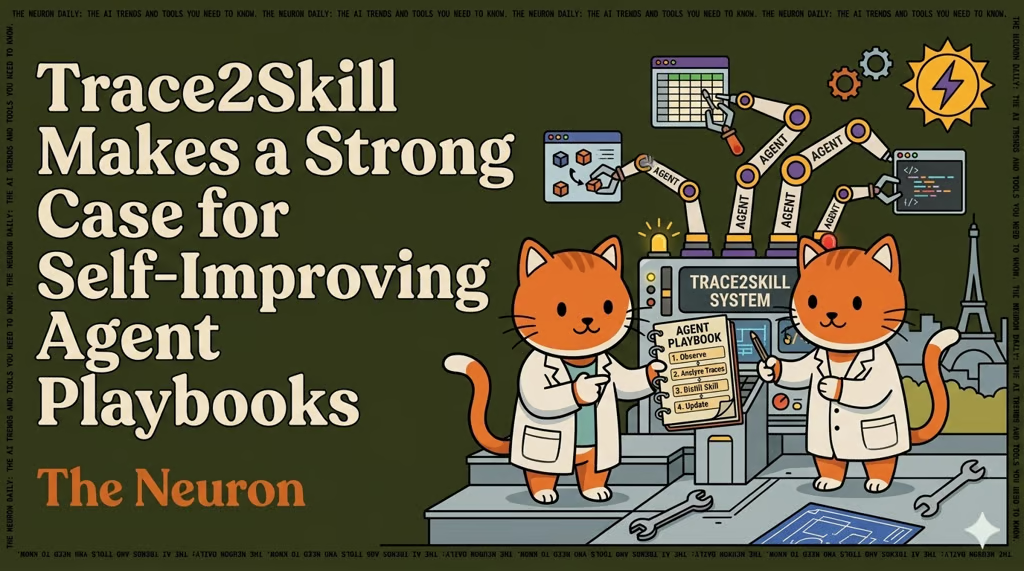


Is it possible the key to better performing agents is as simple as creating more AI Skills for clearer instructions and not necessarily better models?
An interesting research paper on Hugging Face this week called Trace2Skill promises a significant agent performance boost based on tools we already have.
It matters because it points at something much more practical and, frankly, much more useful: the next leap in AI agents may come less from making models bigger and more from getting better at turning experience into reusable instructions.
That sounds almost annoyingly simple. It is also probably right.
Bigger models aren’t the only way forward
The paper comes from Alibaba’s Qwen Large Model Application Team, alongside researchers affiliated with ETH Zurich, the University of Zurich, Peking University, and Zhejiang University. And its core claim is refreshingly concrete: instead of fine-tuning models every time an agent stumbles through a domain, or stuffing more memories into a retrieval layer, you can watch lots of agent trajectories, extract the patterns, and distill them into a better skill.
In other words, give your agents a better playbook, not just bigger models. Without better instructions, bigger models will fail, too.
The real bottleneck is operational know-how
That framing matters because we are entering the part of the agent cycle where the market is separating demo magic from operating reality. We’ve already written about why agents still fail most real-world tasks, and the pattern keeps repeating: the raw model is often good enough to do parts of the work, but the full system still falls apart on handoffs, tool use, sequencing, edge cases, and domain-specific judgment.
Trace2Skill is basically an answer to that problem.
Trace2Skill turns agent runs into reusable skills
The authors argue that most automated skill-generation methods are too shallow or too brittle. They either rely on what the model already “knows,” which is often generic and incomplete, or they update skills one trajectory at a time, which risks turning a bunch of local lessons into a messy pile of overfit instructions. Their proposed fix is to analyze many trajectories in parallel, extract local lessons from both successes and failures, and then merge those into a single, conflict-free skill directory.
That distinction is more important than it sounds. A lot of agent work right now is still built like a patchwork quilt: more prompts, more retries, more memories, more exceptions, more “if this then that” duct tape. Trace2Skill is making the case that the better path is consolidation. Learn from many runs. Generalize the pattern. Write the procedure down once.
If that reminds you of context engineering, that’s because it’s basically context engineering with a feedback loop. The model doesn’t just receive instructions. The system improves the instructions by mining its own behavior.
Why this could matter more than another model upgrade
That may be the most important strategic signal in the paper.
For the last two years, a lot of AI discussion has been model-centric: which frontier model is best, which context window is biggest, which benchmark moved by three points. But if agent performance can improve dramatically through better distilled skills, then some of the real leverage shifts away from pure model capability and toward workflow capture, operational learning, and skill maintenance.
That’s a very different product story.
It suggests the winners in agentic software may not just be the companies with the smartest base models. They may be the ones that best capture how work actually gets done, turn that into durable instructions, and keep improving those instructions over time. The “secret sauce” stops being just intelligence and starts becoming institutionalized know-how.
That’s especially notable because the paper claims those evolved skills transfer across model sizes and even across tasks. One of the headline results is that skills evolved by Qwen3.5-35B improved a larger Qwen3.5-122B agent by as much as 57.65 percentage points on WikiTableQuestions. If that result holds up, it’s a pretty sharp rebuttal to the idea that experience is always trapped inside the model or always has to be retrieved dynamically at inference time.
It also creates an interesting competitive angle with systems like Anthropic’s skills repository, which helped popularize the idea that agents can be meaningfully improved by attaching structured instructions, scripts, and references. Trace2Skill doesn’t reject that worldview. It extends it. The paper’s big idea is that skills shouldn’t just be hand-authored assets. They should be living artifacts that evolve from real agent behavior.
A more practical roadmap for enterprise agents
That is a much bigger deal than “new benchmark, line go up.”
Because if this approach works in the wild, it gives enterprises a more believable path to better agents. Not “wait for GPT-7.” Not “fine-tune a custom model for every workflow.” Not “build a giant memory stack and hope retrieval picks the right snippet.” Instead: run agents, collect traces, identify what worked, codify what matters, and redeploy the improved skill.
That’s operationally legible. Managers can understand it. Builders can implement it. Compliance teams can at least read it.
Promising results, with the usual early-paper caveats
And yes, there’s a catch.
This is still an arXiv preprint, not a peer-reviewed publication, and the paper explicitly labels itself a work in progress. The experiments are promising, but they live in benchmark-heavy domains like spreadsheets, visual QA, and math reasoning. Those are useful tests, but they are still a long way from the chaos of real enterprise operations, where the hardest part is often less “solve the task” and more “figure out what the task even is, given vague humans, brittle tools, and moving targets.”
So no, this does not mean autonomous agents are suddenly ready to run your company.
But it does suggest that one of the smartest places to invest is not just model access, but skill infrastructure: systems for capturing trajectories, extracting reusable lessons, and turning repeated mistakes into clearer operating procedures.
That’s a much less glamorous story than AGI in a box.
It’s also probably the one that ships first.
