


The most interesting AI product launches often don’t look like new models. They look like someone finally packaging a workflow power users were already hacking together by hand.
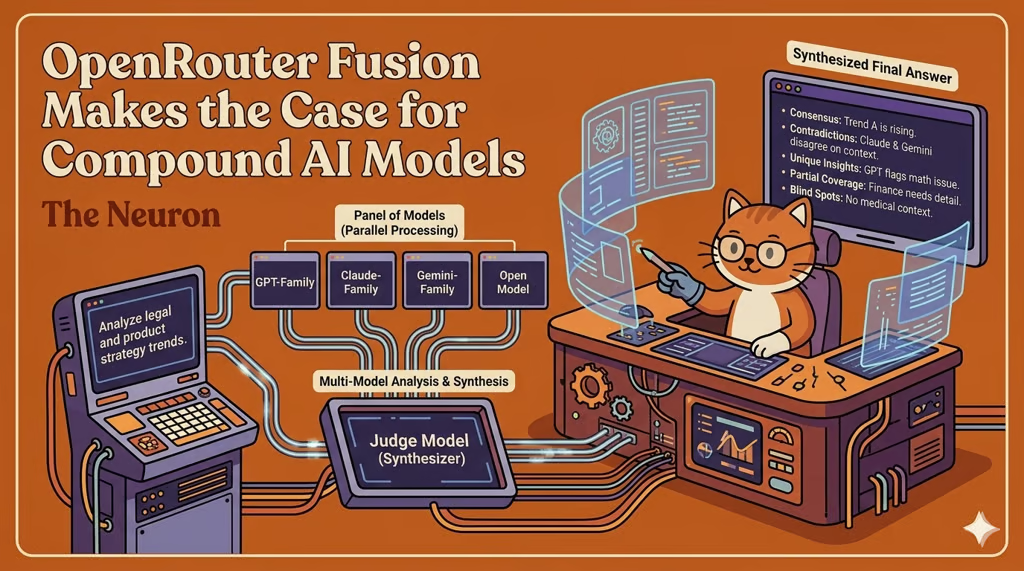
That’s why OpenRouter’s new Fusion API is worth paying attention to. On the surface, it’s a compound model: send in one prompt, get back one answer. Underneath, Fusion fans the task out to a panel of models, has them analyze the problem in parallel, then uses a judge model to synthesize the result into a final answer.
In other words: it turns “let me ask GPT, Claude, Gemini, and maybe one weirdly brilliant open model, then compare the answers myself” into a button.
That may sound small. It is not.
OpenRouter describes Fusion as “multi-model analysis with a judge model.” According to its docs, a panel of models answers the prompt in parallel with web search and web fetch available. A judge then compares their outputs and extracts the structure: consensus points, contradictions, partial coverage, unique insights, and blind spots. The final answer is written from that structured analysis.
The launch claim is punchy: OpenRouter says Fusion reaches Fable-level performance on deep research at roughly half the cost. The company says it tested Fusion on DRACO, Perplexity’s benchmark for deep research tasks across domains like law, medicine, finance, and product comparison. OpenRouter says a budget panel using Gemini 3 Flash, Kimi K2.6, and DeepSeek V4 Pro beat solo GPT-5.5 and solo Opus 4.8, while landing within 1% of Fable 5 at about half the price.
Big if true, and still worth treating as a vendor benchmark until third parties kick the tires. But even if you ignore the exact leaderboard claim, the product idea is the thing.
The next phase of AI may be less about picking the one best model and more about designing the right bundle of models for the job.
Microsoft is already poking at this from another direction. Its Model Council in Microsoft 365 Copilot Researcher runs the same question through GPT and Claude research agents at the same time, then shows where they agree, diverge, and uniquely contribute. That’s the same basic instinct: don’t force one model to be the whole brain when several models can form a better review loop.
Builders have been doing versions of this manually for a while. You ask Claude for structure, GPT for breadth, Gemini for long-context retrieval, a coding model for implementation detail, then maybe toss everything into another model and ask it to adjudicate. Agent builders have also used multi-agent “councils,” debate loops, critic models, and evaluator chains for years.
But packaging matters. A workflow is not really mainstream until it becomes a default affordance.
Fusion’s clever move is that it makes the compound system feel like a single model. Developers can call openrouter/fusion as a model slug, or configure the underlying panel and judge themselves. OpenRouter says the default quality preset uses a panel of Claude, GPT, and Gemini-family models, while developers can switch to a budget preset or override the panel with specific analysis_models.
That customization is where this gets much more interesting.
Today, most model choice is framed like a horse race: which lab is winning this week? OpenAI vs. Anthropic vs. Google vs. xAI vs. DeepSeek vs. Moonshot. Benchmark charts turn model selection into sports talk with token pricing.
But real work is rarely solved by the single smartest generalist. Different models have different temperaments, strengths, weaknesses, refusal behavior, context handling, coding style, research discipline, latency, cost, and citation habits. One model may be better at planning. Another may be better at catching gaps. Another may be cheaper and good enough for first-pass extraction. Another may be unusually strong at math, code, or long documents.
So the frontier starts to look less like “choose the winner” and more like “compose the team.”
A legal research bundle might combine one model that is citation-disciplined, another that is strong at adversarial review, and a judge tuned to flag unsupported claims. A product strategy bundle might pair a market research model with a financial reasoning model and a skeptical evaluator. A coding bundle might include one model for architecture, one for implementation, one for tests, and one for security review. A newsroom bundle might include one model for source discovery, one for claim checking, one for clarity, and one for headline variants.
This is also why OpenRouter is unusually well-positioned to try the idea. The company already sits at the model-access layer. As we’ve written before at The Neuron, OpenRouter’s basic pitch is one API key for many models. Fusion turns that from convenience into orchestration.
The risk, of course, is that “ask five models and summarize” becomes the new “just add agents”: useful when designed well, expensive and mushy when sprayed everywhere.
OpenRouter’s own docs are clear that Fusion is not for every prompt. Because it runs multiple panel members plus a judge, the price is the sum of those underlying completions, not the cost of a single model call. It can also add latency. And sending a prompt through multiple providers raises the usual enterprise questions: what data is being sent where, what gets logged, which providers are allowed, and how do you evaluate whether the compound answer is actually better?
Those caveats are not reasons to dismiss it. They are reasons to treat Fusion less like magic and more like infrastructure.
The best version of this future is not “every AI answer goes through a giant committee.” The best version is task-specific model composition. Cheap panel for everyday research. High-end panel for decisions where being wrong is expensive. Company-approved panel for sensitive workflows. Personal panel for how you like to think. Maybe even bundles that learn over time which models tend to help on your tasks and which ones mostly add noise.
That is the real unlock: not just multiple models, but customizable model roles.
The first wave of AI products made model choice visible. The next wave may make model composition visible. Instead of asking, “Which chatbot should I use?” users will ask, “What kind of thinking process do I want this task to run through?”
Fusion is early, and OpenRouter still has to prove the benchmark claims outside its own tests. But the product direction feels right. The future of AI work is probably not one monolithic model swallowing every task. It is systems that know when to route, when to deliberate, when to critique, when to synthesize, and when to shut up and let the cheap model handle it.
The button matters because it makes that future legible.
And once people get used to choosing the council, they are going to want to customize the council.
