


Y’know how when you ask ChatGPT to generate or edit a single image, it takes at least 30 seconds to wait for it, only to find the text was misspelled or your edits changed everything except what you actually wanted?
Well, OpenAI just released GPT Image 1.5, and it's 4x faster while being significantly better at actually following your instructions. The model is rolling out now to all ChatGPT users and is available in the API as GPT-Image-1.5 (docs).
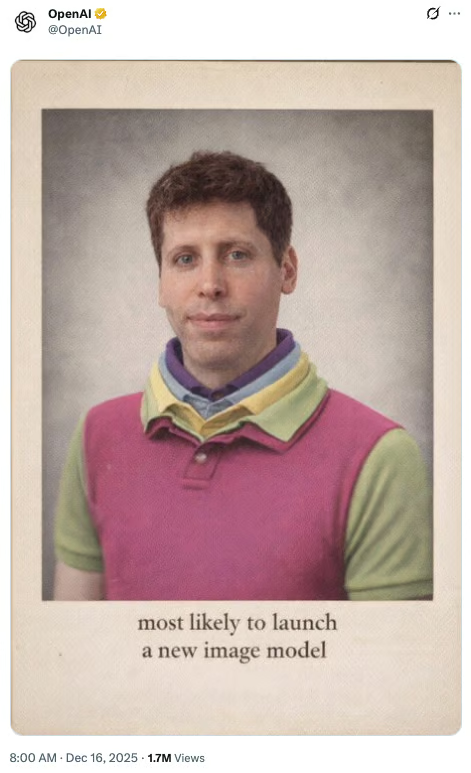
If you don’t know what this image is referencing, watch this X video (youtube version)
Here's what makes it different: The new model preserves what matters. When you ask for edits, it changes only what you specify while keeping lighting, composition, and people's appearance consistent across multiple edits.
Translation: no more accidentally transforming your subject's entire face into a hideous Renaissance painting alternate universe version of itself when you just wanted to change the background.
Where GPT Image 1.5 excels:
- Precise editing: Add, subtract, combine, blend, or transpose elements without losing the image's essence.
- Text rendering: Finally handles dense, small text accurately (think readable newspaper layouts, not jumbled letters).
- Instruction following: Creates intricate compositions with proper relationships between elements—like an actual 6x6 grid with 36 different objects, each in the right spot.
- Creative transformations: Apply preset styles instantly; turn photos into movie posters, 80s fitness ads, or fashion campaigns while preserving key details.
- Speed: Up to 4x faster than the previous version, so you can iterate without the wait.
OpenAI also launched a dedicated Images interface in the ChatGPT sidebar with preset filters, trending prompts, and one-time likeness uploads (kinda like Sora Cameos) for easier creation.
How does it stack up against the competition? According to independent benchmarks, OpenAI dominates:
- Text-to-image: GPT Image 1.5 leads with 1264 points on the Artificial Analysis leaderboard—a 29-point lead over second place.
- Image editing: ChatGPT's image model tops LM Arena at 1409 points, narrowly beating Google's Nano Banana Pro (2K) by 3 points, and has a 6 point lead over Nano Banana Pro on Artificial Analysis’ image editing leaderboard.
- Improvements: +147 points in text-to-image and +245 points in editing over GPT Image 1.0 on LM Arena.
How's it compare to Nano Banana Pro (Gemini 3 Pro Image) features wise? The two models target different needs. Nano Banana Pro's edge:
- 4K resolution and up to 14 reference images for brand consistency
- Real-world grounding via Google Search for accurate infographics and diagrams
- Multilingual excellence for localized campaigns across languages
- Broader integration across Gemini, Google AI Studio, Vertex AI, Adobe Firefly, and Photoshop
GPT Image 1.5's edge:
- 4x faster generation for rapid iteration.
- One-shot precision on edits without losing composition.
Think of it like this: GPT Image 1.5 = speed and precision edits. Nano Banana Pro = production-grade assets with additional enterprise features.
Btw, for those following along, there’s two new image models OpenAI benchmarked on the leaderboards:
- gpt-image-1.5 = The API model name that developers access directly through OpenAI's API
- chatgpt-image-latest = The version deployed in the ChatGPT web/app interface
The key difference: chatgpt-image-latest scores slightly higher on the LM Arena benchmarks (1409 vs 1395 on image editing), suggesting it may have additional interface-specific optimizations (system prompts, safety post-processing, or UI-tuned parameters) that make it score slightly higher on editing benchmarks. Historically, OpenAI's consumer products have had these extra layers compared to raw API access. But TBH, IDK.
Why this matters: AI image generation just crossed a critical threshold. For the first time, these tools can actually preserve what you care about while changing what you want… reliably. No more generating 50 versions hoping one works. AI image editing is finally moving from its Gacha Blind Box stage to “Got ya! Exactly the change I needed.” (sorry; cheesy, but I had to…)
Expect the competition to intensify over the next 3-6 months as OpenAI and Google, race to dominate this space, while Midjourney and Black Forest Labs (who makes FLux) aim to differentiate themselves. Both models are already integrated into major creative tools, which means millions of designers and marketers will have access to production-quality AI imaging by Q1 2025.
If you create visual content for work, try the new ChatGPT Images interface to test it out or test both models head-to-head in LM Arena or AA Image Arena to see which fits your workflow better.
P.S: We tested it on the same challenge we gave Nano Banana Pro in our live-demo of GPT-5.2 on Friday, and this is what it created.
