



Welcome, humans.
it looks like Figure's 03 humanoid robot can be your new jogging accountability buddy:
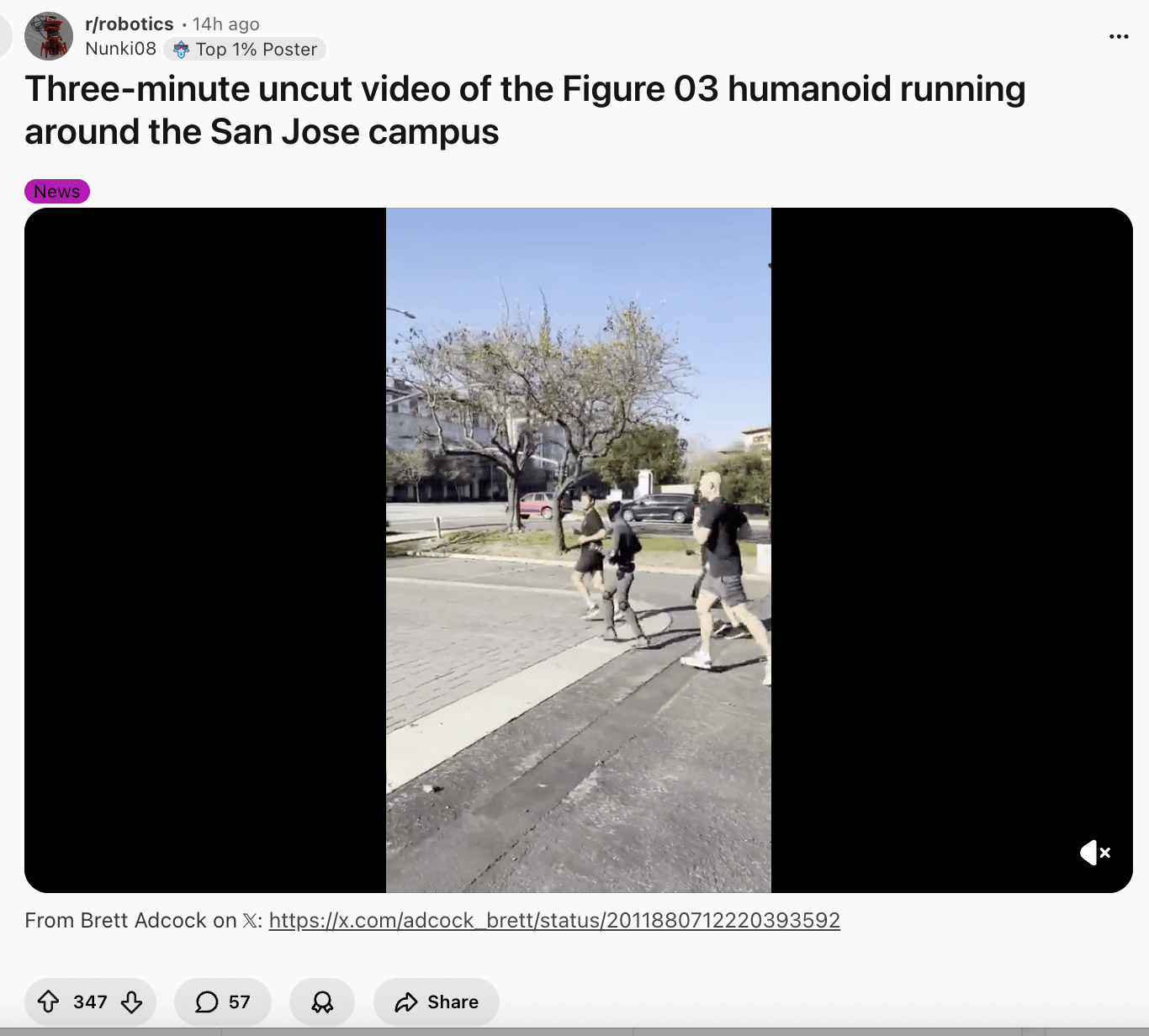
As for me? I'd want to be the guy chilling at home teleoperating the robot lol. Still get time with the boys, but I get to chill on the couch.
The range of reactions to this in the thread are hilarious. My three faves: "how to make nerds exercise", "awesome, now I can get a robot to do my workouts for me" and "can't wait to have one of these things transport me around town in a rickshaw." Well, speaking of that...
New dream unlocked: putting together an Alaskan dog-sledding team made entirely of these bad boys:
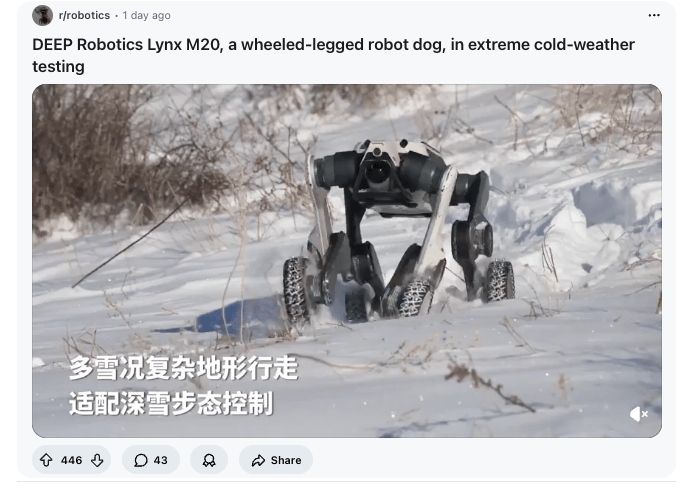
(source)
This would be incredibly useful tech to help bring supplies to humans trapped in dangerous locations, or to patrol barren wastelands, or as the top reddit comment says, used as hospital stretchers with Earthquake rescue gear. They’ll just need some tech similar to this where the robots can hot-swap batteries in and out of the sled, which could house a giant charger).
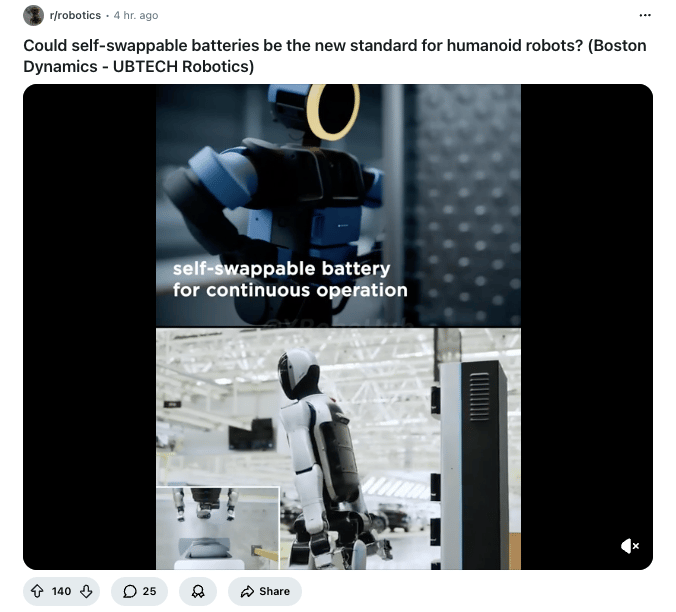
Side note: This makes us think. You know the phrase “as soon as humanly possible?” That’s going to become a super relevant phrase in the next few years. Maybe we need a new version: “As soon as agenticly possible” or “as soon as robotically possible.”
Here’s what happened in AI today:
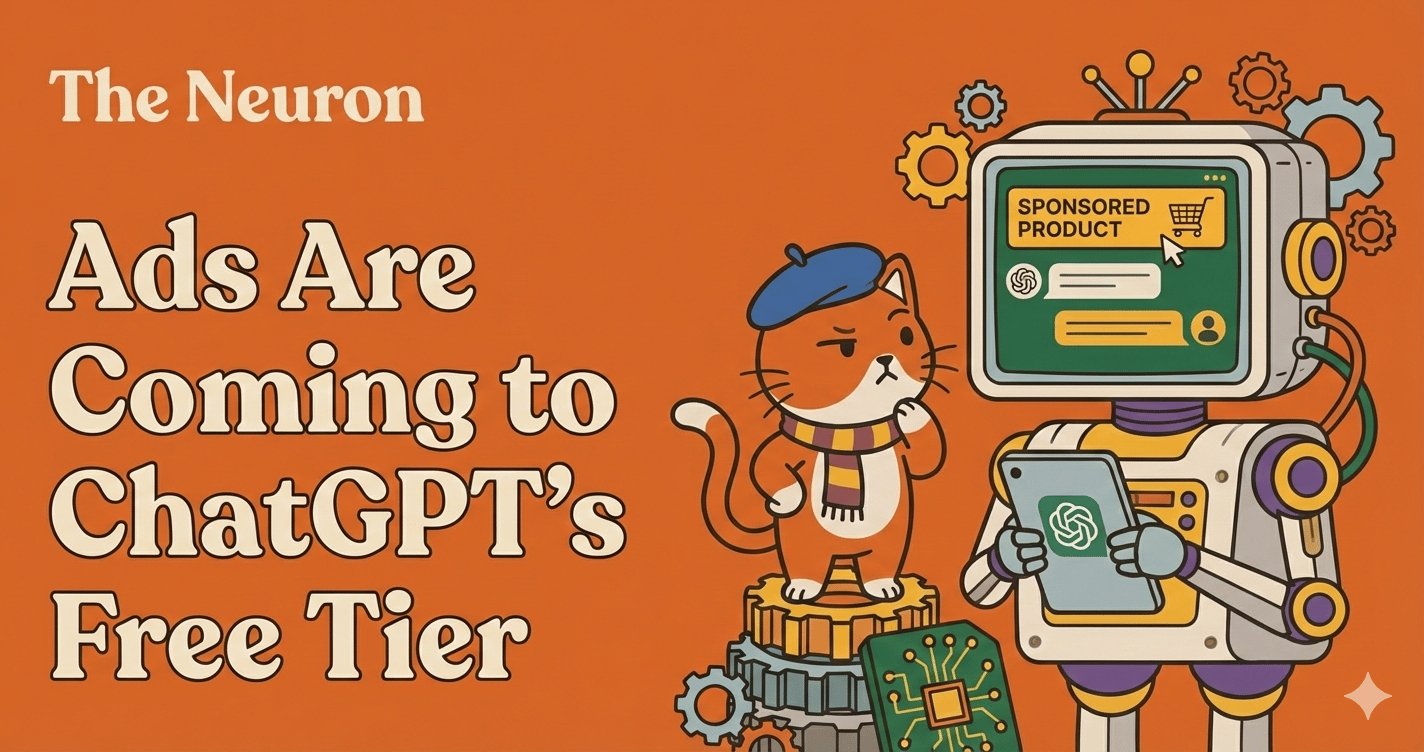
- OpenAI announced ads coming to ChatGPT's free tier in the next few weeks.
- Anthropic is trying to raise $25B.
- OpenAI revealed Elon Musk demanded $80B equity and AGI control for his children.
- OpenAI launched ChatGPT Go for $8/month with 10x more messages (but still includes ads).

OpenAI Just Made ChatGPT Free Forever—With a Catch
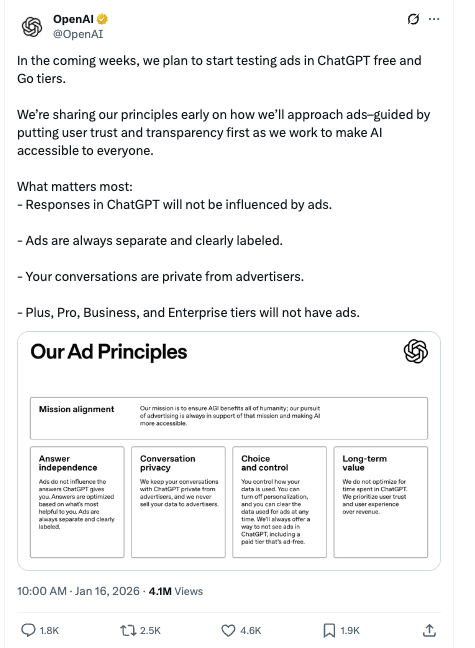
Y'all non-tech folks know what “Freemium” means? It's when a product has both a free tier, and a premium tier with more features to make you want to upgrade. When software doesn't follow this model, you either have to pay upfront... or its free with ads.
Facebook did it. YouTube did it. And now it's ChatGPT's turn. Nothing (free) lasts forever… We all knew it was coming, but wow, can't believe we're finally here.
Thats right: OpenAI just announced that ads are coming to ChatGPT's free tier and the new budget-friendly “Go” plan (more on that in a sec). Starting in the next few weeks, you'll see sponsored content at the bottom of your AI-generated answers.
CEO Sam Altman's reasoning: “A lot of people want to use a lot of AI and don't want to pay.” In case you didn’t know, running these models costs billions. OpenAI reportedly burned $5B in 2024, and ~$9B in 2025 on $13B in revenue (a cash burn rate of roughly 70%). So this year, advertisers are footing the bill.
Here's how ads will work:
- Appear at the bottom of responses when there's a relevant sponsored product.
- Only for logged-in US adults (at first).
- No ads for under-18 users or on sensitive topics (health, mental health, politics).
- You can dismiss ads and explain why.
- OpenAI promises ads won't influence ChatGPT's actual answers or access your conversation data.
Want ad-free? ChatGPT Plus ($20/month), Pro ($200/month), Business, and Enterprise remain completely ad-free.
There’s a new plan for US users too: OpenAI also launched ChatGPT Go in the US for $8/month. You get 10x more messages than the free tier, plus file uploads, image generation, and longer memory.
The catch: Go users still see ads. You're paying $8/month and getting commercials. That's... bold.
Why this matters: Free, ad-free AI is officially over. OpenAI needs revenue to offset infrastructure costs ahead of a potential 2026 IPO. Google is already planning ads for Gemini this year, so expect every major AI company to follow (except maybe Anthropic, which will just be premium-tier expensive forever I guess)?
This also launches a new battleground: conversational advertising. Unlike search ads, ChatGPT will try to sell you products mid-conversation. If OpenAI executes well, these ads could feel helpful. If not, they'll feel like an intrusive friend who won't stop pitching MLM schemes.
For now, free ChatGPT users have a few weeks left before those pristine responses get a sponsored footnote. Enjoy it while it lasts, friends.
Our take: Look, we’re an ad supported platform, so we get it. We’re even considering a premium, ad-free version of The Neuron for folks who are interested. Personally, we like systems where you can get content for free for the price of some ads, and we like that you can pay to get ad free (like certain streaming services).
In fact, we wish more “premium” products worked this way, or at least let you buy one-off articles like songs on iTunes (for example, WSJ / NY Times / Bloomberg / FT; why can’t we pay 30 cents per article to view one offs?)
Now ChatGPT just needs to share ad revenue with publishers whose content is used via web search / fetch so publishers can get paid too… We imagine it would work like this: you get a certain amount of free “tokens” to view articles per month, and once those are up, you can pay per use like how you pay per use via the API. Metronome, sign a deal with the big pubs plz!

FROM OUR PARTNERS
Agents that don’t suck
Are your agents working? Most agents never reach production.
Agent Bricks helps you build high-quality agents grounded in your data. We mean “high-quality” in the practical sense: accurate, reliable and built for your workflows.
Generic benchmarks don’t cut it. Agent Bricks measures performance on the tasks that matter to your business.
Evaluate agents automatically, and keep improving accuracy with human feedback. With research-backed techniques for building, evaluating and optimizing, you can turn your business data into production agents faster — with governance built in from day one.

Prompt Tip of the Day
Grant went ahead and followed Peter Yang’s Skills advice this weekend, and turned all of our recurring project prompts into Skills that he can call. This is a huge unlock.
One thing we didn’t mention the other day is that you don’t have to navigate Anthropic’s menus to go directly to the Skills capabilities to create one. You can just write this prompt:
Let's create a skill together using your skill-creator skill. First ask me what the skill should do.
The two projects we’re definitely going to keep as “projects”? Our “General Purpose” Neuron project folder, with all our Style Guide context and writing preferences, and a “Skills creator” project with the above prompt saved as the custom instructions!

Treats to Try
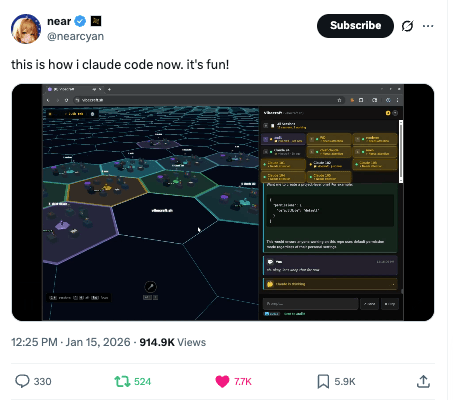
- Vibecraft (featured above) manages Claude Code through a hexagonal grid interface with spatial audio—drag a Claude instance to your left and hear it working from that direction, watch real-time animations of what each agent is doing, and organize multiple coding sessions visually instead of juggling terminal tabs (built in 2 days, uses your local Claude Code instances with no data sharing, free).
- Cowork lets you describe complex tasks like "organize my Downloads" or "create a presentation from these notes" and Claude autonomously handles the multi-step work on your Mac, delivering finished Excel files, PowerPoints, and organized folders while you step away (guide)—now available to Pro subscribers ($20/month, macOS only).
- Midjourney released Niji v7, its anime model with dramatically improved coherence for fine details like eyes and reflections, more literal prompt understanding, and a new flatter aesthetic that emphasizes traditional anime linework over 3D rendering—add --niji 7 to any prompt (covered well here by Heather Cooper).
- Aikido Security automatically detects and fixes security vulnerabilities as you write and deploy code—built for developers shipping AI-generated software at speed (raised $60M).
- DocuSign added AI that distills contracts into plain-English summaries and answers natural-language questions like "What happens if I cancel?" for signers, while automatically identifying agreement types and placing signature fields with one click for businesses—solving the problem where 60% of consumers sign terms they don't understand and document prep remains the most time-consuming, error-prone step in workflows.
- Tasklet is probably the closest thing to "general purpose Claude Code" that works regardless of what computer you're on—describe business automations in plain English like "every weekday at 7 AM, compile a briefing from my calendar and top emails, send to Slack" and it connects to your tools, sets up triggers (scheduled, email, webhooks), and runs 24/7 in the cloud, handling everything from monitoring feeds to auto-drafting support replies by checking your knowledge base (built by Shortwave team, supports thousands of integrations, any HTTP API, MCP servers, and browser automation, in beta).
- Open Responses from OpenAI solves AI provider lock-in with an open spec that lets you write agentic code once and run it across OpenAI, Anthropic, Google, or local models—unified schema for messages, tool calls, and streaming means switching providers is just changing the model string instead of rewriting your entire stack (built by OpenAI, Hugging Face, and the community, day-0 support from Vercel AI Gateway, OpenRouter, and vLLM, free and open-source).
- Replit now builds React Native mobile apps from text descriptions—get a working app in minutes, scan a QR code to test on your phone, and publish directly to the App Store with database, auth, and integrations already wired up (partnership with Expo, Play Store coming soon)—this drops as the vibe coding wars reach $50B+ in combined valuations, with Replit hitting $260M ARR (26x in 12 months, raising $400M at $9B), neck-and-neck with Lovable's $250M ARR (fastest to $100M ARR in history, $6.6B valuation), while Cursor leads at $1B+ ARR ($29B valuation).
- Aura writes and compiles flawless Unreal Engine C++ code, generates Blueprint logic graphs, and creates game assets directly in your Engine—describe what you want like "create a wall-running mechanic" and it handles the technical implementation while you watch (demo, runs on Claude Opus 4.5).
- Cole calls rams, UI Skills, and Vercel's Web Interface Guidelines the "holy trinity of agentic UI": rams reviews agent code for WCAG compliance and visual issues, UI Skills sets opinionated constraints to guide agent generation, and Vercel's Guidelines provide comprehensive rules from interactions to performance—all installable as slash commands in Claude Code, Cursor, and OpenCode—all free.
- Joe from Recon Analytics told us about DuckDB on our livestream Friday, which runs blazingly fast SQL queries directly on your CSV, Parquet, or JSON files without needing a separate database server—zero setup, works on any machine, handles datasets larger than your RAM.
- LTX-2 generates synchronized audio and video up to 20 seconds at native 4K/50fps; it's the first fully open-source audio-video model with complete training code that runs locally on consumer NVIDIA RTX GPUs, plus controllable camera movements (code)—free to try.
- TeamOut matches you with corporate retreat venues by describing your event ("30 people, warm beach, 3 nights") and delivers quotes within 24 hours—free to try.
- BlinqIO generates virtual testers that autonomously write, run, and debug test automation code in 50+ languages (raised $5M)—free trial, then $250/scenario.
- folk Assistants analyzes your email and WhatsApp to draft follow-ups at the right time, summarizes relationship history, and auto-enriches company profiles—$20/month.
- Oboe turns prompts into personalized courses with text, AI podcasts, quizzes, and printable study guides—generates chapter-based paths in seconds and adapts to your goals (raised $16M from a16z)—free unlimited courses, $15/month for deeper access.
- Adam replaces CAD clicks with prompts—type "add a fillet here" to edit parts, optimize feature trees by merging duplicates, and convert ad-hoc models into parametric designs with cascading variables.
- Step-Audio-R1.1 hit #1 on speech reasoning leaderboards with 96.4% accuracy (beating Grok, Gemini, OpenAI) and 1.51s response time—first audio model with test-time compute scaling for end-to-end audio reasoning without added latency (try it, weights)—free to try.

Around the Horn
- OpenAI responded to Elon Musk's claims in the lawsuit by publishing internal communications showing that Musk himself pushed for a for-profit structure in 2017 but demanded majority equity and full control. More details:
- CEO Sam Altman revealed that during negotiations, "Elon said he wanted to accumulate $80B for a self-sustaining city on Mars, and that he needed and deserved majority equity," adding that "when we discussed succession he surprised us by talking about his children controlling AGI." According to OpenAI's blog post, when the company refused to give Musk unilateral control in late 2017, he told them they had a "0% probability of success" and left to create competitor xAI.
- The post includes excerpts from co-founder Greg Brockman's private journal showing that while Brockman and Ilya Sutskever preferred a B-corp structure, they were willing to work within the nonprofit if it could raise sufficient funding—contradicting Musk's fraud allegations that cite a November 2017 journal entry where Brockman wrote "cannot say that we are committed to the non-profit" as evidence of deception.
- A federal judge ruled the case can proceed to trial in April 2026, stating there's "considerable evidence" raising questions about whether OpenAI's leadership made false assurances to Musk.
- Anthropic released its Economic Index report (PDF) introducing "economic primitives"—new metrics measuring task complexity, skills, autonomy, and success rates across 1M Claude conversations from November 2025. The report found:
- Claude usage in the US could reach per-capita parity across states within 2-5 years, roughly 10x faster than historical technology diffusion rates.
- Claude succeeded on most tasks but struggled with complex ones, showing a 70% success rate for basic tasks dropping to 66% for college-level work.
- Adjusting productivity estimates for task success rates roughly halved AI's projected impact from 1.8 to 1-1.2 percentage points of annual labor productivity growth over the next decade, though Wharton professor Ethan Mollick noted that "if you have a tool that saves 8 hours 65% of the time, that changes work, even counting potential error rates," suggesting an inflection point in AI's workplace impact.
- Work use dominated globally at 46%, while coursework use peaked in lower-income countries and personal use was highest in wealthier nations.
- OpenAI is trying to raise $100B and now Anthropic is trying to raise $25B; if you're wondering where that money could potentially come from, The Information has a good (in depth) guess: big tech hyperscalers, sovereign wealth fund, and banks trying to curry favor ahead of what would probably be the biggest IPO in history (paywalls).
- Tulip raised $120M in a Series D round led by Mitsubishi Electric, reaching a $1.3B valuation for its no-code AI factory platform that empowers frontline workers rather than replacing them. The MIT spinout's platform enabled 60K factory workers across 1K sites in 2025, with a Forrester study showing customers saw 448% ROI over three years, 15% efficiency gains for direct labor, and 50% time savings for indirect labor.
- The U.S. datacenter boom doesn’t have enough skilled electricians to keep up (paywall); if you’re even remotely technical and interested in learning a new trade, this would definitely be a good one given the demand for electricity beyond just datacenters (full electrification needs, new power plants, batteries, transmission upgrades, etc).
- The WSJ has discovered Claude Code (lol)—paywalled.

FROM OUR PARTNERS
Wispr Flow
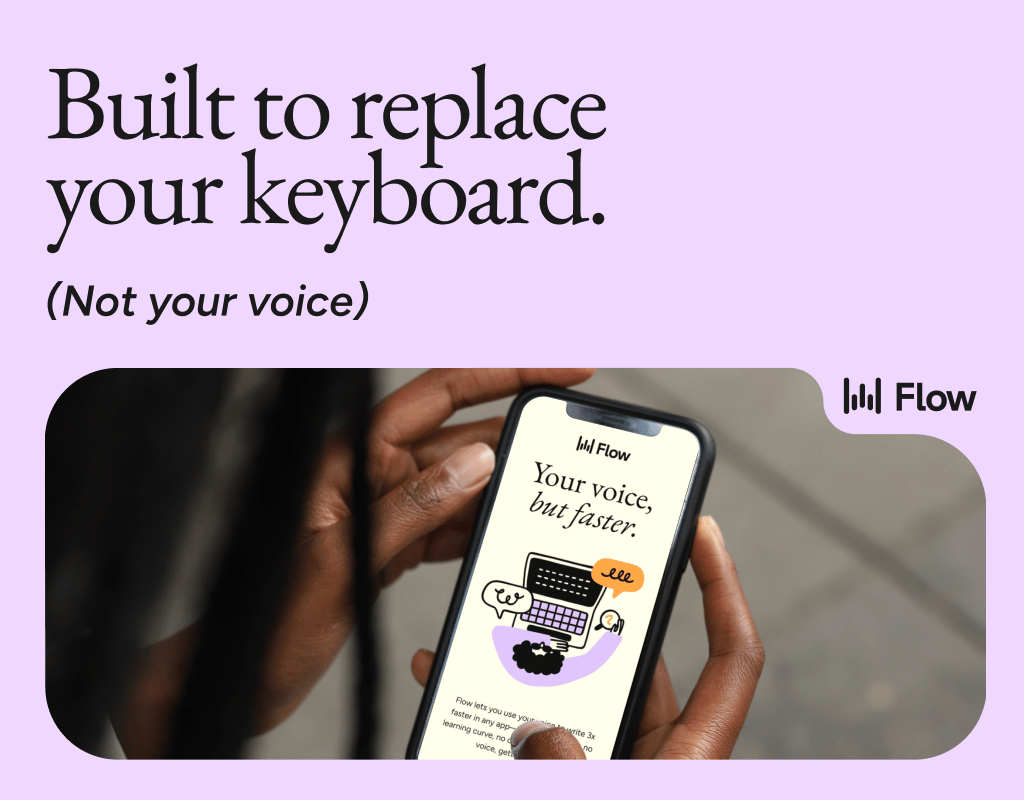
One voice layer across your tools. Dictate into Slack, email, docs, and AI prompts and Wispr Flow gives you clean text right where you are working.
Give your hands a break ➜ start flowing for free today.
Sunday Special
AI video tools usually regenerate your entire clip; which means they mess with performance, lighting, and all the good stuff you want to keep.
This workflow fixes that. You create a precise mask around only the area you want to change (in this case, Wolverine's mask), then feed that into Wan 2.2 Animate in ComfyUI. The AI only generates what's inside the mask. Everything else stays untouched—same facial expressions, same motion blur, same lighting.
The creator used Lockdown (a tracking tool in After Effects) to create the mask and make sure it followed the face perfectly. The trickiest part was extending the mask just enough to cover the target area while leaving the mouth exposed—too tight and you lose details, too loose and you start messing with the original footage.
Then it's just Kijai's Wan workflow with an input video node piped into the Blockify masking node. The blur and blending happens automatically.
Result: professional-looking VFX that would've taken hours in traditional software, done in a fraction of the time. Several commenters confirmed that major VFX studios are already incorporating ComfyUI into their pipelines.
More stuff that caught our eye this week:
- Engineer Leila Clark ran three real-world coding tests on Claude Opus 4.5 and discovered what separates AI from senior engineers.
- Dan Koe argued that having multiple interests is now your competitive advantage, calling pure specialization "almost certain death" in the AI era.
- Charlie Guo abandoned deep work to manage AI agents in five-to-fifteen-minute intervals, revealing the new skills required for the "AI manager's schedule."
- Former Clinton Navy Secretary Richard Danzig told the Pentagon it "doesn't need a wake-up call about AI—what they need to do is to get out of bed," warning that AI's first-mover advantage in cybersecurity is "significant but perishable."
- AI forecasters apparently nailed the technical benchmarks but spectacularly missed on real-world impacts—underestimating frontier lab revenues by nearly 2x while overestimating public concern about AI by 3x.
- Allen Park writes for Latent Space (legendary AI podcast & substack! featured below) about Brex's incredible turn-around, and specifically how they handle AI fluency at the company; their four step pyramid, starting from user and scaling to > advocate > builder > native is a great framework for others to adopt; definitely read it for that framework alone, it's great!
- NVIDIA researchers slashed robot reasoning latency by 89.3% by proving robots don't need to think in English sentences to plan effectively.
- Forrester analyst JP Gownder claimed AI productivity gains are "nowhere in recent productivity data," predicting 6% structural job loss by 2030—but many announced cuts are just "financial decisions masquerading as AI job loss."
- Benn Stancil explained why Claude Code works but Anthropic's new Cowork product will fail—and it comes down to a surprising difference between code and emails.
- A high school student revealed why schools refuse to discuss AI despite nearly every student using it to cheat.
- Meta released Action100M, a 120,000-video dataset with hierarchical annotations designed to teach robots how to perform real-world tasks.
- Engineer Alex Kondov can instantly spot AI-generated code—not by comments or style, but by something far more revealing about developer habits.
- Transformer analyzed why AI technologists predict 10-20% unemployment while economists forecast 0.5% increases—a gulf that reveals two fundamentally different assumptions about AI's future.
- Researchers introduced , the first video deep research benchmark revealing that agentic approaches for video question answering aren't consistently superior to workflow methods when models must extract visual anchors from videos and perform multi-hop reasoning across web sources.
- Researchers introduced VideoDR, the first video deep research benchmark revealing that agentic approaches aren't consistently superior to workflow methods for video question answering.
Speaking of AI forecasting...
Eli Lifland recently dropped a thread showcasing the wild variance in AI forecasting—and the gulf between scenarios is absolutely bonkers.
The spectrum of possibilities:
- Eli's median: Automated Coder (AC) in May 2038, superintelligence (ASI) by January 2044. Assumes we need 1,000 work-years of coding capability and doubling times stay at 6 months.
- Daniel Kokotajlo's median: AC in March 2030, ASI in July 2031. Much faster—only needs 3.3 work-years of capability and hits superintelligence in just 16 months after automating coding.
- Anthropic-aligned trajectory: AC in October 2026, ASI in June 2028. Absolutely wild—requires only 9.4 work-months of coding capability. This basically says "we're already almost there."
- OpenAI-aligned (based on Sam Altman hints): AC in August 2027, ASI in August 2030. Needs just 4 work-months—slightly less aggressive than Anthropic on arrival, but slower takeoff.
- Original "AI 2027" forecast from April 2025: AC in January 2027, ASI in December 2027. Everything happens in one year, requiring only 18 work-years of capability.
The key variables creating this 17-year spread:
- Current doubling time: 2.9-6 months
- Progress difficulty curve: Whether each doubling gets easier (0.80x) or harder (0.96x)
- AC capability threshold: Ranges from 9.4 work-months to 1,000 work-years
- Research taste improvement rate: How quickly AI gets better at picking experiments (1.9-3.0 standard deviations per compute growth)
Plot twist: Eli admitted that improving their model caused a 2-4 year shift in their forecasts—bigger than any update from actual empirical evidence since April 2025. Translation: "We're still figuring out how to model this thing even as we publish timelines."
So the variance = "we genuinely don't know which functional form governs AI progress." One scenario has superintelligence in 2027. Another has us still waiting in 2044.
YouTubers to Watch
We've always wanted to do a data dump of all the sources we use to gather news, because we think it would be valuable for our readers who are similarly obsessed with staying up to date as we are. For starters, here's our short-list of the best AI YouTubers and content creators to look out for if you want to subscribe to some of the best resources for learning about AI via video.
- Ray Amjad always covers new Claude Code releases as soon as they happen (or as soon as anyone can humanly possible make a video about them).
- Tina Huang for beginner-friendly introductions to AI tools and skills to know and Harper Carroll for approachable, easy to understand AI explainers from an actual ML expert.
- Two Minute Papers for really fun AI and VFX paper recaps.
- Peter Yang and Greg Isenberg for timely, hands-on tutorials on how to use AI tools and up-level your existing skills in the AI age (Lenny's Podcast is also good for this, but he has a wider mandate and covers non-AI stuff too).
- Allie K. Miller for AI demos and advice.
- Latent Space pod for in-depth, well-researched interviews with major players in the AI industry, and their AI Engineer channel to learn all about how to become an AI engineer (we also recommend their very technical but maximal depth coverage of the AI industry newsletter AI News).
- TBPN for daily live tech industry news (not always AI-related) and interviews with major players in the AI, VC, and tech world, Matt Berman's Forward Future Weekly show for weekly AI news recaps and live guest interviews, and Alex Kantrowitz's Big Technology pod for semi-weekly business-related AI news discussions.
- Theo for more programming-based news recaps, but covers AI frequently; Corbin Brown for in-depth, beginner friendly tutorials for how to get started with AI and programming; Ray Fernando for vibe-coding advice and vibe-coding livestreams where you can learn and ask questionst live, plus he has a weekly podcast with two other AI engineers called Rate Limited.
- Dr. Hannah Fry for in-depth podcasts about what Google DeepMind is up to (her own channel is more broad, but fun for sciencey stuff!)
- AI for Humans for hilarious weekly recaps of the week's AI news.
- Sinead Bovell for thoughtful interviews that critique and analyze the industry from (in our POV, maybe she would agree) a humanist / human-first perspective, and Nate B. Jones for AI thought leadership for knowledge workers and non-engineers.
- AI Explained for just the best AI deep dives, period.
- byCloud for AI paper deep dives with a comedic editing style (very meme friendly).
There's more we're missing too (including much more technical channels that have historically provided lots of interesting resources), but this is a great starter list for anyone who wants to follow the industry as closely as we do!
Don’t forget: Check out our podcast, The Neuron: AI Explained on Spotify, Apple Podcasts, and YouTube — new episodes air every week on Tuesdays after 2pm PST!
