


Google used I/O to turn the prompt box into plumbing: Search, Gmail, Android, YouTube, shopping, and coding all got dragged into the agent era.
Welcome to the Around the Horn Digest, everything that crossed the AI desk today, sorted so your browser does not have to become a cry for help.
The day’s official headline was Google I/O, but the real theme was perimeter expansion: agents moved into enterprise sandboxes, inboxes, shopping carts, research labs, package registries, IDEs, and even DNA models. Meanwhile, Standard Chartered said the quiet part out loud on job cuts, OpenAI kept industrializing media provenance and capacity, and researchers kept asking the same awkward question from different angles: can agents actually do the hard part yet? Today’s answer was “sometimes, but please keep the sandbox locked.” Let’s get into it.
Previous digests: Monday, May 18 | Week in Review, May 11-15 | Wednesday-Thursday, May 13-14 | Tuesday, May 12 | Monday, May 11 | Weekend, May 9-10 | Thursday, May 7 | Wednesday, May 6 | Tuesday, May 5
Monthly skill digests: AI Skill of the Day Digest — May 2026
🆕 NEW From The Neuron
- What the Transformer vs. Post-Transformer debate revealed about AI's next architecture covers Pathway putting Lukasz Kaiser, Llion Jones, Mathias Lechner, and Adrian Kosowski into the architecture-ring question: whether Transformers still deserve the belt, or whether the next tests will matter more than the next slogan.
- Elon vs. Altman update: Elon lost. Here’s why breaks down why Musk’s OpenAI lawsuit ended on the clock instead of the grand moral question everyone wanted the court to answer.
- Everything That Happened in AI Today — Monday, May 18 catches the pressure day before I/O: ChatGPT got closer to bank accounts, GPU rentals got stupid, and local AI backlash kept getting less theoretical.
- Thinking Machines Wants AI to Stop Waiting Its Turn is Corey’s read on Mira Murati’s bet that the next interface shift is AI that can listen, watch, interrupt, and collaborate in real time.
Around the Horn — Tuesday, May 19, 2026
The big story today was Google trying to make “agentic Gemini” the default shape of the internet. Not just a better chatbot. Not just a faster model. A whole product stack where Search answers and acts, Workspace drafts and listens, Android surfaces agent state in the status bar, Shopping follows you across retailers, YouTube remixes videos, Project Genie simulates places, and Antigravity turns coding agents into a managed operating layer.
The model center of gravity was Gemini 3.5 Flash, which Google positioned as fast frontier intelligence for real-world action; Artificial Analysis put it at 280+ output tokens per second, while Simon Willison noticed the other half of the story: it is more expensive and Google appears ready to use it everywhere.
The product implication is bigger than the keynote sizzle reel. Google is not only competing with ChatGPT and Claude on model quality; it is trying to convert every surface it owns into an agent runtime. If this works, the prompt box stops being a destination and becomes an invisible layer across Search, Gmail, Android, YouTube, Workspace, shopping, and developer tools. If it does not, Google just gave itself one of the largest coordination problems in software history. Either way, the browser, phone, inbox, IDE, and shopping cart all got pulled into the same fight.
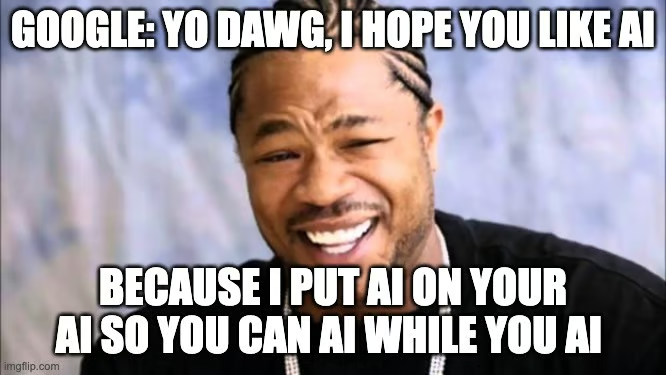
To AI, or not to AI... for Google users, that question is everything right now. And if you're using Google anything, your every interface surface is going to have AI in it.
🏆 TOP 5 NEWS (Other than Google IO stuff)
- Anthropic made Claude Managed Agents more enterprise-ready with self-hosted sandboxes (agent workspaces inside your own infrastructure) and MCP tunnels (private connectors to internal tools), while ClaudeDevs, the docs, and the cookbook showed teams how to run it.
- SpaceX reportedly planned to acquire AI coding startup Cursor 30 days after its own IPO, with Bloomberg also reporting the deal timing.
- Google DeepMind published Co-Scientist in Nature, showing a multi-agent research system that generated, debated, refined, and lab-validated biomedical hypotheses, including acute myeloid leukemia drug combinations.
- Standard Chartered said it would cut more than 7,000 jobs over four years while using AI to replace “lower-value human capital,” a much blunter version of the productivity story than most CEOs put on slides.
- A new Shai-Hulud wave compromised 600+ npm packages, with Socket and Aikido tying Mini Shai-Hulud to @antv packages, CI/CD secret theft (developer pipeline credentials), and backdoors in VS Code and Claude Code.
Honorable Mentions
- OpenAI advanced content provenance with C2PA Content Credentials (tamper-evident media labels), SynthID watermarks, and a verification tool for AI-generated media.
- Andrej Karpathy joined Anthropic’s pre-training team, with Andrew Curran framing it as part of a recursive-self-improvement push.
- Viktor raised $75M after hitting a reported $15M ARR (annual recurring revenue) in roughly 10 weeks for its Slack/Teams AI coworker, and the company’s own site pitches it as “not a tool, a hire.”
- NanoGPT-Bench found current coding agents recovered only 9.3% of human progress on a real AI R&D benchmark, mostly by tuning hyperparameters instead of discovering new algorithms.
- Cerebras said it was running Kimi K2.6 at roughly 1,000 tokens per second in enterprise trials, while another Cerebras post claimed major 70B-model training speed and cost advantages over H100 clusters.
🍪 TOP TREATS TO TRY
- Pentagon runs teams of AI agents on a shared canvas with channels, delegation, live status, memory, and permissions — no pricing details.
- Capsule builds and hosts agentic apps with auth, messaging, payments, polished UI, and Python infrastructure for AI agents — no pricing details.
- Carbon processes DNA sequences with a model Leandro von Werra said is 275x faster than the next best option, letting you continue sequences, score mutations, and visualize proteins — free demo.
- Unsloth Qwen3.6 local runs show how to run Qwen3.6-27B and 35B-A3B locally with Multi-Token Prediction (generating multiple tokens at once for faster output), alongside the GGUF model and Unsloth Studio — free/open source.
- Reposeek finds repos worth building on by matching your idea to codebases, README summaries, licenses, stars, and forks — 10 free searches/month.
- Pomelli creates small-business brand systems and websites from uploaded identity materials, while Google Pics brings collaborative image creation/editing into Workspace — Pomelli free; Pics pricing not listed.
- OpenAIReview reviews uploaded papers in-browser and returns critique plus reproducibility checks — no pricing details.
🏢 Big Tech & Major Companies
- Google I/O 2026 introduced the broadest agentic Google push yet: Gemini 3.5, Gemini Omni, developer highlights, AI Studio updates, Android app-building in AI Studio, Search agents, Workspace voice and Pics, Universal Cart, and Project Genie + Street View.
- Simon Willison noted Gemini 3.5 Flash went straight to general availability and got pricier, while Artificial Analysis put it on the speed-intelligence Pareto frontier (best tradeoff between quality and speed) at 280+ output tokens/second.
- Google Search shifted further from links toward conversational answers, agentic actions, and interactive surfaces, raising the obvious publisher-traffic question.
- Gemini Omni turns images, audio, text, and video into editable videos; Nataniel Ruiz demoed a Lovecraftian short built from mixed references, while Rohan Paul highlighted scene-stable edits across identity, lighting, motion, and physics.
- Android XR eyewear is coming this fall, with WIRED, SiliconANGLE, and TechCrunch covering the Warby Parker/Gentle Monster smart-glasses push.
- Gemini Spark is Google’s 24/7 Gmail-integrated assistant, with Google AI also announcing Daily Brief for proactive summaries and next steps.
- YouTube launched conversational video search and AI remixing, while Android Central argued the new remixing tools could make AI slop harder to avoid.
- Google Flow added Gemini Omni, agents, mobile apps, and Flow Music updates, with CNET covering the creative-tool expansion.
- Android Halo puts live AI-agent intelligence in the Android status bar, with 9to5Google flagging the mysterious I/O tease; Android 17 Continue On also looks like Google’s answer to Apple Handoff.
- Apple unveiled Apple Intelligence-powered accessibility features for VoiceOver, Magnifier, and Voice Control, with MacStories noting the deeper multimodal control angle.
- Bloomberg reported Apple hardware chief Johny Srouji is reorganizing product-design oversight, and Macworld framed the move as Apple trying to stop being late.
- SoftBank insiders reportedly worried about Masayoshi Son’s $60B+ devotion to Sam Altman and OpenAI.
- OpenAI celebrated a court win against Musk but still faces legal and structural challenges; Musk said he would appeal and The Neuron’s explainer lays out why the calendar killed the case.
- OpenAI and 1Password partnered to give Codex agents secure credential access, with demos and reactions from Theo, Nathan Lambert, and Ithilgore.
- OpenAI said ChatGPT users now generate more than 1.5B images a week, and Greg Brockman explained Guaranteed Capacity as discounted token availability in exchange for 1-3 year enterprise commits.
- xAI brought Grok into OpenClaw for SuperGrok and X Premium users, with posts from xAI and OpenClaw.
💼 AI Productivity, Labor & Economics
- Anthropic and KPMG formed a strategic alliance to integrate Claude across KPMG’s 276,000-person workforce, including tax, audit, legal, private equity, and cybersecurity workflows.
- Demis Hassabis told WIRED that AI job cuts are dumb and companies should use productivity gains to do more, not just shrink teams.
- Ocean raised $20M Series A for AI email-security agents that analyze intent, while TechCrunch reported a $28M raise for the same agentic phishing-defense market.
- Zyphra is raising $500M to challenge Nvidia’s AI hardware and model-infrastructure dominance.
- Status AI raised $17M to turn social media into interactive entertainment where users play inside story worlds instead of scrolling feeds.
- Slash launched Action Center, a dashboard for payment approvals, card requests, missing receipts, and reimbursements.
- Dylan argued AI adoption is irreversible once internal workflows show 60-93x ROI, because labor costs dropping 90% permanently changes buyer expectations.
- Harper Carroll argued the industry’s AGI obsession misses near-term life-saving use cases like earlier cancer detection.
- Manoel Horta Ribeiro warned against the “Anti-AI Trap”: dismissing AI as mere hype instead of governing a genuinely powerful technology.
🤖 AI Agents & Infrastructure
- Google Antigravity 2.0 added a desktop app, CLI, SDK, dynamic subagents, scheduled tasks, and managed agents; TechCrunch covered the $100 AI Ultra plan, while Ali Çevik highlighted single-call remote Linux agents in the Gemini API.
- Prime Intellect open-sourced General-Agent, a self-evolving synthetic RL environment (training tasks where agents improve through rewards) with 4,504 tool-use tasks, 1,040 domains, and 8,159 unique tools; the dashboard shows the environment.
- MetaCogAgent introduced a metacognitive multi-agent framework where agents estimate confidence, delegate subtasks, and re-plan when they know they need help.
- TeamBench evaluates multi-agent teamwork under OS-enforced role separation, with the paper, GitHub, dataset, and launch post showing 851 templates across 19 categories.
- AstraFlow trains agentic LLMs with dataflow-oriented reinforcement learning for faster asynchronous multi-agent evolution, with arXiv, GitHub, and Infini-AI-Lab sharing details.
- FlashEvolve is an async worker-queue framework for LLM agent evolution that runs 3.5x faster than synchronous GEPA locally and 4.9x faster with API models, per Zhen Wang.
- Mercury v1.1.9 added a React web dashboard, Kanban, browser IDE, Git commits, and dual-layer memory to its 24/7 agent, with GitHub and release post available.
- Rover turns DOM-native web interfaces into sub-second AI-agent surfaces without screenshots or virtual machines, with Blink.new and Blink’s post pitching instant Chrome-extension/app creation for browser workflows.
- Nanobot is a lightweight open-source agent for tools, chats, and workflows, announced by nanobot_project.
- LangSmith Engine scans production agent traces, detects recurring failures, proposes evals and regression examples, and hands fixes to another agent.
- 0xSero recommended VibeMax project structure with root-level agents, /projects, /research, /resources, /content, and a central AGENTS.md for shared context.
💻 AI Coding & Developer Tools
- Modern Web Guidance gives coding agents Chrome-backed prompts for modern UX, passkeys, CSP security, and LCP/INP performance fixes.
- NanoGPT-Bench tests coding agents on AI R&D progress against NanoGPT Speedrun records, where Codex, Claude Code, and Autoresearch recovered only 9.3% of human progress.
- Cursor Composer 2.5 was shown building a ThreeJS racing game from scratch, with Liminal Warmth calling the speed “Opus on steroids.”
- Modular showed how one developer built a pure Mojo app plus 10 missing libraries with AI agents, with the Modular post sharing the build story.
- Code as Agent Harness frames executable code itself as the environment where LLM agents can be evaluated and audited, with Moyix highlighting the safety/correctness angle.
- HarnessAudit audits agent harnesses for tool, resource, and information-flow violations across trajectories, with the paper and X thread showing task success and safety often diverge.
- SODIUM turns messy open web sources into queryable databases, with GitHub, Colab demo, Substack, Medium, and Daniel Kang showing 91% accuracy on web-data extraction tasks.
- open-design is a local-first alternative to Claude Design with 19 skills, 71 design systems, sandboxed previews, and HTML/PDF/PPTX/MP4 export, surfaced by nexu.io.
- Reposeek helps coding agents find the right repo to build on, with Samuel Zhang sharing the launch.
- OpenClaw + Grok lets SuperGrok and X Premium subscribers use Grok in a local-first personal agent.
- Element115 is an open-source flight sim built with AI-assisted development, with Jason Kneen sharing the build.
🔬 AI Research & Models
- Unsloth Qwen3.6 lets users run Qwen3.6 locally with a guide and launch post highlighting fast inference.
- HRM-Text is a 1B text model based on Sapient’s Hierarchical Reasoning Model, with Hugging Face weights and Sapient’s launch claiming strong low-cost reasoning.
- LiteFrame is an 87M-parameter video encoder that processes 8x more frames with lower latency for long-video understanding, with paper, GitHub, and launch post.
- SANA-WM from NVIDIA is a minute-scale world model for camera-controlled 720p video generation, announced by NVIDIA AI.
- Spectral Progressive Diffusion grows image/video resolution during denoising for 2x+ speedups, with arXiv, Gordon Wetzstein, and ChicagoHAI sharing the work.
- MOSAIC reproduces research on when diffusion models learn to generate multiple objects, tied to arXiv 2605.00273 and yyujjinii’s thread.
- Tensor Product Representation Probes study shared structure across linear directions in models, surfaced by a_jy_l and Orgad Hadas.
- The Hitchhiker’s Guide to Actionable Interpretability argues interpretability should be judged by the interventions and decisions it enables, with a PDF.
- Test-Time Reasoners argues reasoning models can solve multiple-choice tests using only answer choices by inferring missing questions, challenging simple shortcut explanations; Nishant Balepur shared the thread.
- ESI-Bench tests embodied spatial intelligence in 3D scenes, with GitHub and Yining Hong showing active exploration beats passive viewing.
- Tadpole pretrains autoencoders as foundation models for 3D physics simulations, with Thuerey Group sharing the online synthetic-data angle.
- AIRA-Compose and AIRA-Design let agents discover neural architectures, with Yoram Bachrach and Marla Magka covering AIRAformer/AIRAhybrid results.
- SynPro generates extra pretraining tokens from organic data to stretch data-bound scaling, highlighted by Pratyusha Sharma.
- OP-Mix treats data mixing as an online decision problem across training stages, with GitHub and Michael Hu showing 95% compute savings in continual learning.
- MixSD injects knowledge without an external teacher by mixing expert and base-model conditionals, with Jiarui Liu reporting better retention than SFT (standard supervised fine-tuning).
- RTM adds recursive latent refinement to image generators, with GitHub, paper, and Mehdi Esmaeilzadeh.
- AI for Auto-Research surveyed 250+ tools across the research lifecycle, with HF paper and Lingdong Kong.
- RubricEM uses rubric-guided meta-RL (reward training organized by stage-specific rubrics) for open-ended research agents, with Gaotang Li sharing the results.
- AI Agents May Always Fall for Prompt Injections argues tool-using agents have persistent injection risks, with Sahar Abdelnabi sharing the security framing.
- DreamerV3 from Scratch documents building a world model, custom autograd, RSSM (a learned memory model), actor-critic, and CUDA to train a humanoid through imagined experience, with Pavi Dhiman.
- Carbon is HuggingFaceBio’s fast DNA model demo, with Leandro von Werra detailing the 6-mer tokenizer and speed tricks.
- SimpleTES proposes a new scaling axis for AI-driven scientific discovery through evaluation-driven search loops, with Haotian Ye reporting faster solvers and better science tasks.
- SimDist pretrains world models in simulation for faster real-world robot adaptation, with Tyler Westenbroek sharing peg-insertion and locomotion results.
- Nemotron-Labs-Diffusion unifies autoregressive, diffusion, and self-speculation decoding in one language model, with HF collection, technical report, and Pavlo Molchanov.
- Marlin 2B is NemoStation’s tiny video model, with a demo app and Pablo showing it off.
- RoPE long-context proof argues rotary position embeddings (a technique for tracking token positions) fail to distinguish positions or tokens reliably in long contexts.
- Continuous Diffusion scales competitively with discrete diffusion for language, with Zhi-Han Yang sharing the thread.
- Symmetry-Compatible Optimizers proposes matching optimizer operations to weight-tensor symmetries, with GitHub, Tim Lautk, and Scott Maddox discussing implications.
- MEG-XL pretrains brain-to-text models on 2.5 minutes of MEG context per sample, with HF weights, GitHub, and Dulhan Jay reporting 1 hour of fine-tuning data can match 50 hours.
- ELF explores Embedded Language Flows, with GitHub and Linlu Qiu sharing the project.
- FMQ aligns flow-map policies with optimal Q-guidance for robotics RL (training policies using a value estimate), with arXiv, GitHub, HF, and Christos Ziakas.
- Scaling Categorical Flow Maps and A Unified View of Score-Based and Drifting Models were part of the flow/diffusion discussion, with Jesse Lai crediting prior Score-Difference Flow work.
- CNA from Nous Research identifies sparse MLP neuron circuits (small behavior-driving pieces inside a model) and ablates them for behavior steering without retraining, with paper, GitHub, HF paper, and Nous launch.
- OProver is a unified framework for agentic formal theorem proving, with PDF, GitHub, and HF collection.
🏛️ AI Policy, Governance & Safety
- Anthropic widened its frontier-AI values process by meeting with religious, philosophical, humanist, cultural, and political thinkers across 15+ traditions, amplified by Anthropic’s X post and Andrew Curran.
- METR released its February-March 2026 Frontier Risk Report on agentic risks, with METR_Evals and careers pointing to the eval-lab context.
- CISA exposed plaintext passwords and cloud keys in a public GitHub repo, per TechCrunch and Brian Krebs reporting.
- Guidelight AI Standards published a set of AI standards, with sjgadler sharing the launch.
- Sealing Conditional Misalignment proposes consistency training for inoculation prompting, while Negation Neglect and Teaching Models to Understand High-risk Data explore related safety/training failure modes.
- Persuading LLMs found models respond to human-style persuasion principles when pushed toward objectionable requests, with Ethan Mollick flagging the result.
- Robi Rahman argued DiLoCo could weaken compute governance by enabling low-communication distributed training across consumer GPUs.
- OpenAI provenance and the OpenAI post pushed media verification through C2PA labels, watermarks, and verification tooling.
🛠️ AI Tools & Products
- Qwen3.5-LiveTranslate from Tongyi Lab promises real-time interpretation across 3,500+ language pairs with visual context and voice cloning, with Ali TongyiLab, BaiLian console, and Discord linked.
- SkyClaw-v1 is an agent model optimized for tool use and multi-turn execution, with Skywork AI sharing availability through APIFree.
- Mirelo SFX 1.6 adds longer generations, extension, loops, and inpainting for iterative sound design, with posts from Mirelo and Sam Sheffer.
- StreamDiffusionV2 streams dynamic interactive video generation, with paper PDF and Chenfeng X.
- Adaptive Chunking automatically selects the best chunking method per document for RAG (retrieval-augmented generation, where a model reads outside documents before answering), with HF paper and Paulo Moura.
- Index by Parallel lets content owners see how much their work is worth to AI agents and earn compensation, with p0 and Josh Woodward sharing the launch.
- General Instinct deploys frontier models onto constrained edge hardware for robots, drones, and physical AI systems, amplified by YC.
- Mirelo / Nous / Mercury / FlashEvolve / open-design all landed in the same tools stream: audio editing, neuron steering, 24/7 agents, agent evolution, and local-first design generation.
- OpenAIReview uploads papers for AI critique and reproducibility checks.
🤖 Robotics, Vision & World Models
- PicoLab is a $200 autonomous lab robot made from a repurposed 3D-printer gantry, with Omkar Kovvali showing liquid transfers, camera verification, and OpenAI-assisted experiment planning.
- Project Genie now connects with Street View so users can generate explorable worlds anchored in real places, with Google’s blog and poolio sharing demos.
- EgoForce estimates 3D hand pose from a monocular egocentric camera using forearm guidance, with paper PDF and Meta Aria.
- SAM demos showed why Meta’s segmentation models still matter: SkalskiP built sports analytics, Driveline Kyle used SAM for baseball seam segmentation, Benjamin Henriksson used it for 3D Gaussian splat segmentation, Prince Canuma ported SAM3 to MLX, checkfoc_us removed microphones from concert photos, and Maziyar Panahi combined SAM with Falcon Perception for video HUD overlays.
- SalesBench is a long-horizon RL environment where a small model manages an insurance sales pipeline against an LLM buyer and is scored by revenue, shared by Karpathy.
- Andrew Price mapped practical 3D Gaussian Splatting uses across real estate, ecommerce, historical preservation, accident scenes, construction, and insurance.
📊 Fundraising & Deals Roundup
- Zyphra — raising $500M to challenge Nvidia’s AI infrastructure dominance.
- Viktor — raised $75M for its Slack/Teams AI coworker after reportedly hitting $15M ARR in about 10 weeks.
- Thinking Machines Lab — announced interactivity research grants for AI systems that interact more fluidly with humans, with the launch post.
- Ocean — raised $20M Series A for AI-driven email-attack defense.
- Status AI — raised $17M for gamified social storytelling.
🎙️ Interviews, Panels & Podcasts
- Claude’s The Problem Solvers launched as an unscripted series with founders like Cognition CEO Scott Wu, amplified by Claude and the X trend.
- Dwarkesh Patel highlighted Eric Jang’s AlphaGo point about pruning hopeless moves, while another Dwarkesh thread argued the AI bottleneck is now high-quality long-horizon evaluation environments.
- Ethan Mollick criticized Google for burying Gemini’s reasoning traces behind vague summaries, while follow-up tied transparency to agent trust.
💡 Industry Commentary & Analysis
- Rohit Krishnan called “I asked AI if it was AI” an embarrassing detection method for a writing dispute, arguing judges should understand AI enough not to outsource authorship decisions to the model itself.
- François Chollet argued useful agents need faithful long-term trajectory memory because most real human tasks are non-Markovian (they depend on what happened before, not only the current state).
- Boaz Barak and Ben Edelman argued AI will change the world without taking it over through cartoon “3D chess,” resurfaced through Boaz Barak, tinygrad, and Andrew Curran.
- Dean Ball said Google I/O focused on real utility instead of eval bar charts, and that Demis Hassabis projects rare AGI conviction.
- Julien Chaumond analyzed Claude’s 1,500-line system prompt as a runtime environment for tool use, memory, and planning.
- Janus argued Claude 3 Opus remains uniquely preserved because users and researchers find it unusually compelling, with Textural_Being calling it potentially consequential for model character.
- Eddie Jiao argued diffusion models are where LLMs were in 2022: still dismissed as toys, but clearly heading toward generated visual communication.
- wccftech reported Chinese memory investment could crush DDR5 price spikes, while Jim Keller asked for historical cycle data to contextualize the semiconductor surge.
Previous Around the Horn Digests
- Monday, May 18: Microsoft open-sourced ECHO, OpenAI moved into bank-account territory, GPU rentals spiked, and the AI backlash found real-world bottlenecks.
- Week in Review, May 11-15: Anthropic refused China access to Mythos, compute companies tried to leave Earth, and Google confirmed criminal AI-driven zero-day exploitation.
- Wednesday-Thursday, May 13-14: Nvidia cleared H200 sales to China while data-center backlash, Meta layoffs, and state-media model influence all hit the same digest.
- Tuesday, May 12: Anthropic refused China access to a new model, Isomorphic raised $2.1B, and attackers hit Mistral and TanStack supply chains.
- Monday, May 11: Cerebras upsized its IPO, Cowboy Space pushed compute into orbit, and Anthropic shipped Claude Platform on AWS.
- Weekend, May 9-10: Anthropic valuation chatter, White House AI security order drafts, and Apple-Intel chip politics filled the weekend file.
- Thursday, May 7: Goodfire argued neural networks think in curved manifolds, Fitbit added Gemini, and safety papers clustered around sabotage and alignment automation.
- Wednesday, May 6: Anthropic ran a developer day, DeepSeek lined up its first fundraise, and Apple paid to settle the AI Siri that never shipped.
- Tuesday, May 5: Big Tech layoffs, Harvey ARR growth, and OpenAI superintelligence-governance recirculation shaped the day.
- Monday, May 4: The White House weighed pre-release model vetting, OpenAI and Anthropic paired with private equity, and Mayo Clinic AI spotted pancreatic cancer early.
- Monthly skill digests: AI Skill of the Day Digest — May 2026.
That’s a Wrap
That is 100+ editorial bullets plus a source ledger covering the major links, duplicate citations, supporting posts, papers, repos, and demos from today’s batch. If you made it to the bottom, congratulations: you now have enough Google I/O context to explain why your inbox, shopping cart, phone status bar, and IDE are apparently all one agent now.
For the daily version (bite-sized, five-minute reads), make sure you are subscribed to The Neuron. We send six issues a week, and yes, we read all of this so you do not have to.
See you tomorrow.
P.S. Know someone who would find this useful? Forward this to them and tell them to subscribe here.
