


This is, perhaps, the coolest thing I’ve seen in AI all year: Disney Research has achieved something extraordinary: they've created a fully autonomous, freely walking robot version of Olaf, the beloved snowman from Frozen, solving problems no roboticist has faced before.
This isn't just a costume on wheels; it's a sophisticated piece of engineering that captures the character's distinctive personality and movement style while solving unprecedented technical challenges (paper).
I almost couldn't believe my eyes when I first saw this. This is an actual working robot that looks like a 3D animation IRL… it’s wild. (video)
First up, the TL;DR
The deets: The robot stands ~2 feet 11 inches, weights ~32.8 pounds and has 25 degrees of freedom. But the biggest challenge = Olaf's proportions violate every rule of stable robotics. The character's massive head, tiny body, and floating snowball feet required genuine mechanical innovation. His heavy head sits on a slim neck with small actuators underneath a heat-trapping costume. Recipe for disaster.
So what did they do? They built an AI that literally learned to manage its own temperature before melting down. Ironically, the hardest part of building a snowman robot is keeping it from overheating!
Here's how it works:
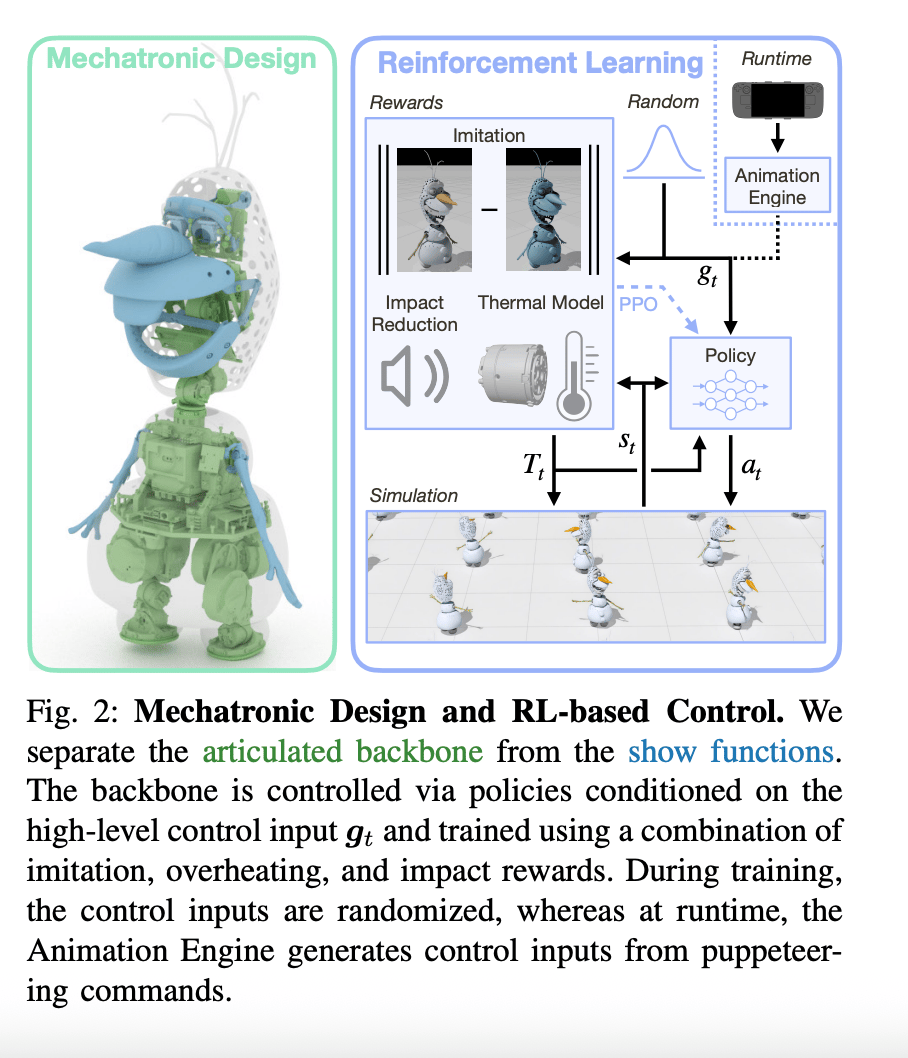
- The robot receives its own actuator temperatures as input alongside normal sensor data.
- They built a thermal model (T˙ = −α(T − Tambient) + βτ², for the nerds) showing temperature rises with the square of motor torque.
- Then they used Control Barrier Functions; essentially, soft limits that tell the AI “hey, you're getting warm, ease up.”
- Result = the robot proactively reduces torque before hitting the 80°C danger zone; it gradually adjusts Olaf's head position to lower sustained load while maintaining expressiveness.
Some other cool innovations:
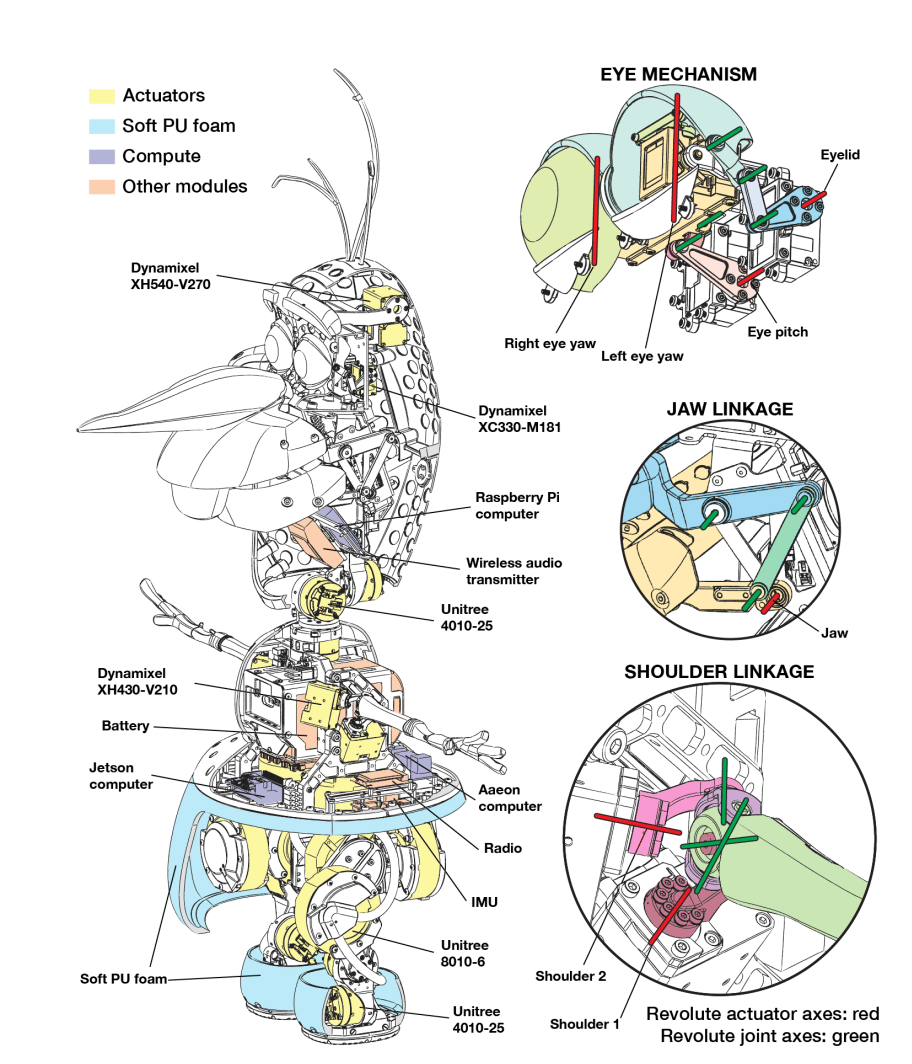
- Asymmetric hidden legs: Mirror-inverted legs (left has rear hip/forward knee, right has forward hip/rear knee) prevent collisions inside the tight body.
- They’re hidden under a soft foam “skirt” that creates the illusion of floating snowball feet.
- Remote actuation: Spherical 5-bar linkages for shoulders, and 4-bar linkages for jaw and eyes; motors placed where there's space, not where joints are.
- Silent stepping: An impact reduction reward cut footstep noise by 13.5 dB (extremely quiet, just barely above the threshold of human hearing).
- Harsh robotic stomps break the illusion instantly…
- Magnetic breakaways: Arms, nose, and hair detach on impact to prevent damage (and enable in-character gags, like this one).
WHY IT MATTERS: First of all, theme parks are gonna be wild in a few years. Imagine life-like 3D characters wandering around the parks more frequently; how cool is that?
But this is bigger than robotic mascots; any machine with heat-sensitive components in tight spaces faces the same problems as Olaf here. We’re talking humanoid robots, prosthetics, drones, space applications…and Disney just proved you can teach AI to self-regulate their temperature through reward functions instead of hard-coded limits.
Now, let's dive into the details a bit more in depth.
The Challenge: Making the Impossible Physical
Olaf presents unique problems for roboticists. His design violates basic principles of stable robotics:
- Massive head, tiny body: A large, heavy head balanced on a slim neck
- Floating feet: In animation, his snowball feet appear to move independently beneath his body with no visible legs
- Non-physical movements: His characteristic waddle and gestures defy normal physics
Creating a believable physical version required innovations in both mechanical design and artificial intelligence.
Hiding the Impossible: Mechanical Innovations
The Asymmetric Leg Solution
The team's most clever trick was designing asymmetric legs hidden inside Olaf's lower snowball body:
- The left leg has a rear-facing hip and forward-facing knee
- The right leg has a forward-facing hip and rear-facing knee
- This prevents the legs from colliding with each other in the tight space
- A soft polyurethane foam "skirt" conceals the mechanics while flexing to allow movement
Remote Actuation Through Linkages
Space constraints meant actuators couldn't be placed directly at joints. Instead, the team used:
- Spherical 5-bar linkages for the shoulders, with motors hidden in the torso
- 4-bar linkages coupling the upper and lower jaw to a single motor
- Planar linkages for eye pitch and eyelids
- Direct-drive for the mechanical eyes' independent yaw movements
Costume Integration
The stretchy 4-way fabric costume must accommodate all movements while maintaining Olaf's appearance. Magnetic attachments for the arms, nose, buttons, eyebrows, and hair allow them to break away during falls—preventing damage while enabling "in-character" gags.
AI That Learns Character
The control system uses reinforcement learning (RL) to master Olaf's distinctive movements:
Imitation Learning
- Artists created animation references using professional tools
- A custom gait generation system captures Olaf's characteristic heel-toe waddle
- The AI learns to replicate these movements while maintaining balance in the real world
Temperature-Aware Intelligence
Perhaps the most innovative feature: thermal-aware policies that prevent overheating.
The slim, costume-covered neck contains small actuators supporting the heavy head—a recipe for overheating. The solution:
- A thermal model predicts actuator temperatures based on torque usage
- The AI receives temperature data as input
- Control Barrier Functions create "soft limits" that encourage the AI to reduce torque as temperatures approach 80°C
- The robot gradually adjusts head position to lower sustained torque before reaching critical temperatures
This prevents shutdowns while maintaining the character's expressiveness—the robot literally learns to "pace itself."
Silent Footsteps
Early versions had a problem: harsh robotic footsteps that shattered the illusion. The team introduced an impact reduction reward that:
- Penalizes rapid changes in vertical foot velocity
- Reduces stepping sound by 13.5 decibels
- Maintains the overall motion profile and character fidelity
Performance Specifications
The final robot achieves:
- Height: 88.7 cm (without hair)
- Weight: 14.9 kg
- Degrees of freedom: 25 total
- 6 per leg
- 2 per shoulder
- 3 in the neck
- 1 jaw
- 1 eyebrow
- 4 mechanical eyes
- Tracking accuracy: ~4° average joint error compared to animation references
- Control frequency: 50 Hz policy updates, 600 Hz actuator commands
Real-Time Puppeteering
Olaf can be controlled live through a three-layer animation system:
- Background animations: Subtle idle behaviors (eye movements, small adjustments)
- Triggered animations: Gestures and spoken lines layered on top
- Joystick control: Real-time control of gaze, posture, and walking
This creates the illusion of a character that's both autonomous and responsive to puppeteering.
Why This Matters
This project pushes robotics beyond traditional functional goals into the realm of believability and character fidelity. The innovations have applications beyond entertainment:
- Thermal-aware control: Relevant for any robot with heat-sensitive components in constrained spaces
- Impact reduction: Useful for robots operating in noise-sensitive environments
- Compact linkage systems: Applicable to humanoid robots and prosthetics
- Character control: Demonstrates that robots can embody specific personalities and movement styles
The team succeeded in creating something that's neither purely functional robot nor simple animatronic—it's a believable character that walks, gestures, and even "thinks" about not overheating, all while maintaining the warmth and charm that made audiences fall in love with Olaf in the first place.
More importantly, any machine with heat-sensitive components in tight spaces faces the same problem as Olaf—humanoid robots, prosthetics, drones, space applications. The techniques here—thermal-aware policies, impact reduction, compact linkages—transfer directly to consumer robotics and companions where character matters as much as capability. Disney just proved you can teach AI to self-regulate thermals through reward functions instead of hard-coded temperature limits, which can help give more powerful robots the ability to self regulate and in theory, work for longer.
