



Ever felt like your computer was a graveyard of apps that don’t talk to each other? For decades, humans have been the "universal glue" between software. We copy from a PDF, paste into a doc, and search a database. You’ve got files scattered across folders, a browser with fifty tabs, and a to-do list that’s more "vague suggestion" than "action plan."
You probably wish you had a sidekick who could just handle it. The answer to that from 2025 was Claude Code, Anthropic’s terminal-based general purpose agent that’s been exploding online lately, not just as a coder's dream, but as a general-purpose AI agent redefining everyday workflows in 2026.
Here's what makes it special: Claude Code is perfectly tooled for its environment—a digital world built entirely of software. Unlike chat-based AIs trapped in browser windows, Claude Code runs locally on your machine with full access to your files, folders, browser, and command line.
It can read, create, manipulate, and organize anything a human with computer access could—without the cloud bottlenecks. Think of it less as "Claude Code" and more as "Claude Local" or "Claude Agent," as Lenny Rachitsky puts it.
But here's the real story: non-engineers are waking up to Claude Code's magic beyond pure coding. Marketing managers are using it to scrape competitor ads. Product managers are synthesizing thousands of customer call transcripts. Writers are organizing scattered voice memos into polished articles. Parents are using it to design backyard slides for their kids.
As Ethan Mollick explains, it's unlocking "a new category of software which is 'useful tool for me'", handling autonomous processes like analyzing credit card records for anomalies or conducting user testing on websites, self-correcting errors along the way.
Yet just as adoption surges, Anthropic started cracking down on third-party tools piggybacking on Claude subscriptions: cutting off xAI staff from Cursor access, banning popular wrappers like OpenCode, and sparking fierce backlash from developers who felt blindsided by the move.
What did all of this lead up to? The launch of Claude Cowork, Claude's new tool for capturing the power of Claude Code and repackaging it for the rest of us non-coders.
Below, we'll break down everything you need to know about Claude Cowork, as well as explore the hype around Claude Code that led to this moment, covering the tech, the drama, and what it all means for the future of AI-assisted everything.
- Claude Cowork, Explained: Anthropic Just Turned Claude into Your New Coworker
- Why this matters:
- What Is Claude Code? A Primer on the Terminal Titan
- Why Claude Code Is Having Its Moment: Productivity Superpowers and Viral Wins
- The Magic Behind the Curtain: How Claude Code Actually Works
- The Crackdown: Anthropic's Iron Fist and the Developer Backlash
- What Claude Code Means for the Future of Work
- Practical Guidance: How to Actually Use Claude Code and Cowork
- The Bigger Picture: Gatekeeping vs. Innovation
- Conclusion: A Watershed Moment or a Walled Garden?
Claude Cowork, Explained: Anthropic Just Turned Claude into Your New Coworker
In case you missed our predictions livestream last Friday, we believe strongly that the AI battle of 2026 will be between General Purpose Agents and Niche Specialist agents. If 2025 taught us anything, it's that having an "agentic workflow" wasn't enough to capture the imaginations of millions of knowledge workers, nor was a sandboxed agent you set and forget.
Surprisingly, the ideal form factor was Claude Code—the coding agent running locally* (*not really, but it can use local tools) inside your terminal with "hands" to move files and browse the web. While devs use it for 10x productivity, non-engineers are waking up to its general-purpose magic: brainstorming domains, organizing chaotic invoices, even diagnosing slow computers. Some users even installed the "Ralph Wiggum" plugin to let it work autonomously for days.
The problem? The name. Calling a general-purpose agent "Claude Code" was short-sighted branding that anchored it to developers.
Today, Anthropic fixes that mistake.
Anthropic released Cowork, a research preview that lets Claude actually complete work for you—not just chat about it. Available now for Claude Max subscribers on macOS, it's basically Claude Code for everyone else.
Here's the pitch: Instead of copying and pasting between Claude and your apps, you give Claude access to a folder on your computer. Then you can ask it to reorganize your messy downloads, turn expense screenshots into a spreadsheet, or draft a report from scattered notes. Claude makes a plan, completes the work, and keeps you updated.
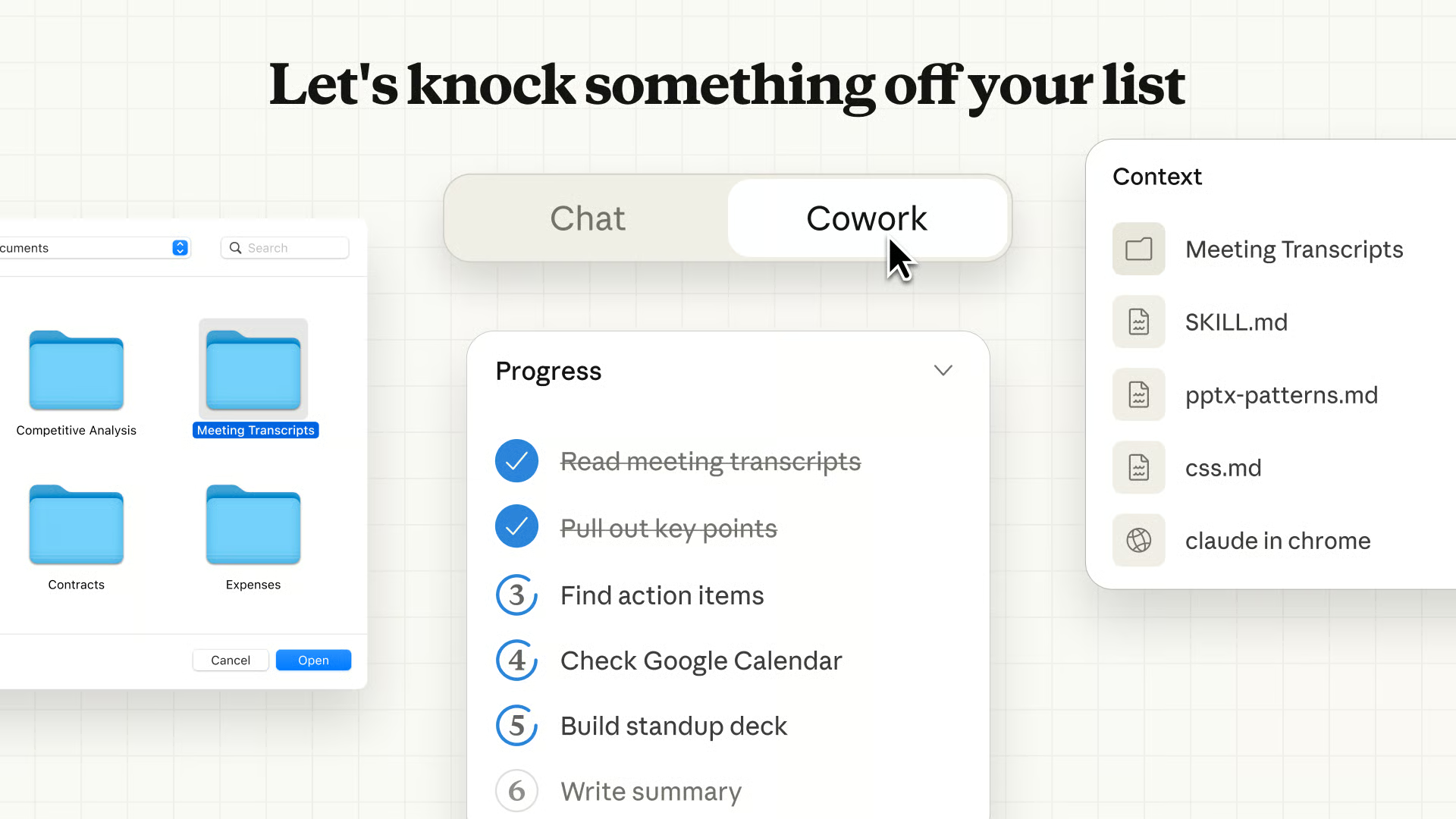
The key difference? Agency. In a regular chat, Claude waits for you after each response. In Cowork, Claude tackles tasks from start to finish while you queue up more work. It's less like texting and more like leaving sticky notes for a colleague.
What Cowork can handle:
- Reorganize files by sorting and renaming them automatically
- Create spreadsheets from piles of screenshots or documents
- Draft reports from disorganized notes across multiple files
- Edit and format documents across your folders
- Use your existing Claude connectors (like Google Drive)
- Pair with Claude in Chrome for browser-based tasks
After seeing this, we had a few questions:
- So is this Copilot for non-coders? Basically, yes. While Microsoft's Copilot lives inside Office apps and GitHub, Cowork operates at the file system level—think Copilot for your entire computer, not just your IDE.
- Will this push Microsoft to launch Copilot Desktop faster? Probably. Anthropic is forcing Microsoft's hand by proving the market exists.
- Where's Google? Good question. Gemini CLI exists, but they have as many apps as Microsoft does, and no efficient way to work between them. Anthropic is claiming the territory first.
The safety stuff: Claude can't access anything you don't explicitly share. It'll ask before taking major actions. But there are two things to know: Claude can delete local files if instructed (so be clear with your directions), and there's always some risk of prompt injections—where malicious content tricks Claude into doing something unintended.
Anthropic's being transparent that agent safety is still evolving industry-wide. They've built defenses, but this is new territory Full safety guide here
Why this matters:
We're witnessing the birth of the Personal R&D Station. AI is shifting from answering questions to actually completing work. Cowork isn't perfect; it's a research preview, but it signals where things are headed: AI that doesn't just advise but executes.
Anthropic is solidifying their main character moment for normies, even as they potentially disrupt developers. This is the culmination of the larger trend we've been tracking: 2026 will be defined by General Purpose Agents versus Niche Specialists.
For knowledge workers, this democratizes capabilities that used to require coding skills. You can prototype ideas, automate file management, and build systems without years of training. Expect more AI firms to gatekeep as agentic tools reshape jobs, shifting us from doers to reviewers.
Whoever wins the marketing battle over the next 6-12 months will capture the largest market share. Anthropic's betting that giving Claude real access to your files, not just browser control, is the winning move.
You can also expect general agents like Cowork to fight vertical specialists for your desktop's soul. Niche tools optimized for specific workflows (writing, design, research) will compete against general-purpose agents that can do everything adequately.
Want to try it? Claude Max subscribers can download the macOS app and click "Cowork" in the sidebar. Cross-device sync and Windows support are coming. Everyone else can join the waitlist.
Pro tip: If you're on a Mac, try asking Cowork to "identify and stop whatever is making my fans spin so loud." It's the easiest way to feel the power of a local agent.
Or start simple: Ask it to rename 50 messy PDFs in your downloads folder. The goal is to feel the agentic power—that moment when you realize you're not asking questions anymore, you're delegating work.
Stop waiting for a "feature" and build your own workflow. Try Cowork, Tasklet (another general purpose work agent), or Claude Code for one file-management task today. Experiment with simple tasks first, watch your output soar, and see how it changes the way you work.
Just don't build knockoffs or spoof credentials—or you'll get the boot. Jump in officially via Claude's site, follow the user guide, and join the next wave of agentic work.
The terminal is becoming the new home of AI. Welcome to the era of the coworker who never sleeps.
Now, let's dive a bit deeper into Claude Code's "Main Character Moment" and what led up to this launch.
What Is Claude Code? A Primer on the Terminal Titan
Claude Code isn't your grandma's code completer. Built on Anthropic's Claude Opus 4.5 model, it's a command-line interface (CLI) tool that integrates deeply with your local machine, allowing agentic workflows where AI acts autonomously. Unlike ChatGPT or standard Claude chats, it operates in your terminal with full file system access, running commands, browsing the web, and executing programs.
Nathan Lambert of Interconnects describes the experience: "The joy and excitement I feel when using this latest model in Claude Code is so simple that it necessitates writing about it. It feels right in line with trying ChatGPT for the first time... but in an entirely new direction. This time, it is the commodification of building. I type and outputs are constructed directly."
Key Features That Make It Different
- Agentic Autonomy: Claude Code can spin off sub-agents for parallel tasks—like debugging while planning the next feature. One user notes: "Claude Code works because it's the frontier of LLM intelligence with complete access to your computer that can spin off 100 subagents to solve for a single prompt."
- Skills and Plugins: Customizable "skills" let it handle domain-specific tasks. Need to build a website? It loads up the Website Creator Skill. Working with Excel? It grabs the spreadsheet skill. As Mollick explains, "Skills are instructions that the AI decides when to use, containing not just prompts, but also the sets of tools the AI needs to accomplish a task."
- Verification Loops: A game-changer. Claude tests its own output, iterating until it's solid. As creator Boris Cherny emphasizes: "Give Claude a way to verify its work. If Claude has that feedback loop, it will 2-3x the quality of the final result."
- Compacting: When its context window fills up—and it will, given Claude reads every file, image, and command—it stops and "compacts" the conversation, taking notes about exactly where it was. Then it clears the window and reads the notes to continue. Think of the amnesiac from Memento checking his tattoos. This lets Claude run for hours autonomously.
- Pricing: At $200/month for Pro/Max tiers, it's subsidized for heavy use—which is precisely why the crackdown on third-party tools is happening. Wrappers were exploiting this for cheaper API-equivalent access.
Why It's Not Just for Coders
Here's where it gets interesting. The "Code" in Claude Code is a misnomer. This is a general-purpose agent that happens to be especially good at coding.
Dan Shipper convinced Lenny Rachitsky that Claude Code was "the most underrated AI tool for non-technical people." After playing with it, Lenny agreed: "Holy sh*t, we've all been sleeping on Claude Code."
The reason? We live in a software world. Your invoices are files. Your emails are files. Your meeting notes, photos, spreadsheets—all files that Claude can read, organize, transform, and create. The command line isn't just for developers; it's the universal interface to everything digital.
As Lambert writes: "Claude Code doesn't need to be restricted to just software development—it can control your entire computer. People are starting to use it for managing their email, calendars, decision making, referencing their notes, and everything in between."
Why Claude Code Is Having Its Moment: Productivity Superpowers and Viral Wins
Something shifted in late 2025. Sergey Karayev captured it: "Claude Code with Opus 4.5 is a watershed moment, moving software creation from an artisanal, craftsman activity to a true industrial process. It's the Gutenberg press. The sewing machine. The photo camera."
What changed? Two things converged: smarter models that can work longer autonomously while self-correcting, and an "agentic harness" of tools and approaches that let them solve problems in new ways. METR tracks how long tasks AI can complete autonomously—measured by how long they'd take human professionals—and it's been increasing exponentially, with large leaps in the past few months.
Wild Examples from the Trenches
The proof is in the demos. Anthropic's official Claude account curated a thread of wins:
- Kevin Roose built a Pocket clone with TTS read-alouds, video summaries, spaced repetition emails, and Kindle sync—in 12 prompts. "How does any app developer survive this?" he asked. He also rebuilt his website and cancelled his $200/year Squarespace subscription.
- Andy Hall ran a full empirical political science study in an hour. A subsequent manual audit found Claude replicated the original paper exactly, coded 29/30 counties correctly, and collected data that correlated >.999 with manual collection. The errors were comparable to what a human researcher might make on a first pass.
- Max Woolf generated a full MIDI mixer as a terminal app, written in Rust.
- Vibecoding Explained created a Tinder-for-movies iOS app in two prompts, then shipped it to the App Store.
- Muratcan Koylan trained LLMs from books using Claude Code's Skills plugins.
But coding is just the beginning. Lenny collected 50 use cases from non-technical users:
- Brainstorming domain names: Describe your project, get creative options across TLDs (.com, .io, .dev), with availability verification.
- Finding high-quality leads: Type "look at what I'm building and identify the top 5 companies for a pilot." Claude scans your codebase to understand the product, then researches prospects.
- Noticing conflict avoidance: Dan Shipper downloads all meeting recordings to a folder and asks Claude "to tell me all of the times I've subtly avoided conflict."
- Diagnosing slow computers: Users report Claude checking load averages, memory pressure, disk space, stuck processes, swap activity—then explaining what's wrong and suggesting fixes with actual commands.
- Cleaning invoice chaos: Claude reads each file in a messy folder, renames it to "YYYY-MM-DD Vendor - Invoice - Product.pdf", and moves it to the right folder.
- Organizing scattered thoughts: Helen Lee Kupp, a mom who voice-records ideas during stroller walks, fed Claude rambling voice notes. It organized them into coherent themes, wrote articles in her exact voice, and created LinkedIn versions automatically.
- Building presentations: Hank Yeomans creates all slides as HTML in Claude Code, then imports them into PowerPoint—or just presents directly from the browser with "previous" and "next" buttons.
- Synthesizing customer calls: Derek DeHart uses it to compile evidence from call transcripts that supports or invalidates running hypotheses, connected via MCPs to Fireflies, Linear, and Notion.
- Creating "self-driving" documentation: James Pember has Claude exploring software independently with Playwright, identifying documentation gaps, and creating the missing docs itself.
The Productivity Numbers
Economist Alex Imas used Claude Code for data analysis and posted: "Here is 24-48 hours of work done in 20 minutes." He added: "Claude Code is not just for code. It is an AI agent that acts like a combination of personal assistant/RA/colleague."
Designer Pietro Schirano fed it his raw DNA data and used it to find health-related genes—no uploads required, all processed locally.
The through-line? Claude Code democratizes agency. It turns terminals into personal superpowers, letting non-technical users accomplish tasks that previously required either coding skills or expensive software subscriptions. Cowork removes the last barrier—the intimidating terminal interface—making this power accessible to everyone.
The Magic Behind the Curtain: How Claude Code Actually Works
To understand why Claude Code feels different—and why Cowork can deliver the same power in a friendlier package—you need to understand its tricks (what Mollick calls the "agentic harness").
Compacting: Solving the Memory Problem
AIs can only "remember" so much at a time. The context window—often 150,000+ words—fills up fast because it contains your entire conversation, every file read, every image taken, and the system prompts. When it fills up, the AI forgets.
Claude Code solves this differently. When it runs out of context, it stops and "compacts"—taking notes about exactly where it was when it stopped. Then it clears the window, and a fresh Claude reads those notes to continue. This is why Claude can run for hours: it carefully documents its progress along the way, producing interim work it can reference later.
Skills: AI-Controlled Instructions
Rather than requiring humans to constantly prompt the AI, Skills let Claude decide when to load specific instructions. Does it need to build a website? It loads the Website Creator Skill. Excel spreadsheet? The Excel skill.
Skills contain not just prompts but the sets of tools needed for a task. And they're written in plain language—the AI can even help you create them. Jesse Vincent released a free list that handles an entire software development process, from brainstorming through testing.
Cowork ships with document-focused skills out of the box, optimized for creating presentations, spreadsheets, and reports—no coding required.
Subagents: Parallel Processing
Claude can launch other, specialized AIs—subagents—to solve specific problems. Because Opus is a large, expensive model, it can hand off easier tasks to cheaper, faster models. It also allows Claude to run many processes at once, working like a team rather than an individual.
MCPs: The Open Integration Standard
The Model Context Protocol (MCP) lets any company give AI agents instructions and access. There are MCPs from publishers for scientific papers, from payment companies for financial data, from software providers for their products. The result is a flexible system where a smart generalist AI can apply specialized skills on the fly.
Both Claude Code and Cowork support MCPs, meaning your Google Drive, Slack, and other connectors work seamlessly in both environments.
The Crackdown: Anthropic's Iron Fist and the Developer Backlash
Just as Claude Code peaks, Anthropic is tightening the noose on third-party tools.
The xAI Bombshell
Kylie Robison scooped that xAI staff had been using Anthropic's models internally through Cursor—until Anthropic cut off access this week. According to an internal Slack message from xAI cofounder Tony Wu:
"Hi team, I believe many of you have already discovered that anthropic models are not responding on cursor. According to cursor this is a new policy anthropic is enforcing for all its major competitors. This is both bad and good news. We will get a hit on productivity, but it rly pushes us to develop our own coding product / models."
This echoes past moves. Anthropic revoked OpenAI's access last August ahead of GPT-5's release. In June, they limited Windsurf's access after reports it was exploring a sale to OpenAI. As cofounder Jared Kaplan said then: "I think it would be odd for us to be selling Claude to OpenAI."
The Third-Party Harness Ban
Thariq from Anthropic explained the policy: "Third-party harnesses using Claude subscriptions create problems for users and are prohibited by our Terms of Service. They generate unusual traffic patterns without any of the usual telemetry that the Claude Code harness provides, making it really hard for us to help debug."
The supported path? Use the API. "We genuinely want people building on Claude, including other coding agents and harnesses," Thariq wrote. "If you're a maintainer of a third-party tool and want to chat about integration paths, my DMs are open."
Bans have been lifted for affected users, but the TOS stands.
The Developer Backlash
Reactions were fierce. DHH (Basecamp founder) called it "Terrible policy for a company built on training models on our code, our writing, our everything. Please change the terms, @DarioAmodei." He later added: "I think it's great that all the model providers are coming out with their own CLIs, but let's be honest, no dev is going to want to have five different CLIs installed."
Mckay Wrigley pushed for clarity: "Would you guys be willing to elaborate more? Are conductor-style apps where it's kind of a local UI wrapper allowed? It would be a massive mistake to 'ban' this type of app. The vibes are amazing rn, but this has admittedly left a bad taste for a lot of people."
Ahmad Osman ditched Claude entirely: "I have fully dropped Claude Code for OpenCode. I don't use Opus 4.5, I use GLM-4.7 and MiniMax-M2.1. They're opensource and can be self-hosted. Nobody can nerf my models or rug pull me."
Brian Cardarella sees a bubble forming: "Anthropic shutting down Claude Pro access to all but Claude Code is the first shot in the bubble. This is going to come faster than people realize."
Why the Crackdown?
The economics explain it. Third-party wrappers let users access Claude models through Pro subscriptions at a fraction of API costs—one estimate suggested 1/20th the price. Anthropic is subsidizing heavy usage as a loss leader; letting wrappers exploit that creates an unsustainable model.
There's also the telemetry angle. As one commenter noted, the data from Claude Code usage feeds back into model improvement. Third-party tools strip that feedback loop.
Daniel Miessler defended Anthropic: "The pushback against Anthropic right now is pretty stupid. Here's basically what happened: They invent a new concept of an all-you-can-eat subscription to their amazing buffet restaurant. It's the best food in town, so everyone wants it..."
The Competition Pivots
OpenCode quickly added ChatGPT Plus/Pro integration. Tibo from OpenAI touted Codex's open-source repo: "With the Claude Code shutdown, I am proud that we build Codex in the open... we are 100% invested in supporting a flourishing ecosystem of agentic coding tools."
Sam Lambert switched allegiances: "Anthropic rugging claude code access has made me realize I prefer codex with Clawd bot."
John Suh offered a contrarian take: "Because people are pretty slow on Twitter, it might take 6 months for people to realize that Codex is better than Claude Code (gpt-5.2 high v Opus). OAI models are much smarter than Claude models at doing any type of work with thinking, but Anthropic models have better personality and finding shortcuts."
What Claude Code Means for the Future of Work
The Commodification of Software
Lambert captures it perfectly: "Software is becoming free and human design, specification, and entrepreneurship is the only limiting factor."
This isn't hyperbole. Ethan Mollick gave Claude Code a single command: "Develop a web-based startup idea that will make me $1000 a month where you do all the work." The AI asked three multiple-choice questions, then worked independently for an hour and fourteen minutes, creating hundreds of code files and prompts. Then it gave him one file to run that deployed a working website—you can see it here—that would have collected real money.
This is the "Gutenberg press" moment Karayev described. The limiting factor is no longer "can I build this?" but "should I build this?"
Cowork democratizes this even further. You don't need to understand the terminal. You don't need to know what a command line is. You just point Claude at a folder and tell it what you want done.
The Rebalancing of Tech
Lambert predicts this "will rebalance the software and tech industry to favor small organizations and startups that have flexibility and can build from scratch in new repositories designed for AI agents. It's an era to be first defined by bespoke software rather than a handful of mega-products used across the world."
The list of what's already commoditized grows daily: website frontends, mini applications, data analysis tools. All without knowing how to write code.
The Mental Model Shift
Andrej Karpathy, one of AI's most famous researchers, recently posted: "I've never felt this much behind as a programmer. The profession is being dramatically refactored as the bits contributed by the programmer are increasingly sparse and between."
As Mollick concludes: "Don't let the awkwardness of the current Claude Code or its specialization for coding fool you. New harnesses that make AI work for other knowledge tasks are coming in the near future, and so are the changes that they will bring."
That future arrived today. It's called Cowork.
Practical Guidance: How to Actually Use Claude Code and Cowork
Getting Started
- Download Claude Desktop from claude.com/download. The Desktop version is easier than the CLI for beginners (though the CLI has more features).
- Give it folder access. Claude can do anything to files in that folder, so start with a dedicated test folder. Make backups of anything important.
- Think beyond coding. Ask it to organize files, analyze data, create documents, research topics—anything you'd do on a computer.
Starter Prompts for Non-Coders
From Lenny's collection:
- "How can I clear some storage on my computer?"
- "Find duplicate files and help me decide which to keep."
- "Organize these downloads into proper folders."
- "Improve the image quality of [filename]."
- "Pick a random row from this Google Sheet to select a winner."
- "Download all images in high-res from this Google Doc: [URL]."
When to Use Cowork Instead
Use Cowork if:
- You're intimidated by the terminal.
- Your tasks are primarily about file organization, document creation, or data compilation.
- You want a simpler, more guided experience.
- You're not writing code.
Use Claude Code if:
- You're comfortable with the terminal.
- You need maximum flexibility and control.
- You're doing actual software development.
- You want access to the full CLI power.
Pro Tips
Use verification loops. Ask Claude to test its own work. "Build this, then test it, then show me the results."
Give it context. The more Claude knows about what you're trying to accomplish, the better. Dump relevant files into its folder.
Learn slash commands. /agents sets up subagents, /skills creates or downloads skills. These unlock the full power.
Start small. Don't begin with "build me a startup." Try "organize this folder" and work your way up.
The Bigger Picture: Gatekeeping vs. Innovation
This saga highlights the central tension in AI today. Claude Code empowers solo creators like never before... but restrictions could stifle the ecosystem that makes it valuable. Expect more lock-ins as competitors respond.
As one observer noted: "The primary purpose of these tools is to accelerate AI research"—and whoever controls the best coding agents controls the pace of AI development itself.
The developer migration has already begun. Some are moving to Codex. Others to self-hosted models. Open ecosystems are thriving—Tibo's OSS repo lets anyone build on Codex directly.
Anthropic's answer? Cowork. By creating an official, supported path for non-coders, they're betting they can capture the mainstream market without the chaos of third-party wrappers.
Future? An arms race in agentic tools. With plugins like Ralph Wiggum enabling days of autonomous work, and new Skills emerging weekly, the autonomy keeps growing.
Conclusion: A Watershed Moment or a Walled Garden?
Claude Code's rise—from side project to industry phenomenon—shows AI's potential to redefine knowledge work. The wins are real: Roose's app in 12 prompts, Hall's peer-reviewed-quality research in an hour, Imas's 24-hour task in 20 minutes.
But the crackdown reveals its fragility. Innovation thrives on openness, yet companies must guard turf to survive. The question isn't whether agentic AI will transform work—it's who gets to control the transformation.
In our opinion, Cowork is Anthropic's attempt to control the narrative. Rather than fighting third-party tools forever, they're building the official general-purpose version. It's Claude Code without the terminal. It's the agent for everyone else.
Lambert's prediction feels right: "Claude with a 100X context window and 100X the speed will be AGI. By the end of 2026 we definitely could get the first 10X of both."
Until then, the terminal's future is bright—and now it's accessible to everyone, not just developers.
The terminal is becoming the new home of AI. Welcome to the era of the coworker who never sleeps.
