


New challenge unlocked: Today we're going to try to capture EVERYTHING going on in AI right now in a single article. Let's see if we can do it.
First, why do this? Because there's a lot going on!
Now, a few observations:
1. There's a war of attrition happening where AI labs try to focus on developers, but then leave normies out in the cold (and vice versa).
ChatGPT has spent the better half of the last three months laser-focused on devs, but their normie tools in GPT have atrophied. OpenAI launched Codex, a cloud-based software engineering agent powered by the GPT-5-Codex model, and over 1 million developers are now using it according to their latest release notes.
Meanwhile, Anthropic is going dead on for enterprises and "normie" office workers, and they've been crushing it. They just launched Claude Cowork with 13 new enterprise plugins (Google Workspace, DocuSign, FactSet), and 80% of their business is now enterprise.
But devs are complaining their devrel team has made a series of forced errors. In January, Anthropic cracked down on unauthorized third-party tool usage, blocking popular tools like OpenCode and Cursor. DHH called it "customer hostile," and many developers publicly said they're switching to Codex.
2. Big tech companies are spending more than they ever have on datacenters, anticipating massive demand.
These investments make a lot of sense, because as intelligence becomes smarter and cheaper to run at scale, there will be more demand for it. Big tech is set to spend $650 billion to $690 billion in 2026, a 67-74% increase year over year. Hyperscaler capex alone will exceed $600 billion, with roughly 75% going to AI infrastructure. JLL forecasts 100 GW of new datacenter capacity between 2026 and 2030.
But you know what makes more sense? Making the chips we DO have more efficient.
This is where a series of interesting companies that launched recently come into play:
- Open source competitors, in both China (Kimi from Moonshot, GLM from Zhipu AI, Qwen from Alibaba, and the infamous DeepSeek) and the US (Arcee AI, which released its 400B-parameter Trinity Large model under Apache 2.0 in January; Ai2; and Reflection AI, which raised $2B at an $8B valuation from Nvidia to become America's answer to DeepSeek).
- Stefano Ermon's diffusion language model Mercury from Inception Labs, which takes a fundamentally different approach to text generation. Instead of predicting one token at a time, Mercury uses diffusion (the same technique behind image generators) to generate text. The result: Mercury 2 hit 1,009 tokens per second, 5-10x faster than traditional LLMs. The company raised $50M from Menlo Ventures. (arXiv paper)
- New ideas to reduce cost and improve on the transformer architecture. Pathway launched a post-transformer architecture called "Baby Dragon Hatchling" (BDH) that enables AI to generalize over time (WSJ covered it in December). And Logical Intelligence introduced Kona 1.0, an energy-based reasoning model that achieved 96% accuracy on Sudoku puzzles (compared to 2% for LLMs). Yann LeCun joined as founding chair. (Demo)
- New ideas to improve the software to work with chips (Modular, whose Mojo programming language is going fully open source with 450K+ lines of code and has an AMD partnership for GPU portability).
- And new chips themselves (Cerebras, which just confidentially filed for a US IPO targeting Q2 2026 at a $23 billion valuation after raising $1B+ in its February Series H; Google's TPUs; Groq; and the newly announced MatX, which just raised $500M from Jane Street and Situational Awareness (Bloomberg). The MatX One chip targets 2,000 tokens per second using a hybrid SRAM+HBM design). Longer-term bets in this area include photonic chips and even quantum computers.
3. The AI we DO have keeps getting smarter, and the benchmarks can barely keep up.
Quick reality check on where raw AI capability stands. ARC-AGI, François Chollet's benchmark designed to test whether AI can reason like humans on tasks that are trivially easy for people, tells the story well.
ARC-AGI-1, the original version from 2019, is essentially solved. Multiple systems now score above 85%. So in 2025, Chollet released ARC-AGI-2, a harder version designed to resist brute-force approaches. When it launched, pure LLMs scored 0%. AI reasoning systems managed single digits.
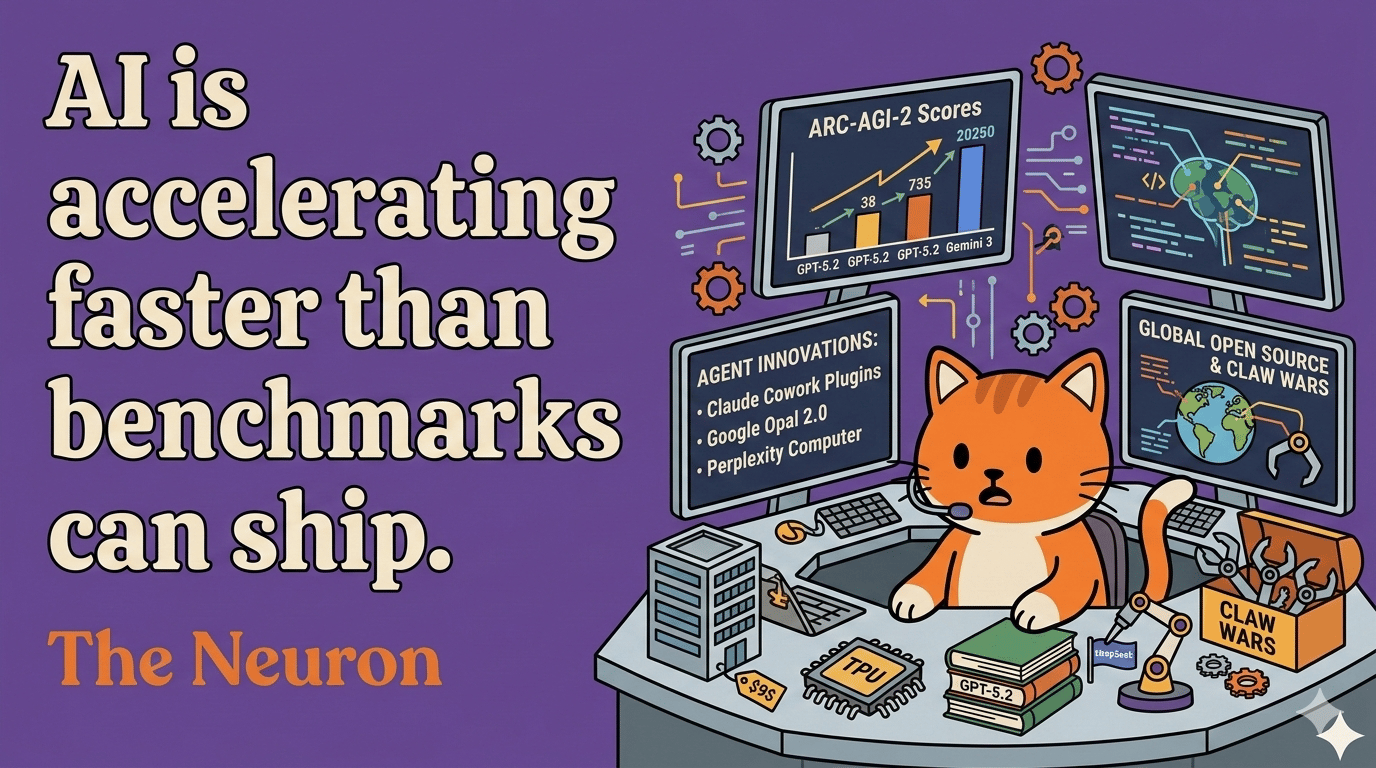
Fast forward to February 2026: the benchmark is getting demolished. GPT-5.2 hit ~53%. Gemini 3 Deep Think reached 84.6%. And Imbue's code evolution method, using Gemini 3.1 Pro, pushed to 95.1% on the public eval set. At the start of the year, the top score was 54%. Two and a half months later, it nearly doubled.
Here's the kicker: ARC-AGI-3, the next version that shifts to interactive reasoning (think video-game-like environments where AI agents have to explore, learn, and adapt), isn't even officially out until March 25. But people are already solving the publicly available preview games with memory scaffolds and current frontier models. The benchmarks can't even ship before AI catches up.
So the question becomes: what do we do with AI this smart, and what do we do with the humans we have as the AI scales in intelligence?
Right now, most of the industry's answer is: agents.
4. It's now all about agentic engineering and how to apply agents. Here's how you (normal person) can apply agents depending on your primary AI stack preference:
- Copilot: Use Copilot Studio, Microsoft's agent platform with multi-agent orchestration, MCP integration, and 1,400+ connectors. GPT-5 Chat is now GA, and they recently added Anthropic model support too (release notes).
- Gemini: Use Opal, which just got a massive upgrade. Opal 2.0 adds a new agent step that analyzes your goal, determines the best approach, and automatically calls the right tools (Veo for video, web search for research, etc.). That's a meaningful shift from "flow builder" to "decision-making system." It also adds Memory (persistent context across sessions), Dynamic Routing (conditional logic without code), and Interactive Chat (user-in-the-loop). Available in 160+ countries at opal.google. If you're an engineer, Antigravity is Google's Gemini 3-powered agentic IDE (free public preview), or use Gemini CLI from the terminal.
- ChatGPT: Codex automations for cloud-based software engineering tasks.
- Claude: Cowork for office workers, or if you're an engineer, Claude Code with browser control extension (fun fact: it's used by employees at Microsoft, Google, and OpenAI).
- Perplexity: Just launched Perplexity Computer, a cloud-based super-agent for Max subscribers ($200/month) that orchestrates 19 different AI models to handle complex workflows in an isolated compute environment. It builds on their Comet browser, which launched last summer and is now used as a primary browser for 70% of tasks by its adopters. The company is also pivoting hard toward enterprise and subscriptions, abandoning its ad business entirely after concluding ads undermine trust in AI-generated answers. Revenue hit ~$200M ARR in 2025, and they're targeting $500M in 2026.
5. Open source agents have exploded, and the "Claw Wars" are the best example.
Remember OpenClaw? Austrian developer Peter Steinberger built an open-source personal AI agent (originally called "Clawdbot," then "Moltbot" after Anthropic sent a trademark complaint) that connects to any LLM and lets you control your computer through chat apps like WhatsApp and Telegram. It went nuclear. 100,000+ GitHub stars in under a week. 200,000+ now. One user's agent negotiated $4,200 off a car purchase while he slept. Another's accidentally fought an insurance company and won. CrowdStrike published a security advisory about it. Steinberger joined OpenAI in February and moved the project to an independent foundation.
Then came the clones. So. Many. Clones.
NanoClaw (security-hardened, runs in containers). IronClaw (100% Rust, 194x less memory than OpenClaw, launched by NEAR AI for crypto-secure agents). PicoClaw (runs on $10 hardware with <10MB RAM, built by Chinese hardware company Sipeed). ZeroClaw (deterministic execution). ZeptoClaw. TinyClaw. NullClaw. MiniClaw. There's literally a comparison website tracking them all.
And Chinese companies didn't just fork it; they productized it. Moonshot AI launched Kimi Claw, a cloud-native version running on their Kimi K2.5 model with 5,000+ pre-loaded skills and 40GB storage. No local setup needed. The Institute for AI Policy and Strategy already published a national security analysis warning that Kimi Claw represents deeper data exposure than TikTok, since an always-on AI agent has access to files, apps, and communications. Where TikTok collects data from one app, these agents see everything.
The irony: most of these Chinese forks are clones of the open-source code. But the one that genuinely innovated, DeepSeek, is the model powering many of these clones as the cheapest cloud option.
6. Perplexity is reinventing itself.
Perplexity is in the middle of a fascinating strategic shift. They abandoned advertising entirely after concluding it would erode user trust (they were one of the first AI companies to try ads back in 2024). They're now going all-in on subscriptions and enterprise, with plans ranging from $20 to $200/month and an enterprise team expanding rapidly.
But there's a rougher side: they've been mass-canceling promotional subscriptions from partners like Airtel (400M potential customers), O2 UK, Revolut, and Samsung, citing "suspected abuse." The Perplexity subreddit is full of complaints about new rate limits. The company's message to low-revenue users is blunt: you're no longer the priority.
Their bet: that Perplexity Computer (a cloud super-agent) and the Comet browser (AI-native browsing) will make paying subscribers sticky enough to build a $500M business without needing Google's ad model. The developer conference "Ask" is March 11 in San Francisco.
P.S: If you like this format, where we aren't deep diving on a specific topic but trying to capture the overall vibe of what's going on, let us know in the feedback and we'll do another one!
test
